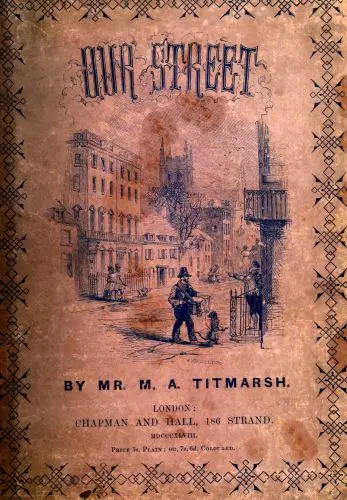
“Our Street”
William Makepeace Thackeray
THE CLASSIC COLLECTION · 1856
"Burlesques" by William Makepeace Thackeray is a collection of satirical writings and tales that reflects the author's brilliant wit and keen social commentary, likely composed during the mid-19th century. The work includes various pieces with humorous takes on society, literature, and contemporary issues of the time, showcasing Thackeray's unique storytelling style and critique of human nature. At the start of "Burlesques," the reader is introduced to a range of characters and settings through a collection of contents that outlines stories from different authors, demonstrating a playful exploration of various genres and styles. One key tale involves George de Barnwell, who is portrayed as a poetic character caught in a tumultuous struggle between ambition and reality, navigating the complexities of love and societal expectations. The opening sets the stage for a narrative infused with humor and a deeper narrative that addresses timeless themes of desire, morality, and the human condition.
Introduction adapted from the source catalogue; source summaries may be automatically generated.
Free to read · English · 155,399 words · No account needed
MAKE TIME FOR A GOOD BOOK
On by default. Untick to stop anonymous reading totals. Each page counts after 10 seconds in view. How this works.
Anonymous counting is on unless you have switched it off.
I leave you to fancy what a splendid triumph for the British Washerwoman's Home was to come off on that day. A beautiful tent was erected, in which the Ladies-Patronesses were to meet: it was hung round with specimens of the skill of the washerwomen's orphans; ninety-six of whom were to be feasted in the gardens, and waited on by the Ladies-Patronesses.
Well, Jemmy and my daughter, Madame de Flicflac, myself, the Count, Baron Punter, Tug, and Tagrag, all went down in the chariot and barouche-and-four, quite eclipsing poor Lady Kilblazes and her carriage-and-two.
There was a fine cold collation, to which the friends of the Ladies-Patronesses were admitted; after which, my ladies and their beaux went strolling through the walks; Tagrag and the Count having each an arm of Jemmy; the Baron giving an arm apiece to Madame and Jemimarann. Whilst they were walking, whom should they light upon but poor Orlando Crump, my successor in the perfumery and hair-cutting.
“Orlando!” says Jemimarann, blushing as red as a label, and holding out
her hand.
“Jemimar!” says he, holding out his, and turning as white as pomatum.
“SIR!” says Jemmy, as stately as a duchess.
“What! madam,” says poor Crump, “don't you remember your shopboy?”
“Dearest mamma, don't you recollect Orlando?” whimpers Jemimarann, whose hand he had got hold of.
“Miss Tuggeridge Coxe,” says Jemmy, “I'm surprised of you. Remember, sir, that our position is altered, and oblige me by no more familiarity.”
“Insolent fellow!” says the Baron, “vat is dis canaille?”
“Canal yourself, Mounseer,” says Orlando, now grown quite furious: he broke away, quite indignant, and was soon lost in the crowd. Jemimarann, as soon as he was gone, began to look very pale and ill; and her mamma, therefore, took her to a tent, where she left her along with Madame Flicflac and the Baron; going off herself with the other gentlemen, in order to join us.
It appears they had not been seated very long, when Madame Flicflac suddenly sprung up, with an exclamation of joy, and rushed forward to a friend whom she saw pass.
The Baron was left alone with Jemimarann; and, whether it was the champagne, or that my dear girl looked more than commonly pretty, I don't know; but Madame Flicflac had not been gone a minute, when the Baron dropped on his knees, and made her a regular declaration.
Poor Orlando Crump had found me out by this time, and was standing by my side, listening, as melancholy as possible, to the famous Bohemian Minnesingers, who were singing the celebrated words of the poet Gothy:--
Your reading position is saved on this browser. Take it to another device with a library code. Reading pages adapt to text, rather than matching a printed edition.
William Makepeace Thackeray
William Makepeace Thackeray
Charles Dickens & William Makepeace Thackeray
William Makepeace Thackeray
BEHIND THE BOOK
This eBook is for the use of anyone anywhere in the United States and most other parts of the world at no cost and with almost no restrictions whatsoever. You may copy it, give it away or re-use it under the terms of the Project Gutenberg License included with this eBook or online at www.gutenberg.org. If you are not located in the United States, you will have to check the laws of the country where you are located before using this eBook. Read the source licence.
The original source file, including credits and licence, is retained by this library. Request an original-format copy at no charge. Please include the book title and Project Gutenberg identifier #2675.
KEEP YOUR CURIOSITY GOING
Coulson Kernahan

Maurice Baring
Frances Wright
Cécile Tormay

Frederic Jesup Stimson

W. H. P. (William Henry Pope) Jarvis