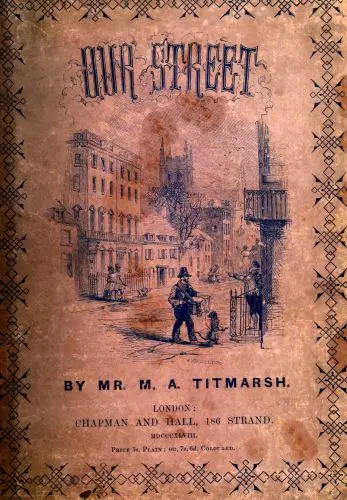
“Our Street”
William Makepeace Thackeray
THE CLASSIC COLLECTION · 1856
"Burlesques" by William Makepeace Thackeray is a collection of satirical writings and tales that reflects the author's brilliant wit and keen social commentary, likely composed during the mid-19th century. The work includes various pieces with humorous takes on society, literature, and contemporary issues of the time, showcasing Thackeray's unique storytelling style and critique of human nature. At the start of "Burlesques," the reader is introduced to a range of characters and settings through a collection of contents that outlines stories from different authors, demonstrating a playful exploration of various genres and styles. One key tale involves George de Barnwell, who is portrayed as a poetic character caught in a tumultuous struggle between ambition and reality, navigating the complexities of love and societal expectations. The opening sets the stage for a narrative infused with humor and a deeper narrative that addresses timeless themes of desire, morality, and the human condition.
Introduction adapted from the source catalogue; source summaries may be automatically generated.
Free to read · English · 155,399 words · No account needed
MAKE TIME FOR A GOOD BOOK
On by default. Untick to stop anonymous reading totals. Each page counts after 10 seconds in view. How this works.
Anonymous counting is on unless you have switched it off.
One day--one famous day last January--all our Market was thrown into a high state of excitement by the appearance of no less than three vehicles at our establishment. As me, Jemmy, my daughter, Tug, and Orlando, were sitting in the back-parlor over our dinner (it being Christmas-time, Mr. Crump had treated the ladies to a bottle of port, and was longing that there should be a mistletoe-bough: at which proposal my little Jemimarann looked as red as a glass of negus):--we had just, I say, finished the port, when, all of a sudden, Tug bellows out, “La, Pa, here's uncle Tuggeridge's housekeeper in a cab!”
And Mrs. Breadbasket it was, sure enough--Mrs. Breadbasket in deep mourning, who made her way, bowing and looking very sad, into the back shop. My wife, who respected Mrs. B. more than anything else in the world, set her a chair, offered her a glass of wine, and vowed it was very kind of her to come. “La, mem,” says Mrs. B., “I'm sure I'd do anything to serve your family, for the sake of that poor dear Tuck-Tuck-tug-guggeridge, that's gone.”
“That's what?” cries my wife.
“What, gone?” cried Jemimarann, bursting out crying (as little girls will about anything or nothing); and Orlando looking very rueful, and ready to cry too.
“Yes, gaw--” Just as she was at this very “gaw” Tug roars out, “La, Pa! here's Mr. Bar, uncle Tug's coachman!”
It was Mr. Bar. When she saw him, Mrs. Breadbasket stepped suddenly back into the parlor with my ladies. “What is it, Mr. Bar?” says I; and as quick as thought, I had the towel under his chin, Mr. Bar in the chair, and the whole of his face in a beautiful foam of lather. Mr. Bar made some resistance.--“Don't think of it, Mr. Cox,” says he; “don't trouble yourself, sir.” But I lathered away and never minded. “And what's this melancholy event, sir,” says I, “that has spread desolation in your family's bosoms? I can feel for your loss, sir--I can feel for your loss.”
I said so out of politeness, because I served the family, not because Tuggeridge was my uncle--no, as such I disown him.
Mr. Bar was just about to speak. “Yes, sir,” says he, “my master's gaw--” when at the “gaw” in walks Mr. Hock, the own man!--the finest gentleman I ever saw.
“What, YOU here, Mr. Bar!” says he.
“Yes, I am, sir; and haven't I a right, sir?”
Your reading position is saved on this browser. Take it to another device with a library code. Reading pages adapt to text, rather than matching a printed edition.
William Makepeace Thackeray
William Makepeace Thackeray
Charles Dickens & William Makepeace Thackeray
William Makepeace Thackeray
BEHIND THE BOOK
This eBook is for the use of anyone anywhere in the United States and most other parts of the world at no cost and with almost no restrictions whatsoever. You may copy it, give it away or re-use it under the terms of the Project Gutenberg License included with this eBook or online at www.gutenberg.org. If you are not located in the United States, you will have to check the laws of the country where you are located before using this eBook. Read the source licence.
The original source file, including credits and licence, is retained by this library. Request an original-format copy at no charge. Please include the book title and Project Gutenberg identifier #2675.
KEEP YOUR CURIOSITY GOING
Coulson Kernahan

Maurice Baring
Frances Wright
Cécile Tormay

Frederic Jesup Stimson

W. H. P. (William Henry Pope) Jarvis