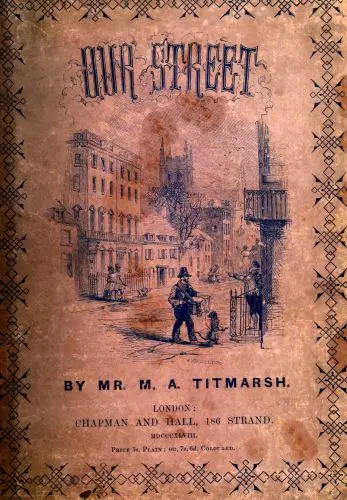
“Our Street”
William Makepeace Thackeray
THE CLASSIC COLLECTION · 1856
"Burlesques" by William Makepeace Thackeray is a collection of satirical writings and tales that reflects the author's brilliant wit and keen social commentary, likely composed during the mid-19th century. The work includes various pieces with humorous takes on society, literature, and contemporary issues of the time, showcasing Thackeray's unique storytelling style and critique of human nature. At the start of "Burlesques," the reader is introduced to a range of characters and settings through a collection of contents that outlines stories from different authors, demonstrating a playful exploration of various genres and styles. One key tale involves George de Barnwell, who is portrayed as a poetic character caught in a tumultuous struggle between ambition and reality, navigating the complexities of love and societal expectations. The opening sets the stage for a narrative infused with humor and a deeper narrative that addresses timeless themes of desire, morality, and the human condition.
Introduction adapted from the source catalogue; source summaries may be automatically generated.
Free to read · English · 155,399 words · No account needed
MAKE TIME FOR A GOOD BOOK
On by default. Untick to stop anonymous reading totals. Each page counts after 10 seconds in view. How this works.
Anonymous counting is on unless you have switched it off.
“There are more things in heaven and earth, Voracio,” said his arch entertainer, when he put this question to her, “than are dreamt of in your philosophy:” and, sooth to say, the archer was by this time in such a state, that he did not find anything wonderful more.
“Are you happy, dear youth?” said the lady, as, after his collation, he sank back in his chair.
“Oh, miss, ain't I?” was his interrogative and yet affirmative reply.
“Should you like such a supper every night, Wolfgang?” continued the
pale one.
“Why, no,” said he; “no, not exactly; not EVERY night: SOME nights I should like oysters.”
“Dear youth,” said she, “be but mine, and you may have them all the year round!” The unhappy boy was too far gone to suspect anything, otherwise this extraordinary speech would have told him that he was in suspicious company. A person who can offer oysters all the year round can live to no good purpose.
“Shall I sing you a song, dear archer?” said the lady.
“Sweet love!” said he, now much excited, “strike up, and I will join the
chorus.”
She took down her mandolin, and commenced a ditty. 'Twas a sweet and wild one. It told how a lady of high lineage cast her eyes on a peasant page; it told how nought could her love assuage, her suitor's wealth and her father's rage: it told how the youth did his foes engage; and at length they went off in the Gretna stage, the high-born dame and the peasant page. Wolfgang beat time, waggled his head, sung wofully out of tune as the song proceeded; and if he had not been too intoxicated with love and other excitement, he would have remarked how the pictures on the wall, as the lady sung, began to waggle their heads too, and nod and grin to the music. The song ended. “I am the lady of high lineage: Archer, will you be the peasant page?”
“I'll follow you to the devil!” said Wolfgang.
“Come,” replied the lady, glaring wildly on him, “come to the chapel; we'll be married this minute!”
She held out her hand--Wolfgang took it. It was cold, damp,--deadly cold; and on they went to the chapel.
As they passed out, the two pictures over the wall, of a gentleman and lady, tripped lightly out of their frames, skipped noiselessly down to the ground, and making the retreating couple a profound curtsy and bow, took the places which they had left at the table.
Your reading position is saved on this browser. Take it to another device with a library code. Reading pages adapt to text, rather than matching a printed edition.
William Makepeace Thackeray
William Makepeace Thackeray
Charles Dickens & William Makepeace Thackeray
William Makepeace Thackeray
BEHIND THE BOOK
This eBook is for the use of anyone anywhere in the United States and most other parts of the world at no cost and with almost no restrictions whatsoever. You may copy it, give it away or re-use it under the terms of the Project Gutenberg License included with this eBook or online at www.gutenberg.org. If you are not located in the United States, you will have to check the laws of the country where you are located before using this eBook. Read the source licence.
The original source file, including credits and licence, is retained by this library. Request an original-format copy at no charge. Please include the book title and Project Gutenberg identifier #2675.
KEEP YOUR CURIOSITY GOING
Coulson Kernahan

Maurice Baring
Frances Wright
Cécile Tormay

Frederic Jesup Stimson

W. H. P. (William Henry Pope) Jarvis