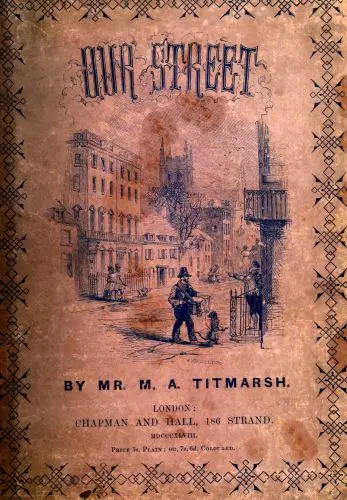
“Our Street”
William Makepeace Thackeray
THE CLASSIC COLLECTION · 1856
"Burlesques" by William Makepeace Thackeray is a collection of satirical writings and tales that reflects the author's brilliant wit and keen social commentary, likely composed during the mid-19th century. The work includes various pieces with humorous takes on society, literature, and contemporary issues of the time, showcasing Thackeray's unique storytelling style and critique of human nature. At the start of "Burlesques," the reader is introduced to a range of characters and settings through a collection of contents that outlines stories from different authors, demonstrating a playful exploration of various genres and styles. One key tale involves George de Barnwell, who is portrayed as a poetic character caught in a tumultuous struggle between ambition and reality, navigating the complexities of love and societal expectations. The opening sets the stage for a narrative infused with humor and a deeper narrative that addresses timeless themes of desire, morality, and the human condition.
Introduction adapted from the source catalogue; source summaries may be automatically generated.
Free to read · English · 155,399 words · No account needed
MAKE TIME FOR A GOOD BOOK
On by default. Untick to stop anonymous reading totals. Each page counts after 10 seconds in view. How this works.
Anonymous counting is on unless you have switched it off.
“The unfortunate part of the affair was this:--His Excellency, despising the Mahratta chieftain, had allowed him to advance about two thousand miles in his front, and knew not in the slightest degree where to lay hold on him. Was he at Hazarubaug? was he at Bogly Gunge? nobody knew, and for a considerable period the movements of Lake's cavalry were quite ambiguous, uncertain, promiscuous, and undetermined.
“Such, briefly, was the state of affairs in October, 1804. At the beginning of that month I had been wounded (a trifling scratch, cutting off my left upper eyelid, a bit of my cheek, and my under lip), and I was obliged to leave Biggs in command of my Irregulars, whilst I retired for my wounds to an English station at Furruckabad, alias Futtyghur--it is, as every twopenny postman knows, at the apex of the Dooab. We have there a cantonment, and thither I went for the mere sake of the surgeon and the sticking-plaster.
“Furruckabad, then, is divided into two districts or towns: the lower Cotwal, inhabited by the natives, and the upper (which is fortified slightly, and has all along been called Futtyghur, meaning in Hindoostanee 'the-favorite-resort-of-the-white-faced-Feringhees-near the-mango-tope-consecrated-to Ram') occupied by Europeans. (It is astonishing, by the way, how comprehensive that language is, and how much can be conveyed in one or two of the commonest phrases.)
“Biggs, then, and my men were playing all sorts of wondrous pranks with Lord Lake's army, whilst I was detained an unwilling prisoner of health at Futtyghur.
“An unwilling prisoner, however, I should not say. The cantonment at Futtyghur contained that which would have made ANY man a happy slave. Woman, lovely woman, was there in abundance and variety! The fact is, that when the campaign commenced in 1803, the ladies of the army all congregated to this place, where they were left, as it was supposed, in safety. I might, like Homer, relate the names and qualities of all. I may at least mention SOME whose memory is still most dear to me. There was--
“Mrs. Major-General Bulcher, wife of Bulcher of the infantry.
“Miss Bulcher.
“Miss BELINDA BULCHER (whose name I beg the printer to place in large
capitals.)
“Mrs. Colonel Vandegobbleschroy.
“Mrs. Major Macan and the four Misses Macan.
“The Honorable Mrs. Burgoo, Mrs. Flix, Hicks, Wicks, and many more too numerous to mention. The flower of our camp was, however, collected there, and the last words of Lord Lake to me, as I left him, were, 'Gahagan, I commit those women to your charge. Guard them with your life, watch over them with your honor, defend them with the matchless power of your indomitable arm.'
Your reading position is saved on this browser. Take it to another device with a library code. Reading pages adapt to text, rather than matching a printed edition.
William Makepeace Thackeray
William Makepeace Thackeray
Charles Dickens & William Makepeace Thackeray
William Makepeace Thackeray
BEHIND THE BOOK
This eBook is for the use of anyone anywhere in the United States and most other parts of the world at no cost and with almost no restrictions whatsoever. You may copy it, give it away or re-use it under the terms of the Project Gutenberg License included with this eBook or online at www.gutenberg.org. If you are not located in the United States, you will have to check the laws of the country where you are located before using this eBook. Read the source licence.
The original source file, including credits and licence, is retained by this library. Request an original-format copy at no charge. Please include the book title and Project Gutenberg identifier #2675.
KEEP YOUR CURIOSITY GOING
Coulson Kernahan

Maurice Baring
Frances Wright
Cécile Tormay

Frederic Jesup Stimson

W. H. P. (William Henry Pope) Jarvis