THE CLASSIC COLLECTION✦Have you an educated heart?CLASSIC FREE BOOKS
Have you an educated heart?
Gelett Burgess
THE CLASSIC COLLECTION · 1914
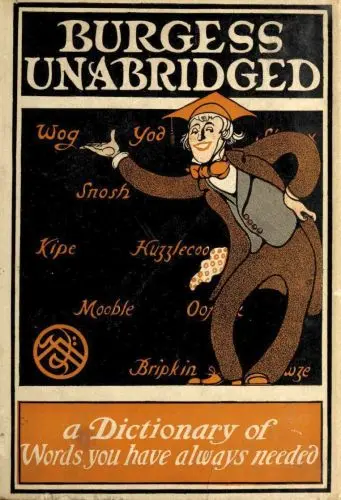
"Burgess Unabridged: A New Dictionary of Words You Have Always Needed" by Gelett Burgess is a humorous and innovative dictionary written in the early 20th century. The book introduces a collection of whimsical, newly coined words aimed at expanding the English language to express contemporary thoughts and ideas more effectively. It reflects the author's playful approach to language and his desire to keep pace with the evolving needs of expression. The opening of "Burgess Unabridged" presents the author's inspiration and rationale behind creating this unique dictionary. Gelett Burgess explains that the English language is dynamic and must adapt to reflect modern experiences. He critiques existing dictionaries for being outdated and outlines his method of coining new words inspired by everyday emotions and situations that lack adequate terminology. With an engaging and humorous tone, he invites readers to explore these creative neologisms, emphasizing the importance and joy of language in capturing the essence of human experience.
Introduction adapted from the source catalogue; source summaries may be automatically generated.
Free to read · English · 26,981 words · No account needed
MAKE TIME FOR A GOOD BOOK
On by default. Untick to stop anonymous reading totals. Each page counts after 10 seconds in view. How this works.
Anonymous counting is on unless you have switched it off.
Ah, robes and uniforms and crowns
Are glorious things, I know,
And queens do wear expensive gowns--
They must be critchety, though!
=Culp=, n. 1. A fond delusion; an imaginary attribute. 2. What one would like to be, or thinks oneself.
=Cul´pid=, a. 1. Visionary, non-existent. 2. Not proved;
autohypnotized.
Many women have the culp that they are beautiful, men that they are irresistible, shrewd, or interesting.
A culpid actor is one who thinks he can act, but can’t. His culp is that he is making a hit. (See Splooch.)
The mother has the baby culp; but the infant to other eyes is not so
wonderful.
The woman with the culpid taste thinks that no other woman knows how to
dress. (See Wumgush.)
The author who has had three letters requesting his autograph, has the
culp that he is popular.
That young man who stays till 11.45 P.M. has a culp that he has
fascinated yawning Ysobel.
She had a culp that she was fair,
In fact, that she was pretty;
Alas, she bought her beauty where
They sold it, in the city.
And now her culp is: Looks will lie;
And her delight is huge--
She thinks that none suspects the dye,
The powder and the rouge!
=Di´a-bob=, n. 1. An object of amateur art; anything improbably decorated; hand-painted. 2. Any decoration or article of furniture manufactured between 1870 and 1890.
=Di-a-bob’i-cal=, a. Ugly, while pretending to be beautiful.
Who invented the diabob? The infamy is attributed to John Ruskin. At any rate, humble things began to lose the dignity of the commonplace; the rolling-pin became exotic in the parlor. The embroidery blossomed in hectic tidies, splashes and drapes. Hand-painting was discovered.
So, from the Spencerian skylark to the perforated “God Bless Our Home.” Now the jigsaw was master; now, the incandescent point that tortured wood and leather into nightmare designs. Plaques began their vogue. (See Gefoojet.)
Diabobical was the hammered brasswork; diabobical the sofa cushion limned with Gibson heads. The decorative fan, genteel; the pampas grass, dyed bright purple; the macramé bags and the seaweed pictures passed; came the embossed pictures stuck on bean-pots and molasses jugs; came the esthetic cat-tail and piano-lamp, “A Yard of Daisies,” and burnt match receivers and catch-alls, ornamented by the family genius.
Ah, Where are the moustache cups of yesteryear?
This object made of celluloid,
This thing so wildly plushed,--
How grossly Art has been annoyed!
How Common Sense has blushed!
And yet, these diabobs, perhaps
Are scarcely more outré
Than pictures made by Cubist chaps,
Or Futurists, today!
=Dig´mix=, n. 1. An unpleasant, uncomfortable, or dirty occupation. 2. A disagreeable or unwelcome duty.
=Dig´mix=, v. To engage in a necessary but painful task.
Your reading position is saved on this browser. Take it to another device with a library code. Reading pages adapt to text, rather than matching a printed edition.
Gelett Burgess
Gelett Burgess & Will Irwin
Gelett Burgess
Gelett Burgess
BEHIND THE BOOK
This eBook is for the use of anyone anywhere in the United States and most other parts of the world at no cost and with almost no restrictions whatsoever. You may copy it, give it away or re-use it under the terms of the Project Gutenberg License included with this eBook or online at www.gutenberg.org. If you are not located in the United States, you will have to check the laws of the country where you are located before using this eBook. Read the source licence.
The original source file, including credits and licence, is retained by this library. Request an original-format copy at no charge. Please include the book title and Project Gutenberg identifier #59004.
KEEP YOUR CURIOSITY GOING

Charles G. (Charles Griffith) Ross
Hannah Webster Foster

Emily Lawless
Edwin Hamlin Carr

Charles De Lano Hine
Andrew Ure