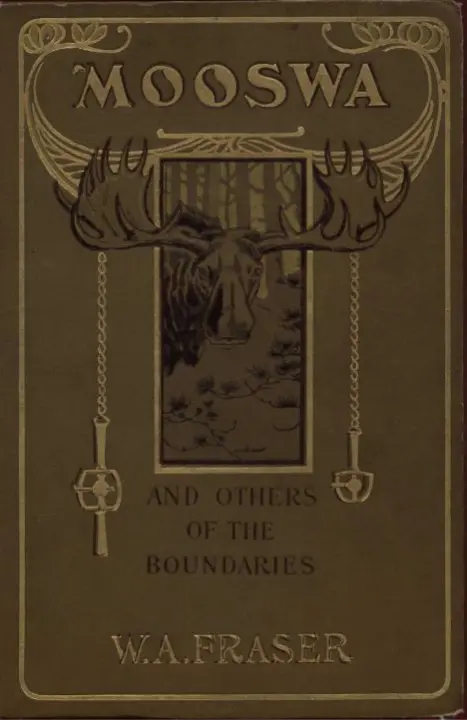
Mooswa & Others of the Boundaries
William Alexander Fraser
THE CLASSIC COLLECTION · 1919
"Bulldog Carney" by William Alexander Fraser is a novel written in the early 20th century. The story is set in a gritty Western environment and centers around the character of Bulldog Carney, a notorious bandit who navigates the dangerous landscape of crime, law, and moral dilemmas. The narrative explores themes of lawlessness, redemption, and the complexities of human nature as it unfolds against the backdrop of early Canadian frontier life. The opening of "Bulldog Carney" introduces the main character, Cameron, who is depicted as a frustrated figure amid the chaos of a rough bar in Edmonton. The atmosphere is charged with tension as the arrival of Bulldog Carney, a known outlaw, incites fear among the bar patrons, particularly in a lean-faced man named Jack Wolf. The stage is set for impending conflict as the characters intertwine in a web of relationships involving crime, authority, and a quest for redemption. As the story progresses, the dynamics between the men, their motivations, and their pasts become key elements that drive the plot forward, hinting at complex interactions and potential betrayals in this rugged environment.
Introduction adapted from the source catalogue; source summaries may be automatically generated.
Free to read · English · 73,184 words · No account needed
MAKE TIME FOR A GOOD BOOK
On by default. Untick to stop anonymous reading totals. Each page counts after 10 seconds in view. How this works.
Anonymous counting is on unless you have switched it off.
The dust cloud swirled closer, and Carney's gray eyes picked out the familiar form of Lathy George, one of Dan Stewart's men. The rider yanked his cayuse to a stand when they met, almost reeling from the saddle in exhaustion. The cayuse spread his legs, drooped his head, and the flanks of his lean belly pumped as if his lungs were parched.
"Hello, Bulldog!" then the man looked warily at Carney's companion.
FitzHerbert saw the look and knew from the stranger's physical shatterment that some vital errand had spurred him; so he touched a heel to his bay's flank and moved slowly along the trail.
Then the rider of the cayuse in tired, panting gasps gave Carney his
message.
"All right, George," Bulldog commented at the finish; "go to the Victoria, feed your horse, have a good supper, get a room and sleep."
"What'll I do, boss, when I wake up--how long'll I sleep?"
"As long as you like--a week if you want."
"What'll I do then--don't you need me?"
"No, play with your toes if you like."
Lathy George pulled his reeling cayuse together, and pushed on. Carney gave a whistle, and FitzHerbert, wheeling his bay, turned. "I've got to go back to town," Carney said.
"I'll go too," the other volunteered; "this devilish boundlessness
is like a painted sky above a painted ocean--it gives me the lonely
willies."
"There's hell to pay back yonder," Carney said, jerking a thumb over his
shoulder.
"It's always back there, or over yonder--never here when there's any hell to pay," FitzHerbert commented dejectedly; "it's just one long plaintive sabbath."
"I've got to go back to the foothills soon's I've got fixed up," Carney
continued.
"Me, too--if there's action there."
"Hardly, my dear boy; it's purely a matter of diplomacy."
"Absolutely, Bulldog; that's why you're going. You're going to kiss somebody on both cheeks, pat him on the back, and say, 'Here's a good cigar for you'--you love it. What's happened?"
"The Stonies are on the war-path."
"Ugly devils--part Sioux. They're hunters--blood letters--first cousins to the Kilkenny cats. In the rebellion, a few years ago, only for the Wood Crees they'd have murdered every white prisoner that came into their hands."
"Yes, they're peppery devils. In the Frog Lake massacre one of them, Itcka, killed a white man or two and was hanged for it."
"What started them now?" FitzHerbert asked. "Whisky."
FitzHerbert stole a glance at Carney's stolid face; then he whistled; Carney's word had been like a gasp of confession, for, undoubtedly, the liquor was from the car.
"How did they make the haul?" he asked.
Your reading position is saved on this browser. Take it to another device with a library code. Reading pages adapt to text, rather than matching a printed edition.
William Alexander Fraser
William Alexander Fraser
William Alexander Fraser
William Alexander Fraser
BEHIND THE BOOK
This eBook is for the use of anyone anywhere in the United States and most other parts of the world at no cost and with almost no restrictions whatsoever. You may copy it, give it away or re-use it under the terms of the Project Gutenberg License included with this eBook or online at www.gutenberg.org. If you are not located in the United States, you will have to check the laws of the country where you are located before using this eBook. Read the source licence.
The original source file, including credits and licence, is retained by this library. Request an original-format copy at no charge. Please include the book title and Project Gutenberg identifier #45926.
KEEP YOUR CURIOSITY GOING
Coulson Kernahan

Maurice Baring
Frances Wright
Cécile Tormay

Frederic Jesup Stimson

W. H. P. (William Henry Pope) Jarvis