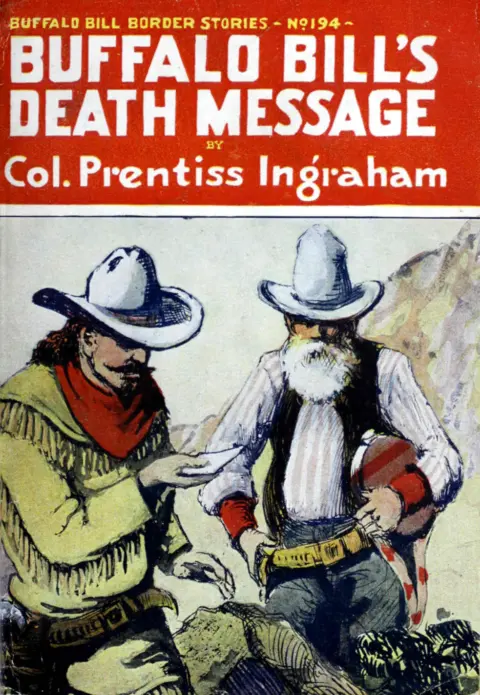
Buffalo Bill’s death message
Prentiss Ingraham
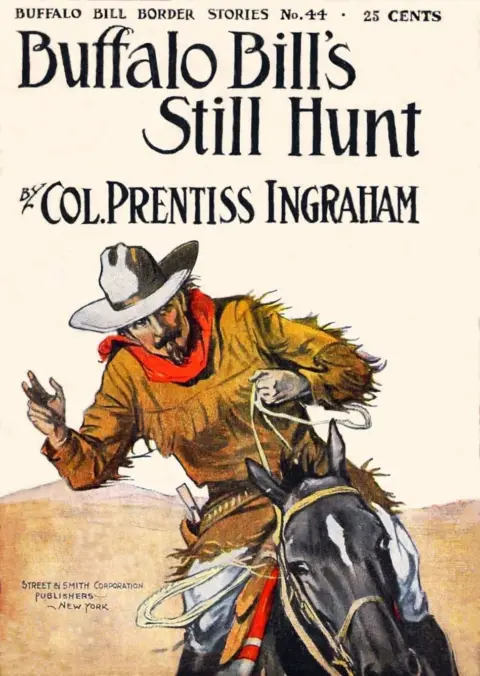
THE CLASSIC COLLECTION · 1907
"Buffalo Bill's Still Hunt; Or, The Robber of the Range" by Colonel Prentiss Ingraham is a novel written in the early 20th century. This thrilling tale follows the legendary figure Buffalo Bill and his encounters with outlaws in the American frontier. The story begins with a daring rescue, hinting at an adventurous narrative filled with danger, romance, and the ever-present tension of lawlessness in the Old West. The opening of the book sets the stage with an intense scene involving a carriage attempting to cross a treacherous Rio Grande during a flood. Inside the carriage are Sister Felicite and a young girl, Nina de Sutro, who displays remarkable courage as they face the perilous crossing. Just as they seem doomed, a horseman boldly intervenes to save them, showcasing bravery and heroism typical of the frontier tales. This encounter sets the tone for the adventures that will unfold, revealing Nina's character and foreshadowing deeper connections and conflicts that will likely arise as the story progresses. As the narrative continues, themes of loyalty, love, and betrayal emerge against the backdrop of an unpredictable and dangerous landscape.
Introduction adapted from the source catalogue; source summaries may be automatically generated.
Free to read · English · 62,329 words · No account needed
MAKE TIME FOR A GOOD BOOK
On by default. Untick to stop anonymous reading totals. Each page counts after 10 seconds in view. How this works.
Anonymous counting is on unless you have switched it off.
“The captain states that he met you, and the others report the same.”
“This is a very remarkable statement, Colonel Dunwoody.”
“I asked Captain Franklin if he would vouch for its being you, and he said that you were veiled, and also the others made the same statement, the sentinels saying that the lady in question reported herself to be Miss Carr.”
“This was at what time, Colonel Dunwoody?” asked the major,
considerably amazed.
The colonel looked at the paper in his hand and gave the time.
“Why, Clarice was absent with us in the carriage at that very time, colonel; in fact, the whole of that day,” the major said.
“Major, I have not for once doubted Miss Clarice in her statement to me, and I only wish to find out who it is that has visited the prisoner, impersonating Miss Clarice to do so.”
“I cannot understand it,” the major replied.
“The lady wore Miss Carr’s red, silver-embroidered sombrero, her
dress, and her veil.”
Clarice gave a start at this, and put her fingers upon her lips to silence Mrs. Lester. But in vain, for out it came:
“Why, colonel, that could have been no one else than Nina de Sutro, for she borrowed that red sombrero as a pattern for some embroidery for one for herself, and on that day, while Mrs. De Sutro has a dress the counterpart of the one Clarice often wears.”
“Miss Clarice, you and Miss De Sutro are about the same size, I
believe?” said the colonel.
“I have nothing whatever to say, Colonel Dunwoody, for I have told you that I made no second visit to the prisoner, Silk Lasso Sam.”
“I hope you will pardon me, Miss Clarice, for the annoyance I have been compelled to give you.”
“There is no need to ask my pardon, colonel, for you have not offended and have done no wrong. I can well understand your position, sir, and I have no feeling whatever in the matter, other than to regret that I have been imposed upon.”
“As I regret it. Miss Clarice, and I assure you that Captain Franklin, the sergeant, corporal, and sentinel shall at once be made acquainted with the fact that the visitor to Silk Lasso Sam was not yourself.”
After a short visit the major and the ladies left the headquarters, and, putting on his hat, Colonel Dunwoody directed his steps to the home of Lieutenant-Colonel De Sutro.
He asked to see Miss De Sutro, and Nina soon entered the room, looking very pretty in a morning-dress.
“This is an honor I appreciate, Colonel Dunwoody, a morning call from you,” she said in her sweet way.
Your reading position is saved on this browser. Take it to another device with a library code. Reading pages adapt to text, rather than matching a printed edition.
Prentiss Ingraham
Prentiss Ingraham
Prentiss Ingraham
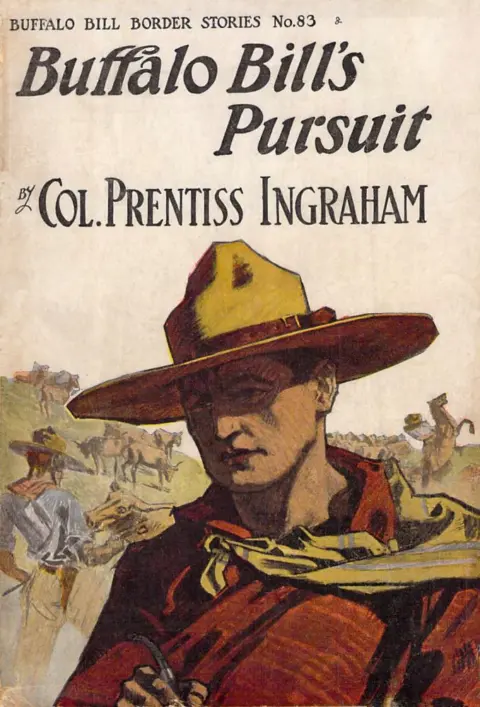
Prentiss Ingraham
BEHIND THE BOOK
This eBook is for the use of anyone anywhere in the United States and most other parts of the world at no cost and with almost no restrictions whatsoever. You may copy it, give it away or re-use it under the terms of the Project Gutenberg License included with this eBook or online at www.gutenberg.org. If you are not located in the United States, you will have to check the laws of the country where you are located before using this eBook. Read the source licence.
The original source file, including credits and licence, is retained by this library. Request an original-format copy at no charge. Please include the book title and Project Gutenberg identifier #64800.
KEEP YOUR CURIOSITY GOING
Coulson Kernahan

Maurice Baring
Frances Wright
Cécile Tormay

Frederic Jesup Stimson

W. H. P. (William Henry Pope) Jarvis