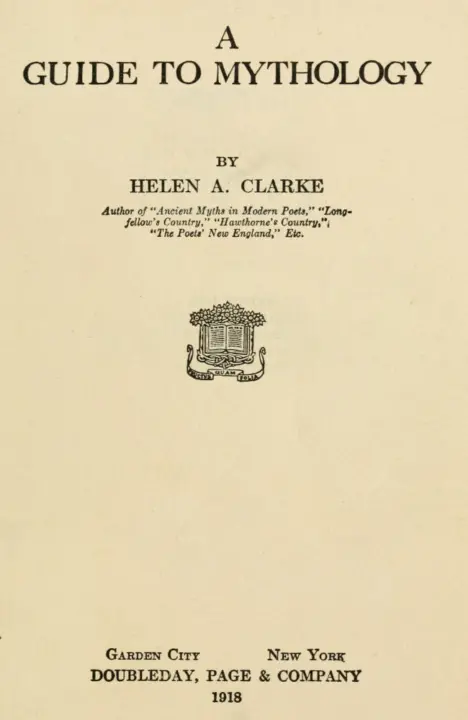
A Guide to Mythology
Helen A. (Helen Archibald) Clarke

THE CLASSIC COLLECTION · 1912
"Browning and His Century" by Helen A. Clarke is a historical account written in the early 20th century. The book explores the context and impact of the 19th century through the lens of poet Robert Browning's work, presenting a detailed analysis of the intellectual struggles and shifts of the time, particularly in relation to the conflict between mind and spirit. Clarke delves into Browning's contributions to literature and philosophy, unraveling his engagement with contemporary scientific, religious, and artistic ideas, making the book a significant resource for those interested in literary history and Victorian culture. The opening of the book introduces the transformative era of the 19th century, marked by humanity's evolving self-awareness and the tension between intellectual understanding and spiritual belief. Clarke begins with a reflection on this period's struggle, emphasizing Browning's role in articulating the complex relationship between mind, spirit, and the overarching societal changes. She references key historical figures and concepts that shaped this conflict, setting the stage for exploring Browning's ideas as they relate to broader themes of evolution, knowledge, and the pursuit of truth. Through this detailed prologue, readers gain insight into the foundational themes that will permeate Clarke's examination of Browning's life and work throughout the book.
Introduction adapted from the source catalogue; source summaries may be automatically generated.
Free to read · English · 79,237 words · No account needed
MAKE TIME FOR A GOOD BOOK
On by default. Untick to stop anonymous reading totals. Each page counts after 10 seconds in view. How this works.
Anonymous counting is on unless you have switched it off.
Liberalism, which had taken on social conditions to the point through legislation where every man was free to be a property holder if he could manage to become one, and to amass wealth, left out of consideration the fact that he never could be free as long as he had to compete with every other man in the state to get these things. Hence the movement of the working classes to gain freedom by substituting for a competitive form of society a cooperative form. Great names in literature and art have helped toward the on-coming of this movement. Carlyle had railed at the millions of the English nation, "mostly fools;" Ruskin had bemoaned the enthronement of ugliness as the result of the industrial conditions; Matthew Arnold had proposed a panacea for the ills of the social condition in the bringing about of social equality through culture, and, best of all, William Morris had not only talked but acted.
To any student of social movements to-day, whether he has been drawn into the swirl of socialistic propaganda or whether he is still comfortably sitting in his parlor feeling an intellectual sympathy but no emotional call to leave his parlor and be up and doing, Morris appears as the most interesting figure of the century. The pioneers in the nineteenth-century movement toward socialism in England, unless we except the social enthusiasm of a Shelley or a Blake, were Owen and Maurice. Owen was that remarkable anomaly, a self-made man who had gained his wealth because of the new industrial order inaugurated by the invention of machinery, who yet could look at the circumstances so fortuitous for him in an impersonal manner, and realize that what had put a silver spoon into his own mouth was taking away even pewter spoons from other men's mouths. Although he was really in love with the new order of machine production, he realized what many to-day fail to see, that machine production organized for the benefit of private persons would most assuredly mean the poverty and the degradation of the workers. He did not stop here, however, but spent his vast fortune in trying to make the conditions of the workingmen better. In the estimation of socialists to-day his work was of a very high order, "not mere utopianism." It bore no similarity to the romantic dreams of poets who saw visions of a perfect society regardless of the fact that a perfect society cannot suddenly blossom from conditions of appalling misery and degradation. Owen was a practical business man. He knew all the ins and outs of the industrial regime, and consequently he had a practical program, not a dream, which he wished to see carried out. Accounts of the conditions of the workers at that time are heartrending. Everywhere the same tale of abject poverty, ignorance, and oppression in field and factory, long hours of labor and dear food. To bring help to these downtrodden people was the burning desire of Robert Owen and his followers. His efforts were not rewarded by that success which they deserved, his failure being a necessary concomitant of the fact that even a practical program for betterment cannot suddenly take effect owing to the inevitable inertia of any long-established conditions. In showing the causes which kept him from the full accomplishment of his ideals, in spite of his genuine practicalness, Brougham Villiers, the recent historian of the socialist movement in England, says he attempted too much "to influence the workers from without, trying, of course vainly, to induce the governing classes to interest themselves in the work of social reform. Yet it is difficult to see what else he could have done at the time. We have already shown how utterly disorganized the working classes were, how incapable, indeed, of any organization. They were also destitute of political power, and miserably underpaid. What could they do to help themselves? Help, if it was to come at all, must come from the only people who then had the power, if they only had the will, to accord it, and to them, at first, Robert Owen appealed. Later, he turned to the people, and for them indeed his work was not utterly wasted, though generations were to pass before the full effect of it could be seen."
Your reading position is saved on this browser. Take it to another device with a library code. Reading pages adapt to text, rather than matching a printed edition.
Helen A. (Helen Archibald) Clarke
Helen A. (Helen Archibald) Clarke
BEHIND THE BOOK
This eBook is for the use of anyone anywhere in the United States and most other parts of the world at no cost and with almost no restrictions whatsoever. You may copy it, give it away or re-use it under the terms of the Project Gutenberg License included with this eBook or online at www.gutenberg.org. If you are not located in the United States, you will have to check the laws of the country where you are located before using this eBook. Read the source licence.
The original source file, including credits and licence, is retained by this library. Request an original-format copy at no charge. Please include the book title and Project Gutenberg identifier #38874.
KEEP YOUR CURIOSITY GOING

David Patterson (Spirit) Hatch
Cécile Tormay

Moritz Busch
Coulson Kernahan
John L. Ransom

Ralph Waldo Emerson