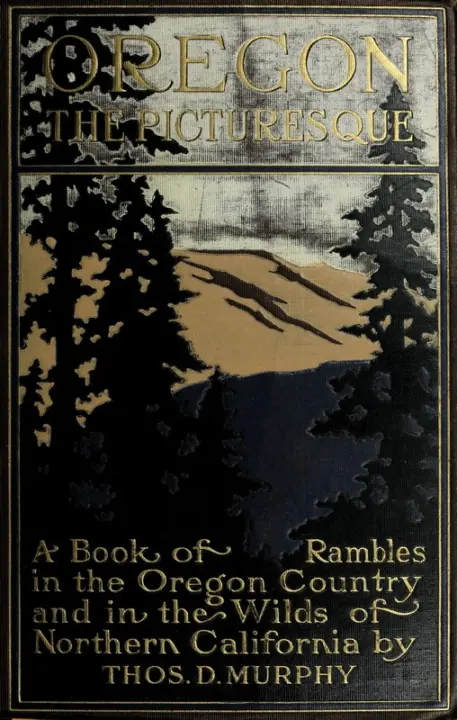
Oregon, the Picturesque A Book of Rambles in the Oregon Country and in the Wilds of Northern California
Thos. D. (Thomas Dowler) Murphy
THE CLASSIC COLLECTION · 1908
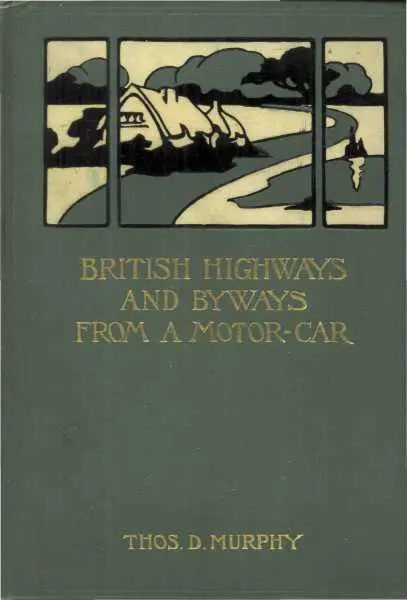
"British Highways and Byways from a Motor Car" by Thos. D. Murphy is a travelogue written in the early 20th century. This work chronicles a five-thousand-mile motor tour through England, Wales, and Scotland, focusing on the various landscapes, historic sites, and towns encountered along the way. The narrative captures the charm of the British countryside while eschewing common tourist paths, aiming to provide insights valuable for anyone interested in exploring Britain, whether by car, train, or even on foot. The opening of the book sets the stage for this unique journey, beginning with reflections on the author's initial visit to Stratford-on-Avon. He compares traveling by train to the freedom and beauty of traveling by motor car, emphasizing the advantages of seeing the countryside and lesser-known locales from behind the wheel. The author discusses the preparation for the trip, including essential mapping resources and the benefits of having a personal vehicle for exploring off-the-beaten-path destinations. His account encourages readers to embrace the adventures that motor travel can afford while providing a glimpse of the alluring English landscapes and remarkable historical places waiting to be discovered.
Introduction adapted from the source catalogue; source summaries may be automatically generated.
Free to read · English · 74,198 words · No account needed
MAKE TIME FOR A GOOD BOOK
On by default. Untick to stop anonymous reading totals. Each page counts after 10 seconds in view. How this works.
Anonymous counting is on unless you have switched it off.
After the procession had crossed the bridge, a policeman informed us that we could proceed. We gained considerable time by making a detour through side streets--not an altogether easy performance--and after much inquiry regained the main road leading out of the city. Warrington is a city of more than one hundred and twenty thousand inhabitants, a manufacturing place with nothing to detain the tourist. On the main street near the river is a fine bronze statue of Oliver Cromwell, one of four that I saw erected to the memory of the Protector in England. Our route from Warrington led through Wigan and Preston, manufacturing cities of nearly one hundred thousand each, and the suburbs of the three are almost continuous. Tram cars were numerous and children played everywhere with utter unconcern for the vehicles which crowded the streets.
When we came to Lancaster we were glad to stop, although our day's journey had covered only sixty miles. We knew very little of Lancaster and resorted to the guide-books for something of its antecedents, only to learn the discouraging fact that here, as everywhere, the Romans had been ahead of us. The town has a history reaching back to the Roman occupation, but its landmarks have been largely obliterated in the manufacturing center which it has become. Charles Dickens was a guest at Lancaster, and in recording his impressions he declared it "a pleasant place, dropped in the midst of a charming landscape; a place with a fine, ancient fragment of a castle; a place of lovely walks and possessing many staid old houses, richly fitted with Honduras mahogany," and followed with other reflections not so complimentary concerning the industrial slavery which prevailed in the city a generation or two ago. The "fine, ancient fragment of a castle" has been built into the modern structure which now serves as the seat of the county court. The square tower of the Norman keep is included in the building. This in general style and architecture conforms to the old castle, which, excepting the fragment mentioned by Dickens, has long since vanished. Near at hand is St. Mary's Church, rivaling in size and dignity many of the cathedrals, and its massive, buttressed walls and tall, graceful spire do justice to its magnificent site. From the eminence occupied by the church the Irish Sea is plainly visible, and in the distance the almost tropical Isle of Man rises abruptly out of the blue waters. The monotony of our previous day's travel was forgotten in lively anticipation as we proceeded at what seemed a snail's pace over the fine road leading from Penrith to Carlisle. We had been warned at Penrith, not against the bold highwaymen, the border moss-troopers or the ranting Highlandmen of song and story, but against a plain, Twentieth Century police trap which was being worked very successfully along this road. Such was our approach in these degenerate days to "Merrie Carlile," which figured so largely in the endless border warfare between the Scotch and English. But why the town should have been famed as "Merrie Carlile" would be hard to say, unless more than a thousand years of turmoil, bloodshed and almost ceaseless warfare through which it passed earned it the cheerful appellation. The trouble between the English and the Welsh ended early, but it has been only a century and a half ago since the closing scene of the long and bitter conflict between the north and south was enacted at Carlisle. Its grim old castle was the scene of the imprisonment and execution of the last devoted followers of Prince Charlie, and according to Scott's Waverly the dashing but sadly deluded young chieftain, Fergus McIvor, was one of those who suffered a shameful death. In this connection one remembers that Scott's marriage to Miss Carpentier took place in Carlisle, an event that would naturally accentuate our interest in the fine old border city. As we had previously visited Carlisle, our stay was a short one, but its remarkable history, its connection with the stories of Walter Scott, its atmosphere of romance and legend and the numerous points of interest within easy reach--all combine to make it a center where one might spend several days. The Romans had been here also, and they, too, had struggled with the wild tribes on the north, and from that time down to the execution of the last adherents of the Stuarts in 1759 the town was hardly at any time in a state of quietude. As described by an observant writer, "every man became a soldier and every house that was not a mere peasant's hut was a fortress." A local poet of the Seventeenth Century summed it up in a terse if not elegant couplet as his unqualified opinion
Your reading position is saved on this browser. Take it to another device with a library code. Reading pages adapt to text, rather than matching a printed edition.
Thos. D. (Thomas Dowler) Murphy
Thos. D. (Thomas Dowler) Murphy
BEHIND THE BOOK
This eBook is for the use of anyone anywhere in the United States and most other parts of the world at no cost and with almost no restrictions whatsoever. You may copy it, give it away or re-use it under the terms of the Project Gutenberg License included with this eBook or online at www.gutenberg.org. If you are not located in the United States, you will have to check the laws of the country where you are located before using this eBook. Read the source licence.
The original source file, including credits and licence, is retained by this library. Request an original-format copy at no charge. Please include the book title and Project Gutenberg identifier #17297.
KEEP YOUR CURIOSITY GOING
Wilfrid Scawen Blunt
Wilfrid Scawen Blunt

E. W. (Edgar Watson) Howe
Cécile Tormay

Moritz Busch
John L. Ransom