THE CLASSIC COLLECTION✦An outlaw’s diary: the CommuneCLASSIC FREE BOOKS
An outlaw’s diary: the Commune
Cécile Tormay
THE CLASSIC COLLECTION · 1909
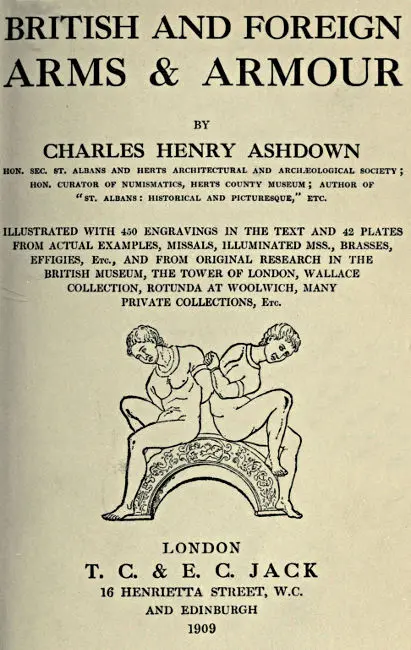
"British and Foreign Arms & Armour" by Charles Henry Ashdown is a historical account written in the early 20th century. The work delves into the study of arms and armor from various historical periods, drawing connections between military artifacts and the socio-political contexts in which they were used. Readers can expect a comprehensive examination of weaponry styles, including details on the design, function, and evolution of arms across different cultures. The opening of the book lays the groundwork for Ashdown’s exploration by emphasizing the importance of understanding arms and armor as artifacts that reflect historical struggles, artistry, and development over time. He discusses the significance of heraldry and collectorship in the study of military equipment. The text notes the lack of accessible literature on the subject and aims to simplify complex concepts for beginners, providing a methodical approach to studying different periods of armor, beginning with prehistoric weaponry and the craftsmanship behind early tools and weapons from the Stone Age.
Introduction adapted from the source catalogue; source summaries may be automatically generated.
Free to read · English · 84,044 words · No account needed
MAKE TIME FOR A GOOD BOOK
On by default. Untick to stop anonymous reading totals. Each page counts after 10 seconds in view. How this works.
Anonymous counting is on unless you have switched it off.
The Hauberk.--During the earlier portion of the Camail and Jupon Period the hauberk was invariably constructed of banded mail, but towards the end of the century it was superseded by linked chain mail, although late examples of the banded may be found, such as that of Lord Berkeley, 1392, at Wotton-under-Edge, Gloucestershire, and Sir Nicholas Hawberk, 1407, Cobham Church, Kent. The defence reached to about the middle of the thigh, and subsequently to 1380 became sleeveless. The lower edge appears as a rule about two inches below that of the jupon, and is, in some cases, made ornamental by pendent rings, as in the case of Sir Robert Swynborne. Under the hauberk the quilted gambeson, or haqueton, was worn as usual, but no portion of it appears in brasses or effigies.
The Bascinet.--The bascinet was very tall at the commencement of the period and acutely pointed at the apex; it gradually lessened in height as time advanced. It descended on both sides well over the ears, and was carried round to the back of the neck, as a rule, in a straight line. The apex was not over the centre of the head, but more towards the rear; when the knight couched his lance and bent forward in the saddle the point was thus brought forward to a perpendicular position. This detail cannot be perceived in brasses, but is very apparent in monumental effigies, and is shown on the opposite page (Fig. 206), taken from a stained-glass window in St. Peter’s Church, St. Albans, and approximately of the date 1380. The visor is represented in gold-coloured glass, and this feature of gold gilding is by no means uncommon in MSS. of the early part of this period, from which it is possible to infer that the visors were either of cuir-bouilli, latten, or were enriched by gilding. At first the visors were removable at will, being merely hung on projecting knobs at the sides; but afterwards, when the snout-faced variety came into vogue, they were invariably fixed, and could only be raised or lowered. An earlier form of bascinet is shown in the windows of the same church which has a close-fitting visor, very similar to those which marked the advent of the pot-helm in the thirteenth century (Fig. 207). Towards the close of the fourteenth century the adoption of the “snout-faced,” or “pig-faced” visor (Fig. 208) became universal, eliciting much uncomplimentary criticisms from contemporary writers and being the subject of many caricatures in carvings of the period. In the Tower of London a bascinet weighing 5¼ lbs. is preserved (Fig. 209); the visor or ventaille, which weighs 1 lb., originally hinged up to a pivot in the centre of the skull. In the Wallace Collection, Fig. 210 shows a beautiful example which was formerly in the Meyrick Collection; it is French, and dates from c. 1400. An early example of this form of visor bascinet is preserved in the collection at Parham dating from 1365, which shows the ventaille partly covering the neck, and this form is common in the Roy. MS. 20, C. 7, in the British Museum, dating from 1400 to 1415 (Fig. 211). Here, however, the feature is made of such huge dimensions, reaching doubtless as far as the collar-bones, that a feeling is engendered of disproportion, or of caricature; but as the examples are very numerous, and all appear the same, the thought is perforce dispelled. Huge visors are also depicted in a History of Richard II. of England preserved in the Bibliothèque du Roi (a figure from which is here shown, Fig. 212), which must have provided a large amount of breathing space and also acted to some extent as a gorget. The bascinet termed the Barbute is essentially Italian, and does not occur upon any English brass or effigy; it appears to have been prevalent on the Continent, and some of the head-pieces shown upon the common soldiery in English MSS. partake of the character of this defence. It was worn without any visor, but a portion of the camail, adapted for the purpose, was lifted in order to cover almost entirely the small opening left in front, being fastened to the staples with which these helmets are almost always provided. The Barbute in the Wallace Collection (Fig. 214) shows this feature very distinctly, as it is provided with two staples for the purpose, while the nasal thus formed by the camail is well shown in the effigy of Ulrich Landschaden, 1369, in Neckarsteinach (Fig. 215), which, however, is defended by the ordinary bascinet, though strange to note, the figure is entirely without any visible plate armour for the limbs. A bascinet with an iron nasal of rigid form is shown in the MS. Roy. 14, E. 4, and depicted in Fig. 216. It will be seen by the various figures illustrating the Camail and Jupon Period that the height of the bascinet became less towards the end of the time when it prevailed, and showed a distinct tendency to merge into the globular form of the succeeding period. The bascinet of Sir William Burgate, 1409, in Burgate Church, Suffolk (Fig. 217), is remarkable for its high comb or apex, and is probably of foreign origin.
Your reading position is saved on this browser. Take it to another device with a library code. Reading pages adapt to text, rather than matching a printed edition.
BEHIND THE BOOK
This eBook is for the use of anyone anywhere in the United States and most other parts of the world at no cost and with almost no restrictions whatsoever. You may copy it, give it away or re-use it under the terms of the Project Gutenberg License included with this eBook or online at www.gutenberg.org. If you are not located in the United States, you will have to check the laws of the country where you are located before using this eBook. Read the source licence.
The original source file, including credits and licence, is retained by this library. Request an original-format copy at no charge. Please include the book title and Project Gutenberg identifier #48573.
KEEP YOUR CURIOSITY GOING
Cécile Tormay

Moritz Busch
John L. Ransom
Frances Wright
Cécile Tormay

Mabel Potter Daggett