THE CLASSIC COLLECTION✦An outlaw’s diary: the CommuneCLASSIC FREE BOOKS
An outlaw’s diary: the Commune
Cécile Tormay
THE CLASSIC COLLECTION · 1909
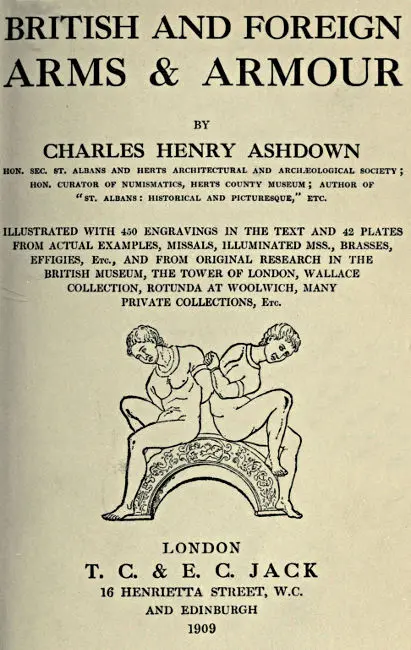
"British and Foreign Arms & Armour" by Charles Henry Ashdown is a historical account written in the early 20th century. The work delves into the study of arms and armor from various historical periods, drawing connections between military artifacts and the socio-political contexts in which they were used. Readers can expect a comprehensive examination of weaponry styles, including details on the design, function, and evolution of arms across different cultures. The opening of the book lays the groundwork for Ashdown’s exploration by emphasizing the importance of understanding arms and armor as artifacts that reflect historical struggles, artistry, and development over time. He discusses the significance of heraldry and collectorship in the study of military equipment. The text notes the lack of accessible literature on the subject and aims to simplify complex concepts for beginners, providing a methodical approach to studying different periods of armor, beginning with prehistoric weaponry and the craftsmanship behind early tools and weapons from the Stone Age.
Introduction adapted from the source catalogue; source summaries may be automatically generated.
Free to read · English · 84,044 words · No account needed
MAKE TIME FOR A GOOD BOOK
On by default. Untick to stop anonymous reading totals. Each page counts after 10 seconds in view. How this works.
Anonymous counting is on unless you have switched it off.
The Flint-lock.--The snap-hance was undoubtedly the intermediate weapon between the wheel-lock and flint-lock. The latter may be claimed as an English invention, as a specimen occurs in the Tower having the date 1614 upon it, the date generally assigned for its introduction being 1630 according to continental records. The knowledge that fire could be produced by striking flint upon steel was well known to the ancients. In the flint-lock the fall of the hammer containing the flint was made to open the flash-pan and at the same time to strike sparks from its cover. The earlier kinds had all the mechanism upon the outside of the lock, but subsequently it was hidden, and a tumbler connected the mainspring with the hammer. Highly decorated examples of the flint-lock are common, especially those of Italian and Spanish origin (Plate XLI.*). The weapon did not come into extensive use in England until the second half of the seventeenth century, but it eventually superseded all others, and was adapted for every kind of firearm, both military and civil, and remained in use until the advent of the percussion cap about 1830.
Pistols underwent the same variations as the larger weapon, but these were often combined, being fixed in shields, battle-axes, pole-axes, daggers, halberds, &c.
The subject of this chapter is an extremely wide one, and an attempt to cover it completely in the pages of this work has not been attempted; the broad facts given here may, however, be acceptable to the general reader.
[1] From “Projectile-throwing Engines of the Ancients,” by Sir Ralph Payne-Gallwey, Bart., by kind permission of the author, to whose work I am indebted for several particulars in this chapter.
[2] The Royal Armoury at Madrid is undoubtedly the finest collection of its kind in the world. It was founded by King Charles V., 1516-1568, and in addition to Spanish armour and arms contains magnificent examples of the works of the greatest armourers of Europe. By the kindness and courtesy of Mr. Albert F. Calvert, author of “Spanish Arms and Armour, being a Historical and Descriptive Account of the Royal Armoury at Madrid,” we are enabled to produce illustrations of many of the exhibits from photographs supplied by him. These illustrations are distinguished by an asterisk (Plate I.*, &c.).
Ailette, 101
” circular, 109, 110
” introduction of, 97
” lozenge-shaped, 103
” of Henry de Beaumont, 102
” of Gilbert de Clare, 103
” of John de Warenne, 102
” use of, 105
Album, Jacobi, 294
Albyn, Robert, brass of, 190
Allecret, 307
Almayne corselets, 305
” rivets, 282, 305
Almeric, Lord St. Amand, bascinet of, 151 ” ” ” chapelle-de-fer of, 151 ” ” ” mentonnière of, 151
Amand, Lord St., 161
Angon, Frankish, 44
Anelace, 252, 334
Anton Pfeffenhauser, 357
Arbalest, 93
Arbalestier, 126
” at Rotunda (Plate 40, p. 366), 132
Archer, Chain Mail Reinforced Period, 122
” Surcoatless Period, 209
Archers, English, 255
” Etruscan, 35
” Half Armour Period, 318
Archer’s stake, 209
Archery, 124, 130
Your reading position is saved on this browser. Take it to another device with a library code. Reading pages adapt to text, rather than matching a printed edition.
BEHIND THE BOOK
This eBook is for the use of anyone anywhere in the United States and most other parts of the world at no cost and with almost no restrictions whatsoever. You may copy it, give it away or re-use it under the terms of the Project Gutenberg License included with this eBook or online at www.gutenberg.org. If you are not located in the United States, you will have to check the laws of the country where you are located before using this eBook. Read the source licence.
The original source file, including credits and licence, is retained by this library. Request an original-format copy at no charge. Please include the book title and Project Gutenberg identifier #48573.
KEEP YOUR CURIOSITY GOING
Cécile Tormay

Moritz Busch
John L. Ransom
Frances Wright
Cécile Tormay

Mabel Potter Daggett