READ · DISCOVER · ENJOYClassic literature · Always free
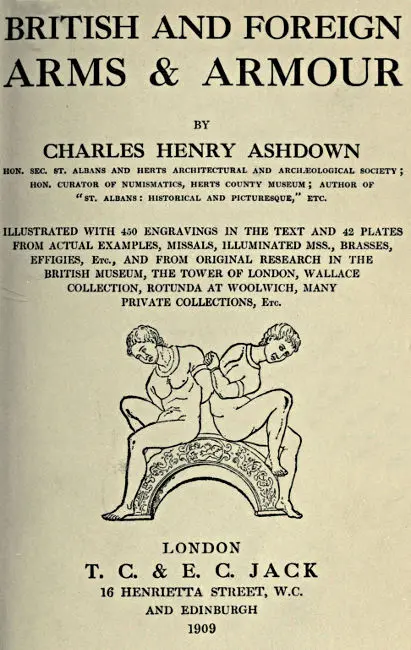
British and Foreign Arms & Armour — digital edition cover

THE CLASSIC COLLECTION · 1909

British and Foreign Arms & Armour

"British and Foreign Arms & Armour" by Charles Henry Ashdown is a historical account written in the early 20th century. The work delves into the study of arms and armor from various historical periods, drawing connections between military artifacts and the socio-political contexts in which they were used. Readers can expect a comprehensive examination of weaponry styles, including details on the design, function, and evolution of arms across different cultures. The opening of the book lays the groundwork for Ashdown’s exploration by emphasizing the importance of understanding arms and armor as artifacts that reflect historical struggles, artistry, and development over time. He discusses the significance of heraldry and collectorship in the study of military equipment. The text notes the lack of accessible literature on the subject and aims to simplify complex concepts for beginners, providing a methodical approach to studying different periods of armor, beginning with prehistoric weaponry and the craftsmanship behind early tools and weapons from the Stone Age.

Introduction adapted from the source catalogue; source summaries may be automatically generated.

Start reading ↓

Free to read · English · 84,044 words · No account needed

MAKE TIME FOR A GOOD BOOK

British and Foreign Arms & Armour

On by default. Untick to stop anonymous reading totals. Each page counts after 10 seconds in view. How this works.

Anonymous counting is on unless you have switched it off.

British and Foreign Arms & Armour

Among the most interesting pieces of armour in the British Isles we must include the Rhodes armour preserved in the Rotunda at Woolwich. The Knights of St. John of Jerusalem occupied Rhodes after their expulsion from the Holy Land, and subsequently migrated to Malta. In the early part of Queen Victoria’s reign General Sir J. H. Lefroy was sent by the British Government to Turkey, and while there secured the Dardanelles cannon described elsewhere, and also the Rhodes armour, left behind by the Knights. This is one of the most valuable of late “finds,” and the whole of it is in the Rotunda. Much is in bad condition and would not bear cleaning, but one suit has been made up and is illustrated in Plate IX., p. 72. The salade is of a very deep form with a large visor; there is a lobster-tail neck-guard of two lames. The mentonnière is more of the nature of a gorget, and is not affixed to the breastplate. The pauldrons are laminated and continuous with the brassarts, which have turners, while the coudières are of the sixteenth century. The vambraces are late fifteenth century, as are also the gauntlets. The breastplate is globose and furnished with a placcate, while the backplate has been provided with a garde-de-rein from the Tower. The cuissarts and genouillières are late fifteenth century, but the jambarts are of a still later date. In order to complete the figure a chain-mail hauberk has been lent from the Tower, and the tuilles and sollerets have been made. The two-handed sword is a fine example, dating from c. 1510. The whole suit may be looked upon as an example of the style prevailing c. 1490.

The period under discussion, from 1430 to 1500, saw the common foot soldier, whether bowman, arbalestier, billman, petardier, or cannonier, much better equipped, and in every way more carefully provided for, than in any preceding age. It had early been perceived in England that the native infantry was as effective in battle as the flower of foreign chivalry, and instead of being jealous of this fact, as were the foreign nobles as a rule of their own foot soldiers, the knights of our own country sought by every possible means to add to the deadly prowess of the soldier, and to defend him by every artifice that wit could devise. It came to be recognised as an article of military knowledge that a charge of cavalry against English archers armed with the long-bow resulted, under ordinary conditions, in disaster, and that no good result was to be obtained by it, but on the contrary it was simply to court destruction. The lessons of Creçy and of Poictiers had been well learnt, and it was remembered that the French chivalry, although encased in steel and the horses defended by bardings, simply melted away before the deadly sleet of arrows emanating from the English position, and in spite of their most strenuous efforts only managed to reach the archers in such a disorganised form that an effective charge was out of the question. So long as the bowmen stood firmly in their position and preserved order and discipline they had nothing to fear from the most determined charge of cavalry. The secret of this undoubtedly was that although the knight himself was impervious to the arrow so long as it did not strike a gousset or the junction or joint between two plates, his horse was by no means equally well protected, and it is well known that the arrow was in most cases directed towards the unfortunate steed in preference to the invulnerable rider. It thus became a custom for the knights and heavily-accoutred men-at-arms to dismount and advance on foot to the charge, in imitation doubtless of the example set by the Black Prince at Poictiers. But the slow progress of such a mass of heavily-armed men against a body of archers gave the latter plenty of time to select their opponents, and with unerring aim to challenge the weak points of their adversaries’ defences with the deadly cloth-yard shaft. The invariable result was that the archer came off victorious, and the discomfited mail-clad knight thus found himself unable to reach the enemy with whom he desired to close either on horseback or on foot. In this dilemma the invention of the pavise came to his help, and for a time the archer was to a certain extent nonplussed. This was at first an upright wicker-work defence, square in form and plane of surface, sufficiently large to cover the knight and also the page or squire who bore it. The knight also carried his own shield as an additional defence, and thus effectually protected from arrows could advance to close quarters, or if necessary, take post behind his own archers in order to repel a charge of cavalry. The pavise, once introduced, was quickly improved upon, and soon developed into a convex shield of wood faced with leather or other protective material, and resting upon the ground. Some of these were elaborately decorated, being painted with designs of more or less merit, some of which have been preserved to the present age and form remarkable instances of mediæval art. In the Wallace Collection is a pavise of parchment upon a foundation of wood, with a semi-circular ridge down the centre, upon which occurs a representation of a castle and background. It is of German origin, and dates from about 1490; another in the same museum of about the year 1500 has a similar ridge down the centre, is of the same materials, and is painted black. The arms of Nuremberg in colours are upon the left-hand top corner. The examples are only sufficiently large to cover one man, and might therefore have been used by archers, arbalestiers, cannoniers, &c., for these were alert to seize upon the new defence, and quickly adopted it. During the siege of a town or fortress the pavise was in constant use, and in MSS. of the fifteenth and sixteenth centuries it is common to note in the illuminations how they are employed to cover every type of combatant. In Cotton MS., Julius, E. IV., many examples are delineated, bodies of pavisiers being shown in combat with each other. Fig. 329 is a representation of a mediæval long bowman of the year 1473, in which he is shown with a hat and gorget of banded mail and a hauberk of overlapping scales of leather covered by a brigandine of leather. The only plate defence is a corselet. The quiver is slung at the back and a sword in front. The arbalestier shown in Plate XL., p. 366, is habited in a very graceful salade, a brigandine of the fifteenth century partly covered by demi-breast and backplates, or placcates, and wears a knee-piece upon the left leg. The arbalestier of the time of Edward IV. is represented in the Harleian MS. No. 4379 (Fig. 330) as possessing a complete defensive equipment, consisting of bascinet, camail, brigandine of jazeraint work, tuilles of leather plates, and complete plate for the legs. In addition he has a corselet of plate. The peculiarly-shaped quiver for the bolts is characteristic of the period. That arbalestiers were as an established rule better provided with defences we have already seen: a further confirmation is afforded by the accompanying Fig. 331 of an arbalestier of the earlier part of the fifteenth century, before the dagged houppelande of Richard II. and Henry IV.’s reign had gone out of fashion: he is represented as being clothed in it, whereby the defences of the body and arms are hidden, but the legs are in plate, with sollerets for the feet, and a chapelle-de-fer, or plain skull-cap, covers the head. It is taken from Sloane MS. 2433.

Your reading position is saved on this browser. Take it to another device with a library code. Reading pages adapt to text, rather than matching a printed edition.

BEHIND THE WORDS

About Charles Henry Ashdown

Charles Henry Ashdown (1856–1922). Explore British and Foreign Arms & Armour in this collection. These books span history.

Explore this author’s books →

THE READERS’ VERDICT

How did this story stay with you?

Not rated yet
Your rating for British and Foreign Arms & Armour

Be the first to share your verdict.

One rating per browser, which you can change or remove. A necessary browser identifier remembers your vote. How ratings work

A GOOD STORY DESERVES COMPANY

Pass this book along.

A great read is even better when it’s shared.

SEND A LITTLE INSPIRATION

Share this book

BEHIND THE BOOK

Edition & source details.

Title
British and Foreign Arms & Armour
Author
Charles Henry Ashdown
First publication (Open Library catalogue match)
1909
Digital edition publisher
Project Gutenberg
Gutenberg release date
2015-03-24
Language
English
Source edition imprint
Not stated in source catalogue
Source identifier
Project Gutenberg #48573
Contributors
No additional named contributors in source metadata

Public-domain source & licence

This eBook is for the use of anyone anywhere in the United States and most other parts of the world at no cost and with almost no restrictions whatsoever. You may copy it, give it away or re-use it under the terms of the Project Gutenberg License included with this eBook or online at www.gutenberg.org. If you are not located in the United States, you will have to check the laws of the country where you are located before using this eBook. Read the source licence.

Full source licence and obtaining an original copy

The original source file, including credits and licence, is retained by this library. Request an original-format copy at no charge. Please include the book title and Project Gutenberg identifier #48573.

the full Project Gutenberg License must appear
prominently whenever any copy of a Project Gutenberg work (any work
on which the phrase “Project Gutenberg” appears, or with which the
phrase “Project Gutenberg” is associated) is accessed, displayed,
performed, viewed, copied or distributed:

This eBook is for the use of anyone anywhere in the United States and most
other parts of the world at no cost and with almost no restrictions
whatsoever. You may copy it, give it away or re-use it under the terms
of the Project Gutenberg™ License included with this eBook or online
at www.gutenberg.org. If you
are not located in the United States, you will have to check the laws
of the country where you are located before using this eBook.

1.E.2. If an individual Project Gutenberg electronic work is
derived from texts not protected by U.S. copyright law (does not
contain a notice indicating that it is posted with permission of the
copyright holder), the work can be copied and distributed to anyone in
the United States without paying any fees or charges. If you are
redistributing or providing access to a work with the phrase “Project
Gutenberg” associated with or appearing on the work, you must comply
either with the requirements of paragraphs 1.E.1 through 1.E.7 or
obtain permission for the use of the work and the Project Gutenberg
trademark as set forth in paragraphs 1.E.8 or 1.E.9.

1.E.3. If an individual Project Gutenberg electronic work is posted
with the permission of the copyright holder, your use and distribution
must comply with both paragraphs 1.E.1 through 1.E.7 and any
additional terms imposed by the copyright holder. Additional terms
will be linked to the Project Gutenberg License for all works
posted with the permission of the copyright holder found at the
beginning of this work.

1.E.4. Do not unlink or detach or remove the full Project Gutenberg
License terms from this work, or any files containing a part of this
work or any other work associated with Project Gutenberg.

1.E.5. Do not copy, display, perform, distribute or redistribute this
electronic work, or any part of this electronic work, without
prominently displaying the sentence set forth in paragraph 1.E.1 with
active links or immediate access to the full terms of the Project
Gutenberg License.

1.E.6. You may convert to and distribute this work in any binary,
compressed, marked up, nonproprietary or proprietary form, including
any word processing or hypertext form. However, if you provide access
to or distribute copies of a Project Gutenberg work in a format
other than “Plain Vanilla ASCII” or other format used in the official
version posted on the official Project Gutenberg website
(www.gutenberg.org), you must, at no additional cost, fee or expense
to the user, provide a copy, a means of exporting a copy, or a means
of obtaining a copy upon request, of the work in its original “Plain
Vanilla ASCII” or other form. Any alternate format must include the
full Project Gutenberg License as specified in paragraph 1.E.1.

1.E.7. Do not charge a fee for access to, viewing, displaying,
performing, copying or distributing any Project Gutenberg works
unless you comply with paragraph 1.E.8 or 1.E.9.

1.E.8. You may charge a reasonable fee for copies of or providing
access to or distributing Project Gutenberg electronic works
provided that:

• You pay a royalty fee of 20% of the gross profits you derive from
the use of Project Gutenberg works calculated using the method
you already use to calculate your applicable taxes. The fee is owed
to the owner of the Project Gutenberg trademark, but he has
agreed to donate royalties under this paragraph to the Project
Gutenberg Literary Archive Foundation. Royalty payments must be paid
within 60 days following each date on which you prepare (or are
legally required to prepare) your periodic tax returns. Royalty
payments should be clearly marked as such and sent to the Project
Gutenberg Literary Archive Foundation at the address specified in
Section 4, “Information about donations to the Project Gutenberg
Literary Archive Foundation.”

• You provide a full refund of any money paid by a user who notifies
you in writing (or by e-mail) within 30 days of receipt that s/he
does not agree to the terms of the full Project Gutenberg™
License. You must require such a user to return or destroy all
copies of the works possessed in a physical medium and discontinue
all use of and all access to other copies of Project Gutenberg™
works.

• You provide, in accordance with paragraph 1.F.3, a full refund of
any money paid for a work or a replacement copy, if a defect in the
electronic work is discovered and reported to you within 90 days of
receipt of the work.

• You comply with all other terms of this agreement for free
distribution of Project Gutenberg™ works.


1.E.9. If you wish to charge a fee or distribute a Project
Gutenberg™ electronic work or group of works on different terms than
are set forth in this agreement, you must obtain permission in writing
from the Project Gutenberg Literary Archive Foundation, the manager of
the Project Gutenberg™ trademark. Contact the Foundation as set
forth in Section 3 below.

1.F.

1.F.1. Project Gutenberg volunteers and employees expend considerable
effort to identify, do copyright research on, transcribe and proofread
works not protected by U.S. copyright law in creating the Project
Gutenberg™ collection. Despite these efforts, Project Gutenberg™
electronic works, and the medium on which they may be stored, may
contain “Defects,” such as, but not limited to, incomplete, inaccurate
or corrupt data, transcription errors, a copyright or other
intellectual property infringement, a defective or damaged disk or
other medium, a computer virus, or computer codes that damage or
cannot be read by your equipment.

1.F.2. LIMITED WARRANTY, DISCLAIMER OF DAMAGES - Except for the “Right
of Replacement or Refund” described in paragraph 1.F.3, the Project
Gutenberg Literary Archive Foundation, the owner of the Project
Gutenberg™ trademark, and any other party distributing a Project
Gutenberg™ electronic work under this agreement, disclaim all
liability to you for damages, costs and expenses, including legal
fees. YOU AGREE THAT YOU HAVE NO REMEDIES FOR NEGLIGENCE, STRICT
LIABILITY, BREACH OF WARRANTY OR BREACH OF CONTRACT EXCEPT THOSE
PROVIDED IN PARAGRAPH 1.F.3. YOU AGREE THAT THE FOUNDATION, THE
TRADEMARK OWNER, AND ANY DISTRIBUTOR UNDER THIS AGREEMENT WILL NOT BE
LIABLE TO YOU FOR ACTUAL, DIRECT, INDIRECT, CONSEQUENTIAL, PUNITIVE OR
INCIDENTAL DAMAGES EVEN IF YOU GIVE NOTICE OF THE POSSIBILITY OF SUCH
DAMAGE.

1.F.3. LIMITED RIGHT OF REPLACEMENT OR REFUND - If you discover a
defect in this electronic work within 90 days of receiving it, you can
receive a refund of the money (if any) you paid for it by sending a
written explanation to the person you received the work from. If you
received the work on a physical medium, you must return the medium
with your written explanation. The person or entity that provided you
with the defective work may elect to provide a replacement copy in
lieu of a refund. If you received the work electronically, the person
or entity providing it to you may choose to give you a second
opportunity to receive the work electronically in lieu of a refund. If
the second copy is also defective, you may demand a refund in writing
without further opportunities to fix the problem.

1.F.4. Except for the limited right of replacement or refund set forth
in paragraph 1.F.3, this work is provided to you ‘AS-IS’, WITH NO
OTHER WARRANTIES OF ANY KIND, EXPRESS OR IMPLIED, INCLUDING BUT NOT
LIMITED TO WARRANTIES OF MERCHANTABILITY OR FITNESS FOR ANY PURPOSE.

1.F.5. Some states do not allow disclaimers of certain implied
warranties or the exclusion or limitation of certain types of
damages. If any disclaimer or limitation set forth in this agreement
violates the law of the state applicable to this agreement, the
agreement shall be interpreted to make the maximum disclaimer or
limitation permitted by the applicable state law. The invalidity or
unenforceability of any provision of this agreement shall not void the
remaining provisions.

1.F.6. INDEMNITY - You agree to indemnify and hold the Foundation, the
trademark owner, any agent or employee of the Foundation, anyone
providing copies of Project Gutenberg™ electronic works in
accordance with this agreement, and any volunteers associated with the
production, promotion and distribution of Project Gutenberg™
electronic works, harmless from all liability, costs and expenses,
including legal fees, that arise directly or indirectly from any of
the following which you do or cause to occur: (a) distribution of this
or any Project Gutenberg work, (b) alteration, modification, or
additions or deletions to any Project Gutenberg work, and (c) any
Defect you cause.

Section 2. Information about the Mission of Project Gutenberg

Project Gutenberg is synonymous with the free distribution of
electronic works in formats readable by the widest variety of
computers including obsolete, old, middle-aged and new computers. It
exists because of the efforts of hundreds of volunteers and donations
from people in all walks of life.

Volunteers and financial support to provide volunteers with the
assistance they need are critical to reaching Project Gutenberg’s
goals and ensuring that the Project Gutenberg collection will
remain freely available for generations to come. In 2001, the Project
Gutenberg Literary Archive Foundation was created to provide a secure
and permanent future for Project Gutenberg and future
generations. To learn more about the Project Gutenberg Literary
Archive Foundation and how your efforts and donations can help, see
Sections 3 and 4 and the Foundation information page at www.gutenberg.org.

Section 3. Information about the Project Gutenberg Literary Archive Foundation

The Project Gutenberg Literary Archive Foundation is a non-profit
501(c)(3) educational corporation organized under the laws of the
state of Mississippi and granted tax exempt status by the Internal
Revenue Service. The Foundation’s EIN or federal tax identification
number is 64-6221541. Contributions to the Project Gutenberg Literary
Archive Foundation are tax deductible to the full extent permitted by
U.S. federal laws and your state’s laws.

The Foundation’s business office is located at 41 Watchung Plaza #516,
Montclair NJ 07042, USA, +1 (862) 621-9288. Email contact links and up
to date contact information can be found at the Foundation’s website
and official page at www.gutenberg.org/contact

Section 4. Information about Donations to the Project Gutenberg
Literary Archive Foundation

Project Gutenberg™ depends upon and cannot survive without widespread
public support and donations to carry out its mission of
increasing the number of public domain and licensed works that can be
freely distributed in machine-readable form accessible by the widest
array of equipment including outdated equipment. Many small donations
($1 to $5,000) are particularly important to maintaining tax exempt
status with the IRS.

The Foundation is committed to complying with the laws regulating
charities and charitable donations in all 50 states of the United
States. Compliance requirements are not uniform and it takes a
considerable effort, much paperwork and many fees to meet and keep up
with these requirements. We do not solicit donations in locations
where we have not received written confirmation of compliance. To SEND
DONATIONS or determine the status of compliance for any particular state
visit www.gutenberg.org/donate.

While we cannot and do not solicit contributions from states where we
have not met the solicitation requirements, we know of no prohibition
against accepting unsolicited donations from donors in such states who
approach us with offers to donate.

International donations are gratefully accepted, but we cannot make
any statements concerning tax treatment of donations received from
outside the United States. U.S. laws alone swamp our small staff.

Please check the Project Gutenberg web pages for current donation
methods and addresses. Donations are accepted in a number of other
ways including checks, online payments and credit card donations. To
donate, please visit: www.gutenberg.org/donate.

Section 5. General Information About Project Gutenberg electronic works

Professor Michael S. Hart was the originator of the Project
Gutenberg concept of a library of electronic works that could be
freely shared with anyone. For forty years, he produced and
distributed Project Gutenberg eBooks with only a loose network of
volunteer support.

Project Gutenberg eBooks are often created from several printed
editions, all of which are confirmed as not protected by copyright in
the U.S. unless a copyright notice is included. Thus, we do not
necessarily keep eBooks in compliance with any particular paper
edition.

Most people start at our website which has the main PG search
facility: www.gutenberg.org.

This website includes information about Project Gutenberg,
including how to make donations to the Project Gutenberg Literary
Archive Foundation, how to help produce our new eBooks, and how to
subscribe to our email newsletter to hear about new eBooks.


KEEP YOUR CURIOSITY GOING

Your next chapter awaits.