THE CLASSIC COLLECTION✦An outlaw’s diary: the CommuneCLASSIC FREE BOOKS
An outlaw’s diary: the Commune
Cécile Tormay
THE CLASSIC COLLECTION · 1909
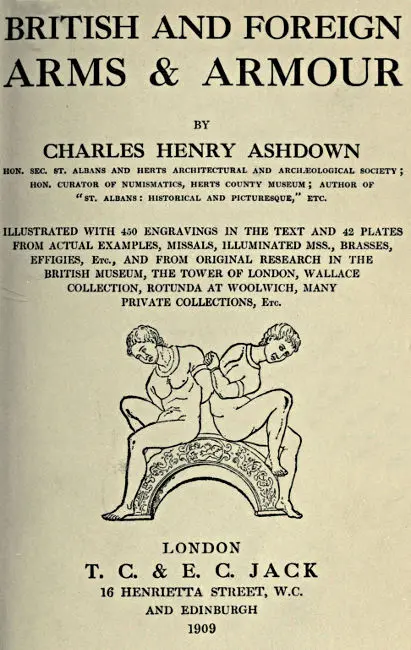
"British and Foreign Arms & Armour" by Charles Henry Ashdown is a historical account written in the early 20th century. The work delves into the study of arms and armor from various historical periods, drawing connections between military artifacts and the socio-political contexts in which they were used. Readers can expect a comprehensive examination of weaponry styles, including details on the design, function, and evolution of arms across different cultures. The opening of the book lays the groundwork for Ashdown’s exploration by emphasizing the importance of understanding arms and armor as artifacts that reflect historical struggles, artistry, and development over time. He discusses the significance of heraldry and collectorship in the study of military equipment. The text notes the lack of accessible literature on the subject and aims to simplify complex concepts for beginners, providing a methodical approach to studying different periods of armor, beginning with prehistoric weaponry and the craftsmanship behind early tools and weapons from the Stone Age.
Introduction adapted from the source catalogue; source summaries may be automatically generated.
Free to read · English · 84,044 words · No account needed
MAKE TIME FOR A GOOD BOOK
On by default. Untick to stop anonymous reading totals. Each page counts after 10 seconds in view. How this works.
Anonymous counting is on unless you have switched it off.
Of the same date as the Beauchamp effigy is the well-known brass of John Daundelyon at Margate, 1455, whose breastplate is of the short character, as shown in the effigy; the bascinet is very pointed at the apex, and the mentonnière appears of singularly graceful form. The palettes are large and dissimilar, the left covering a considerable portion of the breastplate; upon the left arm is a circular garde-de-bras attached to the coudière, while an extremely large coudière is shown upon the left arm which may be regarded as a second garde-de-bras: the gauntlets are characterised by long pointed cuffs. Walter Green, 1450, whose brass occurs at Hayes, Middlesex, is represented without any bascinet, but with the head resting on a visored tilting helm (Fig. 318). The epaulières consist of a number of lames which extend upwards to the neck, where they are confined by a band, and over these are two symmetrical pauldrons of plain pattern. His armour bears a remarkable resemblance to that of John Gaynesford, 1460, in Crowhurst Church, Surrey, even to the plain gauntlets of four plates covering the hands. In both examples the taces are numerous and worked into broad escallops, tuilles being omitted (Fig. 319). An early example of the garde-de-bras is that represented upon the memorial effigy of Sir John Verney, Albury, 1452, where a small garde is attached to the coudière of the right arm and an enlarged one of peculiar shape to the left (Fig. 320). Upon the same effigy also occurs a complicated genouillière, which, fitting closely to the knee, is provided with two reinforcements above and below, the extreme plates being worked into highly ornamental forms (Fig. 321). A coudière of large size and graceful form is shown upon the brass of Henry Parice, 1464, at Hildersham, Cambridge, where arming points are seen attaching it to the brassart and vambrace: it is serrated in the upper extension, and the same decoration is repeated upon the pike-guard of the pauldron. In this figure the lance-rest is shown affixed to the breastplate (Fig. 322). Upon the same brass there is an example of extravagant tuilles attached to the lowest of three taces by straps, while the rare occurrence of the skirt of the haqueton with the edge of a defence of mail (possibly a hauberk) is shown, another instance being that at Roydon, Essex, upon the brass of Robert Colt, 1475. Sir Robert Staunton’s brass, 1458, in Castle Donington Church, Leicestershire (Fig. 323), affords us the best example of extravagant coudières, and is also remarkable for showing the salade, which is of extreme rarity upon brasses and effigies. The latter is represented very wide in form, with a falling visor having the occularium in it, and guided by a prolongation which apparently runs backwards and forwards upon a hidden comb. The gorget is of plate, over which the laminated epaulières are shown, apparently meeting over the chest: other details of the arms are hidden by the enormous coudières, which, strange to say, are of similar size and form. They are cusped and fluted in the upper parts. Upon viewing these arm defences the reason may readily be perceived why the knights deemed the shield superfluous. A demi-placcate is added to the breastplate. The armour shown upon the brass of Sir Robert del Bothe, 1460, in Wilmslow Church, Cheshire (Fig. 324), is characterised by excessive singularity of contour, suggesting an origin in one of the northern continental countries. No headpiece is shown, but the knight probably wore the salade: a mentonnière of several plates covers the upper part of the breastplate, which apparently is not reinforced. The massive pauldrons are almost similar in outline, and each is provided with a projecting ridge upon the shoulder in addition to a low pike-guard. The chain mail gousset is very apparent where the pauldron has been cut away to permit of the lance being held. The coudières are strange, almost grotesque, in form. The right arm in wielding the sword, mace, and lance, would be almost always in an extended position, hence the small latitude allowed in the coudière for bending it: the left, or bridle arm, would necessarily be bent more. The awkward position of the arms may be explained by stating that on the brass the knight is holding the right hand of his lady with his own. The long form of breastplate necessitates only three taces, which are escalloped, and two large tuilles, vieing in size with those of Henry Parice, are appended. The genouillières are remarkable for the excessive development of the guard-plate protecting the gousset at the back of the knees; this guard is seen upon many effigies but few brasses, and where it occurs in the latter might easily be overlooked--see the brass of Sir Anthony de Grey for example. Upon the brass of Sir Thomas Grene in Grene’s Norton Church, Northamptonshire (Fig. 325), the knee-guards are, if anything, larger than those upon the Bothe brass, while Henry Green, in Luffwick Church, Northamptonshire, 1467, who wears a tabard, has similar guards. Sir Robert del Bothe is among the first, or is the first, to exemplify the wearing of the sword in front of the body sloping from right to left: this fashion was introduced about 1460, and is one of the clues used in identifying the chronology of a brass.
Your reading position is saved on this browser. Take it to another device with a library code. Reading pages adapt to text, rather than matching a printed edition.
BEHIND THE BOOK
This eBook is for the use of anyone anywhere in the United States and most other parts of the world at no cost and with almost no restrictions whatsoever. You may copy it, give it away or re-use it under the terms of the Project Gutenberg License included with this eBook or online at www.gutenberg.org. If you are not located in the United States, you will have to check the laws of the country where you are located before using this eBook. Read the source licence.
The original source file, including credits and licence, is retained by this library. Request an original-format copy at no charge. Please include the book title and Project Gutenberg identifier #48573.
KEEP YOUR CURIOSITY GOING
Cécile Tormay

Moritz Busch
John L. Ransom
Frances Wright
Cécile Tormay

Mabel Potter Daggett