
Lying lips
William Le Queux
THE CLASSIC COLLECTION · 1915
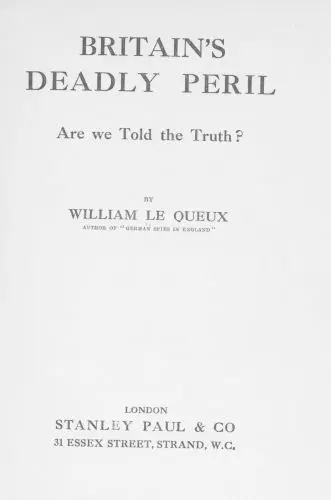
"Britain's Deadly Peril: Are We Told the Truth?" by William Le Queux is a critical historical account written in the early 20th century, specifically during World War I. The book presents a strong condemnation of the British government's handling of the war effort, particularly in terms of transparency and preparedness. It likely explores themes of national security, public sentiment, and governmental responsibility, emphasizing the risks posed by misinformation and negligence during a time of peril. At the start of the book, Le Queux expresses deep concern over Britain's unpreparedness as Germany's military actions unfold. He critiques the government's tendency to downplay threats and mishandle information, noting the public's growing distrust as a result of poor communication and censorship. He argues that the British people deserve a clear understanding of their country's wartime position, rather than the comforting narratives fed to them by officials. The opening sets a tone of urgency and accountability, as Le Queux urges readers to confront the harsh realities of the war and reflect on their implications for national safety and unity.
Introduction adapted from the source catalogue; source summaries may be automatically generated.
Free to read · English · 53,973 words · No account needed
MAKE TIME FOR A GOOD BOOK
On by default. Untick to stop anonymous reading totals. Each page counts after 10 seconds in view. How this works.
Anonymous counting is on unless you have switched it off.
This book deals with the social evil, its causes and its remedies. Necessarily, the writer is compelled to present many aspects of the case, and to describe persons and scenes which he has encountered, as Director of the National Council of Public Morals, in America, India, Europe, the Colonies, etc.; the overruling object of the book, however, is the more difficult and more useful task of discovering the root causes of this vice and of suggesting lasting remedies.
THE FRIEND OF FREDERICK THE GREAT: The Last Earl Marischall of Scotland
By Edith E. Cuthell, F.R.Hist.S., Author of "A Vagabond Courtier," etc.
Demy 8vo, cloth gilt, fully illustrated, 2 vols., 24/- net.
George Keith, a gallant young colonel of Life Guards under Marlborough and Ormonde, fought at Sheriffmuir, led the ill-fated Jacobite expedition from Spain, and was a prominent figure in all the Jacobite plottings before and after the '45. He was the ambassador and friend of Frederick the Great and the friend and correspondent of Voltaire, Hume, Rousseau and d'Alembert. This excellent biography is to be followed later by a work on James Keith, Frederick the Great's Field-Marshal, who was killed in attempting to retrieve the reverse of Hochkeich.
GAIETY AND GEORGE GROSSMITH: Random Reflections on the Serious
Business of Enjoyment
By Stanley Naylor.
Crown 8vo, cloth gilt, with a coloured frontispiece, and 50 other
illustrations, 5/- net.
Here is Mr. George Grossmith in his moments of leisure, laughing, joking, relating anecdotes (personal and otherwise), criticising people and places, and generally expressing a philosophy which has serious truth behind it, but nevertheless bubbles over here and there with humour. Through his "Boswell," Mr. Stanley Naylor, he talks of "Love Making on the Stage and Off," "The Difference Between a Blood and a Nut," "The Ladies of the Gaiety," and other similar subjects. Mr. Grossmith in this book is as good as "Gee-Gee" at the Gaiety. What more need be said?
THE HISTORY OF GRAVESEND: From Prehistoric times to the beginning of
the Twentieth Century
By Alex. J. Philip.
Edition limited to 365 sets, signed by the Author.
In four vols., 9-3/4 × 6-1/2, bound in sealskin, fully illustrated,
12/6 net each volume.
The first volume of this important work is now ready. On historical grounds it is of value not only to those interested in Gravesend and its surroundings, but to the wider circle interested in the Britons, Romans, and Anglo-Saxons, and their life in this country. It also deals with the early history of the River Thames.
AUGUST STRINDBERG: The Spirit of Revolt
By L. Lind-af-Hageby.
Crown 8vo, cloth gilt, with many illustrations, 6/- net.
Your reading position is saved on this browser. Take it to another device with a library code. Reading pages adapt to text, rather than matching a printed edition.
William Le Queux
William Le Queux
William Le Queux
William Le Queux
BEHIND THE BOOK
This eBook is for the use of anyone anywhere in the United States and most other parts of the world at no cost and with almost no restrictions whatsoever. You may copy it, give it away or re-use it under the terms of the Project Gutenberg License included with this eBook or online at www.gutenberg.org. If you are not located in the United States, you will have to check the laws of the country where you are located before using this eBook. Read the source licence.
The original source file, including credits and licence, is retained by this library. Request an original-format copy at no charge. Please include the book title and Project Gutenberg identifier #61040.
KEEP YOUR CURIOSITY GOING
Cécile Tormay

Moritz Busch
John L. Ransom
Frances Wright
Cécile Tormay

Mabel Potter Daggett