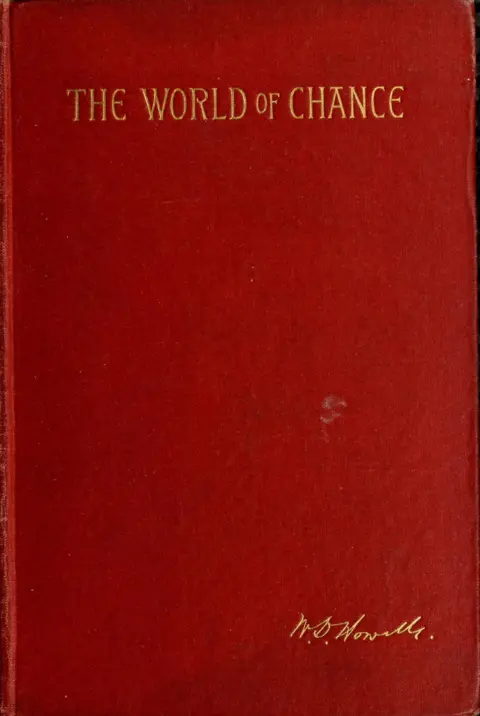
The World of Chance
William Dean Howells
THE CLASSIC COLLECTION · 1893
"Bride Roses" by William Dean Howells is a play that was likely written in the late 19th century. The narrative unfolds in a florist’s shop, centering on themes of floral arrangements which symbolize deeper human connections and societal conventions. This light comedic work captures the spirit of the era through its focus on the nuances of social interactions surrounding significant life events. In the play, a lady visits the florist to arrange flowers for a social gathering, aiming to create a thematic coherence that complements her guest's ethereal beauty. As she debates flower selections, a young man enters, also selecting roses, and a dynamic unfolds that hints at deeper connections. Amidst their exchanges, a misunderstanding arises, connecting the lady's planned flowers and the young man's sentiments, revealing the intricate link between flowers and human emotions. The interactions are interspersed with light humor and conversations that reflect on love, beauty, and the transient moments of life, culminating in a delightful exploration of how floral choices can resonate with personal relationships.
Introduction adapted from the source catalogue; source summaries may be automatically generated.
Free to read · English · 5,427 words · No account needed
MAKE TIME FOR A GOOD BOOK
On by default. Untick to stop anonymous reading totals. Each page counts after 10 seconds in view. How this works.
Anonymous counting is on unless you have switched it off.
The Florist: "No; I am qvite at your service. We haf just had to egsegute a larche gommission very soddenly, and we are still in a little dtisorter yet; but"--
The Lady: "Yes, I see." She glances at the rear of the shop, where the floor is littered with the leaves and petals of flowers, and sprays of fern and evergreen. A woman, followed by a belated smell of breakfast, which gradually mingles with the odor of the plants, comes out of a door there, and begins to gather the larger fragments into her apron. The lady turns again, and looks at the jars and vases of cut flowers in the window, and on the counter. "What I can't understand is how you know just the quantity of flowers to buy every day. You must often lose a good deal."
The Florist: "It gomes out about rhighdt, nearly always. When I get left, sometimes, I can chenerally work dem off on funerals. Now, that bic orter hat I just fill, that wass a funeral. It usedt up all the flowers I hat ofer from yesterday."
The Lady: "Don't speak of it! And the flowers, are they just the same
for funerals?"
The Florist: "Yes, rhoces nearly always. Whidte ones."
The Lady: "Well, it is too dreadful. I am not going to have roses, whatever I have." After a thoughtful pause, and a more careful look around the shop: "Mr. Eichenlaub, why wouldn't orchids do?"
The Florist: "Well, they would be bretty dtear. You couldn't make any show at all for less than fifteen tollars."
The Lady, with a slight sigh: "No, orchids wouldn't do. They are fantastic things, anyway, and they are not very effective, as you say. Pinks, anemones, marguerites, narcissus--there doesn't seem to be any great variety, does there?"
The Florist, patiently: "There will be more, lader on."
The Lady: "Yes, there will be more sun, later on. But now, Mr. Eichenlaub, what do you think of plants in pots, set around?"
The Florist: "Balmss?"
The Lady, vaguely: "Yes, palms."
The Florist: "Balmss would to. But there would not be very much
golor."
The Lady: "That is true; there would be no color at all, and my rooms certainly need all the color I can get into them. Yes, I shall have to have roses, after all. But not white ones!"
The Florist: "Chacks?"
The Lady: "No; Jacks are too old-fashioned. But haven't you got any other very dark rose? I should like something almost black, I believe."
The Florist, setting a vase of roses on the counter before her: "There
is the Matame Hoste."
Your reading position is saved on this browser. Take it to another device with a library code. Reading pages adapt to text, rather than matching a printed edition.
William Dean Howells
William Dean Howells
William Dean Howells
William Dean Howells
BEHIND THE BOOK
This eBook is for the use of anyone anywhere in the United States and most other parts of the world at no cost and with almost no restrictions whatsoever. You may copy it, give it away or re-use it under the terms of the Project Gutenberg License included with this eBook or online at www.gutenberg.org. If you are not located in the United States, you will have to check the laws of the country where you are located before using this eBook. Read the source licence.
The original source file, including credits and licence, is retained by this library. Request an original-format copy at no charge. Please include the book title and Project Gutenberg identifier #33608.
KEEP YOUR CURIOSITY GOING
Coulson Kernahan

Maurice Baring
Frances Wright
Cécile Tormay

Frederic Jesup Stimson

W. H. P. (William Henry Pope) Jarvis