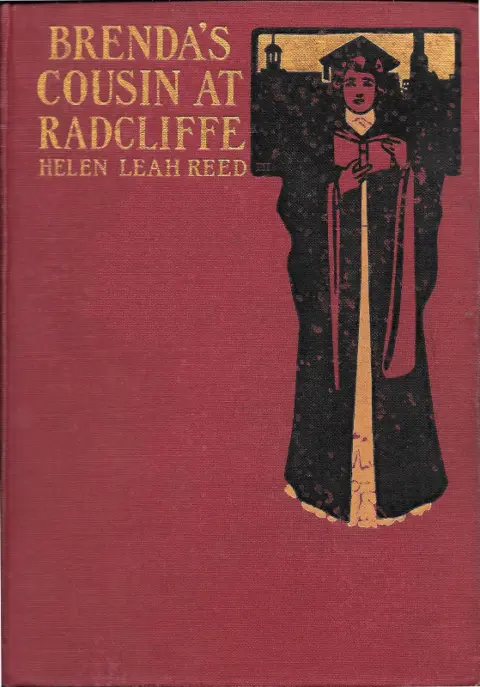
Brenda’s cousin at Radcliffe
Helen Leah Reed
THE CLASSIC COLLECTION · 1903
"Brenda's Bargain: A Story for Girls" by Helen Leah Reed is a novel written in the early 20th century. The story centers around Brenda Barlow, a young woman characterized by her kindness and generosity, as she navigates relationships and moral dilemmas in her life. The narrative presents themes of class differences and the importance of helping others, as Brenda becomes involved in the lives of those less fortunate than herself. The opening of the novel depicts a pivotal moment for Brenda as she ventures into a shop to buy a wedding gift. Her experience takes a dramatic turn when the delicate vase she purchases is accidentally shattered by a shop girl named Maggie. Instead of seeking restitution, Brenda decides not only to comfort Maggie but also to ensure that she isn't penalized for the mishap. This act of compassion leads Brenda to want to take Maggie under her wing and help her secure a better future, highlighting Brenda's caring nature. As the story progresses, themes of social responsibility and the bond between individuals from different walks of life are set to unfold, starting from this impactful beginning.
Introduction adapted from the source catalogue; source summaries may be automatically generated.
Free to read · English · 64,023 words · No account needed
MAKE TIME FOR A GOOD BOOK
On by default. Untick to stop anonymous reading totals. Each page counts after 10 seconds in view. How this works.
Anonymous counting is on unless you have switched it off.
"That means," interpolated Concetta, "that you'll put it in your little bank. She's a regular miser, Miss Northcote."
"No, I ain't," responded Maggie, "only just now I'm saving."
"That's right," said Pamela. "'Many a little make a mickle.'"
"Yes, 'm," and Maggie lapsed into her wonted silence.
Concetta, however, was inclined to be more talkative.
"Oh, she isn't simply saving, she's mean. Why, she got Nellie to buy her blue necktie last week; sold it for ten cents. Just think of that!"
"Well, well, that is no affair of ours."
"She sold a lovely story-book that her aunt gave her Christmas. She said it was too young for her, and she'd rather have the money."
"That may be, Concetta; but still I say that this is none of our
business."
Yet although she thus reproved Concetta for her comments, Pamela wondered why Maggie wished to save. Economy was not a characteristic of girls of her age; though, recalling her own past need of money, Pamela felt that thrift was not a thing to be discouraged.
"Oh, please let us go to the paintings first," begged Concetta.
"No! no! to the jewelry," cried Gretchen; while Maggie, knowing as well as the others that they would first go where Miss Northcote chose, wisely said nothing, expressed no preference.
On their first visit they had walked through all the galleries to get the necessary bird's-eye view, and a second visit had been given almost wholly to the old Greek room. But all the casts and reliefs were as nothing in Concetta's eyes compared with the richness of color in Corot's "Dante and Virgil in the Forest," and the wonderful realism of La Rolle's two peasant women.
"I don't know whether they're Italians," said Concetta of the latter, "but there's something about them that makes me think of Italy;" for Concetta had vague remembrances of her native land and of the picturesque costumes of the Italian women. Although she was proud enough to consider herself an American citizen, she still was pleased when people called her a true daughter of Italy, and she loved everything that reminded her of her old home.
Of all the things that she had seen, Gretchen declared that she would much prefer the great crystal ball to which a fabulous value was attached, although there were some exquisite gold necklaces that had an especial charm for her.
Now on this special day Pamela meant to combine instruction with
pleasure, and so the quartette quickly found themselves in the Egyptian
room.
Your reading position is saved on this browser. Take it to another device with a library code. Reading pages adapt to text, rather than matching a printed edition.
Helen Leah Reed
Helen Leah Reed
Helen Leah Reed
Helen Leah Reed
BEHIND THE BOOK
This eBook is for the use of anyone anywhere in the United States and most other parts of the world at no cost and with almost no restrictions whatsoever. You may copy it, give it away or re-use it under the terms of the Project Gutenberg License included with this eBook or online at www.gutenberg.org. If you are not located in the United States, you will have to check the laws of the country where you are located before using this eBook. Read the source licence.
The original source file, including credits and licence, is retained by this library. Request an original-format copy at no charge. Please include the book title and Project Gutenberg identifier #37335.
KEEP YOUR CURIOSITY GOING
Coulson Kernahan

Maurice Baring
Frances Wright
Cécile Tormay

Frederic Jesup Stimson

W. H. P. (William Henry Pope) Jarvis