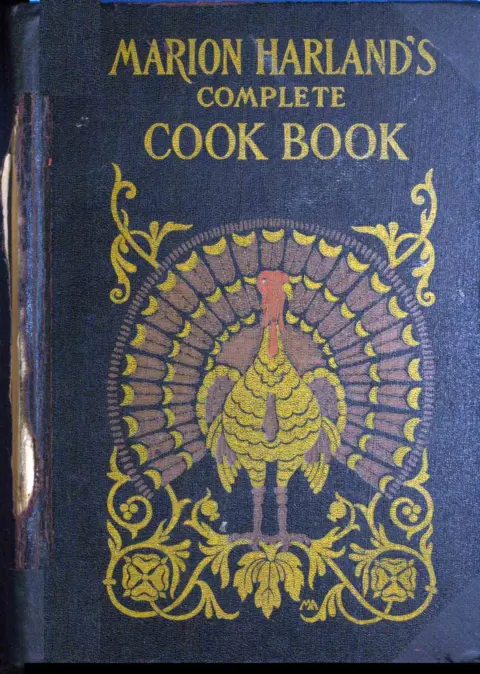
Marion Harland’s Complete Cook Book A Practical and Exhaustive Manual of Cookery and Housekeeping
Marion Harland
THE CLASSIC COLLECTION · 1875
"Breakfast, Luncheon and Tea" by Marion Harland is a comprehensive guide on culinary practices and household management written in the late 19th century. The book delves into the intricacies of meal planning, preparation, and presentation, reflecting the societal norms and expectations of the time. Harland addresses various aspects of cooking, with an emphasis on making meals not only nutritious but also enjoyable for the family. The opening of the book establishes a friendly and conversational tone as Harland introduces the idea of "Common Sense in the Household." She reflects on her gratitude towards readers for their support, sharing her insights on the importance of creating a welcoming environment for meals, particularly breakfast. She discusses the challenges that householders face in managing their duties while maintaining a warm atmosphere at the dining table. Various anecdotes illustrate her points, setting up the subsequent detailed recipes and practical advice that follow, aimed at enhancing the overall dining experience in a traditional household.
Introduction adapted from the source catalogue; source summaries may be automatically generated.
Free to read · English · 103,959 words · No account needed
MAKE TIME FOR A GOOD BOOK
On by default. Untick to stop anonymous reading totals. Each page counts after 10 seconds in view. How this works.
Anonymous counting is on unless you have switched it off.
“An’ it was a thrue word I spake, whin I said it. But an angel couldn’t make something out of nothing, or it’s meself that would thry!”
Matters were too serious for the poor lady to suffer her to smile at the implied assumption of angelic relationship.
“Something must be done, nevertheless,” she uttered, desperately, and, with a woman’s instinct of leaning upon rugged masculine strength when deserted by feminine wit, she sought the billiard-room, whither the inconsiderate brother had conducted his visitors, happily unsuspicious as themselves of the poverty-stricken larder, or the qualms that were racking the secretary of the interior.
He showed an exasperatingly good-humored face at the door in answer to
her knock.
“Come in!” he said blithely, and would have flung wide the door, but for the agonized gesture that beckoned him into the entry.
In a whisper as agonized, she explained the situation. He reflected a
moment.
“Any pie, or cake in the house? fruit, fresh or preserved?”
“Yes, all,” impatiently. “But it isn’t a question of dessert. There is literally nothing for dinner.”
“I understand! I have it! We’ll be fashionable for once. Set on sardines, cheese, pie, cake, claret and sauterne, and a dish or two of fruit. Make a royally strong cup of coffee to wind up with, and call it luncheon!”
In fifteen minutes the guests were summoned to the dining-room, where the pretty hostess, in a becoming demi-toilette, welcomed them as the friends of her husband and brother, and presided over the collation from which not one of them perceived that anything was lacking, like a gracious little queen. A lisp of apology would have spoiled all, and she had tact enough to avoid the danger.
“That man is a Napoleon in small matters!” said I, when she told me the story. “If he never says another good thing, his—‘Call it luncheon,’ should win him lasting fame with all housekeepers who hearken to the tale of his masterly strategy.”
I have given the anecdote at length, that the reader may have the benefit of all the lessons it conveys.
First—Assure yourself, whenever it is practicable, that the materials for dinner are in the house several hours before the time for serving it arrives.
Secondly—It is a wise plan to keep sardines, canned salmon and lobster, cheese, and potted meats on hand always, with preserved fruits, and not to let the stores of cake and crackers run too low.
Your reading position is saved on this browser. Take it to another device with a library code. Reading pages adapt to text, rather than matching a printed edition.
Marion Harland
Marion Harland
Marion Harland
Marion Harland
BEHIND THE BOOK
This eBook is for the use of anyone anywhere in the United States and most other parts of the world at no cost and with almost no restrictions whatsoever. You may copy it, give it away or re-use it under the terms of the Project Gutenberg License included with this eBook or online at www.gutenberg.org. If you are not located in the United States, you will have to check the laws of the country where you are located before using this eBook. Read the source licence.
The original source file, including credits and licence, is retained by this library. Request an original-format copy at no charge. Please include the book title and Project Gutenberg identifier #49944.
KEEP YOUR CURIOSITY GOING

Charles G. (Charles Griffith) Ross
Hannah Webster Foster

Emily Lawless
Edwin Hamlin Carr

Charles De Lano Hine
Andrew Ure