THE CLASSIC COLLECTION✦A dead man’s diaryCLASSIC FREE BOOKS
A dead man’s diary
Coulson Kernahan
THE CLASSIC COLLECTION · 1925
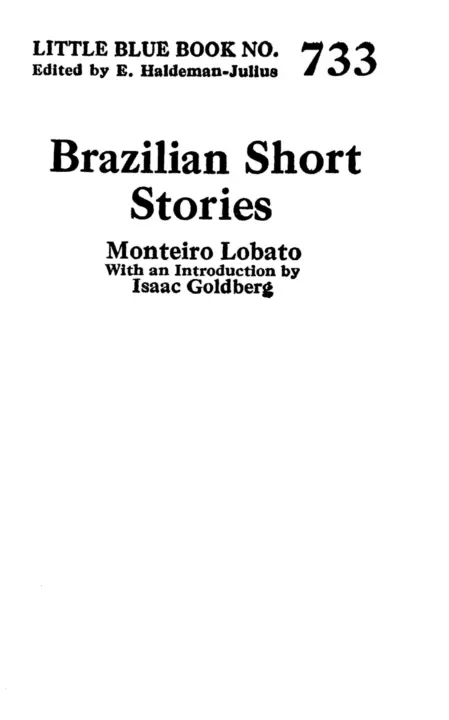
Brazilian short stories by José Bento Monteiro Lobato is a collection of short stories written in the early 20th century. It uses sharp, satirical fiction to examine Brazilian society, from petty politics and bureaucracy to rural life and social pretenses.
An opening introduction frames the author as a nationalist satirist whose fiction doubles as civic protest. The three tales then cut to the bone: in “Modern Torture,” a small-town mail carrier, Izé Biriba, is crushed by patronage, endless errands, and public mockery, ultimately sabotaging an election and vanishing to escape his misery. “The Penitent Wag” follows Pontes, a lifelong joker desperate to be taken seriously; he schemes to make a frail tax collector laugh to death to secure the post, succeeds, is wracked by guilt, misses his chance anyway, and finally hangs himself—only to be laughed at once more. “The Plantation Buyer” portrays a failing farm whose owner stages deceptions to snare a buyer; a charming impostor woos the family and leaves, later returns genuinely wealthy to purchase the place, but is beaten off in rage, and the family loses its last hope as the daughter’s romantic dreams collapse.
Introduction adapted from the source catalogue; source summaries may be automatically generated.
Free to read · English · 14,028 words · No account needed
MAKE TIME FOR A GOOD BOOK
On by default. Untick to stop anonymous reading totals. Each page counts after 10 seconds in view. How this works.
Anonymous counting is on unless you have switched it off.
The next day he went over the remainder of the fazenda, coffee-plantations and pastures; examined the live-stock and out-buildings; and as the amiable young man continued to be charmed, Moreira, who the night before had decided to ask forty contos for Espigão, thought it wise to raise the price. After the scene of the Pau d’Alho, in his mind he raised it to forty-five; after the examination of the live-stock it had already risen to sixty. And thus when the great question was broached, the old man declared courageously in the firm voice of an alea jacta:
“Seventy-five!” and waited standing for the storm to burst.
Trancoso, however, found the price reasonable.
“Well, it is not expensive, the price is more moderate than I expected.”
The old man bit his lips and tried to retract.
“Seventy-five, yes, but ... not including the cattle!...”
“That’s fair,” answered Trancoso.
“... also not including the pigs!”
“Exactly.”
“... and the furniture!”
“Naturally.”
The planter choked; there was nothing more to exclude; he confessed to himself that he was an ass. Why had he not said eighty right off?
The wife informed of the case, called him a fool.
“But, woman, at forty it was already a good business!”
“For eighty it would have been doubly good. Don’t excuse yourself. I never saw a Moreira who was not slow and stupid. It’s in the blood. You are not to blame.”
They sulked for a while but the eagerness to build air-castles with the unexpected pile of money swept the cloud far away.
Zico took advantage of the favorable occasion to insist upon the three contos for setting up the business and was promised them.
Dona Izaura no longer wanted the little cottage. Now she remembered a larger one on a street where processions passed--Eusebio Leite’s house.
“But that one is worth twelve contos,” warned the husband.
“But it is far better than that shanty. Very well arranged. Only I don’t like the windowless room near the pantry; it’s too dark.”
“We could put in a sky-light.”
“The yard, too, needs to be made over; instead of the chicken
enclosure....”
Until far into the night, while sleep did not come, they remodeled the house, transforming it into the loveliest dwelling in town. The couple were giving the last touches, and beginning to get sleepy when Zico knocked at the door.
“Three contos are not enough, father, I need five. There are the arrangements that I had not thought of, the license and the rental and other little things....”
Between two yawns the father generously granted six.
And Zilda? She floated along on the high seas of a fairy tale.
Your reading position is saved on this browser. Take it to another device with a library code. Reading pages adapt to text, rather than matching a printed edition.
BEHIND THE BOOK
This eBook is for the use of anyone anywhere in the United States and most other parts of the world at no cost and with almost no restrictions whatsoever. You may copy it, give it away or re-use it under the terms of the Project Gutenberg License included with this eBook or online at www.gutenberg.org. If you are not located in the United States, you will have to check the laws of the country where you are located before using this eBook. Read the source licence.
The original source file, including credits and licence, is retained by this library. Request an original-format copy at no charge. Please include the book title and Project Gutenberg identifier #78403.
KEEP YOUR CURIOSITY GOING
Coulson Kernahan

Maurice Baring
Frances Wright
Cécile Tormay

Frederic Jesup Stimson

W. H. P. (William Henry Pope) Jarvis