THE CLASSIC COLLECTION✦A dead man’s diaryCLASSIC FREE BOOKS
A dead man’s diary
Coulson Kernahan
THE CLASSIC COLLECTION · 1925
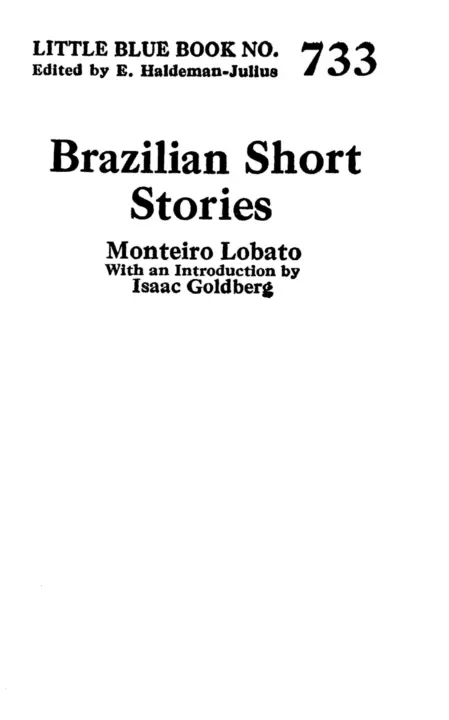
Brazilian short stories by José Bento Monteiro Lobato is a collection of short stories written in the early 20th century. It uses sharp, satirical fiction to examine Brazilian society, from petty politics and bureaucracy to rural life and social pretenses.
An opening introduction frames the author as a nationalist satirist whose fiction doubles as civic protest. The three tales then cut to the bone: in “Modern Torture,” a small-town mail carrier, Izé Biriba, is crushed by patronage, endless errands, and public mockery, ultimately sabotaging an election and vanishing to escape his misery. “The Penitent Wag” follows Pontes, a lifelong joker desperate to be taken seriously; he schemes to make a frail tax collector laugh to death to secure the post, succeeds, is wracked by guilt, misses his chance anyway, and finally hangs himself—only to be laughed at once more. “The Plantation Buyer” portrays a failing farm whose owner stages deceptions to snare a buyer; a charming impostor woos the family and leaves, later returns genuinely wealthy to purchase the place, but is beaten off in rage, and the family loses its last hope as the daughter’s romantic dreams collapse.
Introduction adapted from the source catalogue; source summaries may be automatically generated.
Free to read · English · 14,028 words · No account needed
MAKE TIME FOR A GOOD BOOK
On by default. Untick to stop anonymous reading totals. Each page counts after 10 seconds in view. How this works.
Anonymous counting is on unless you have switched it off.
“In town, Mr. Moreira, water like this, pure as crystal, absolutely drinkable is worth the best of wines. Happy are those who can drink it!”
The family looked at each other: they never imagined that they owned such a precious thing, and each one involuntarily took a little swallow of it as though acquainting themselves with it at that moment for the first time. Zico even smacked his lips.
Dona Izaura could not contain herself with delight. The compliments to her cooking captivated the good lady; she would have considered herself well paid for the hard work with half that praise.
“Learn, Zico,” she whispered to her son, “that’s what a gentleman
should be!”
After coffee, hailed with the word “delicious!” Moreira invited the young man for a turn on horseback.
“Impossible, my friend, I do not ride after meals; it gives me
cephalalgy.”
Zilda blushed. Zilda always blushed when she did not understand a word.
“We will go this afternoon, I am in no hurry. Now I prefer a short walk through the orchard to aid the digestion.”
While the two men went slowly in that direction, Zilda and Zico flew
for the dictionary.
“It isn’t among the S’s,” said the youth.
“Look for it with a C,” suggested the girl.
After some trouble they found the word.
“Headache! Well, I never! Just that....”
In the afternoon on the ride, Trancoso admired and praised all that he saw, to the astonishment of the planter, who, for the first time, heard his belongings praised.
Usually buyers run down everything, looking only for faults; they begin to exclaim about the dangers of loose soil as soon as they come across a crumbling bank; they find the water scarce and bad; and if they see an ox they glue their eyes on the parasites.
Not Trancoso! He only praised! As Moreira, when they passed the counterfeited places, pointed to the standards with trembling finger, the young man exclaimed in astonishment:
“Caquéra! Why this is wonderful!”
At sight of the Pau d’Alho, his amazement reached its height:
“What I see is marvelous! I never expected to see even a vestige of such a tree in these parts,” he said slipping a leaf into his pocketbook as a souvenir.
In the house he unbosomed himself to the old lady:
“Well, madam, the quality of the soil is far beyond my expectations. Even Pau d’Alho! It is really astonishing!”
Dona Izaura lowered her eyes.
The scene occurred on the veranda.
Night had fallen.
A night humming with the chirp of crickets, the croaks of frogs, numberless stars in the sky and endless peace on earth.
Your reading position is saved on this browser. Take it to another device with a library code. Reading pages adapt to text, rather than matching a printed edition.
BEHIND THE BOOK
This eBook is for the use of anyone anywhere in the United States and most other parts of the world at no cost and with almost no restrictions whatsoever. You may copy it, give it away or re-use it under the terms of the Project Gutenberg License included with this eBook or online at www.gutenberg.org. If you are not located in the United States, you will have to check the laws of the country where you are located before using this eBook. Read the source licence.
The original source file, including credits and licence, is retained by this library. Request an original-format copy at no charge. Please include the book title and Project Gutenberg identifier #78403.
KEEP YOUR CURIOSITY GOING
Coulson Kernahan

Maurice Baring
Frances Wright
Cécile Tormay

Frederic Jesup Stimson

W. H. P. (William Henry Pope) Jarvis