THE CLASSIC COLLECTION✦A dead man’s diaryCLASSIC FREE BOOKS
A dead man’s diary
Coulson Kernahan
THE CLASSIC COLLECTION · 1925
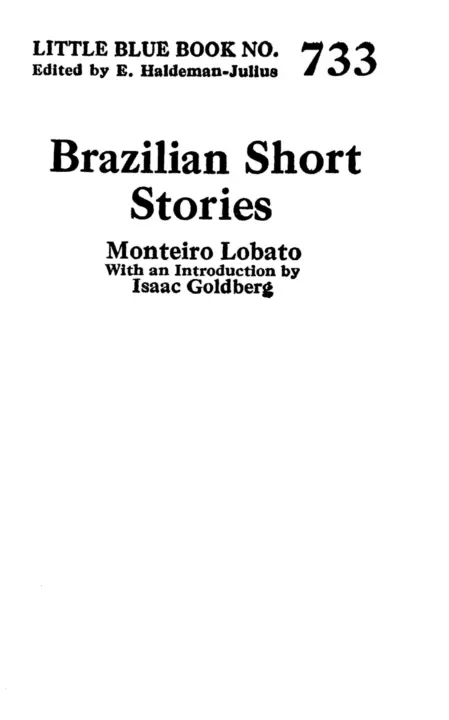
Brazilian short stories by José Bento Monteiro Lobato is a collection of short stories written in the early 20th century. It uses sharp, satirical fiction to examine Brazilian society, from petty politics and bureaucracy to rural life and social pretenses.
An opening introduction frames the author as a nationalist satirist whose fiction doubles as civic protest. The three tales then cut to the bone: in “Modern Torture,” a small-town mail carrier, Izé Biriba, is crushed by patronage, endless errands, and public mockery, ultimately sabotaging an election and vanishing to escape his misery. “The Penitent Wag” follows Pontes, a lifelong joker desperate to be taken seriously; he schemes to make a frail tax collector laugh to death to secure the post, succeeds, is wracked by guilt, misses his chance anyway, and finally hangs himself—only to be laughed at once more. “The Plantation Buyer” portrays a failing farm whose owner stages deceptions to snare a buyer; a charming impostor woos the family and leaves, later returns genuinely wealthy to purchase the place, but is beaten off in rage, and the family loses its last hope as the daughter’s romantic dreams collapse.
Introduction adapted from the source catalogue; source summaries may be automatically generated.
Free to read · English · 14,028 words · No account needed
MAKE TIME FOR A GOOD BOOK
On by default. Untick to stop anonymous reading totals. Each page counts after 10 seconds in view. How this works.
Anonymous counting is on unless you have switched it off.
This reached such a point that it was only necessary for him to open his mouth or raise his hand, for humanity to writhe in laughter. The sight of him was enough. As soon as he appeared, all faces beamed; if he made a spontaneous gesture, laughter could be heard, if he opened his mouth some shrieked, others loosened their belts so as to laugh better. If he spoke, good Lord! one heard shrieks of laughter, yells, squeaks, chokes, sniffling and tremendous catching of breath.
“He beats the devil, this Pontes!”
“Hold on, man, you’ll make me gag!”
And when the wit tried to look innocent and idiotic, remarking:
“But what did I do? I never opened my mouth....”
“Ha, ha, ha!” everyone laughed, their jaws aching, weeping spasmodically with uncontrollable hilarity.
As time passed, the mere mention of his name was enough to provoke merriment. If anyone pronounced the word “Pontes,” the gun-cotton of risibles by which man raises himself above animals who do not laugh, would instantly ignite.
Thus he lived until the age of Christ in a smiling parable, laughing and provoking laughter, without a serious thought,--a vagabond life that exchanges grimaces for dinners and pays small bills with ponderous jokes. A merchant whom he had cheated once said to him, amidst bursts of spluttering laughter:
“You amuse me, at least, and are not like Major Carapuça who cheats with a face like a wooden Indian.”
That unstamped receipt troubled our wag not a little; but as the bill amounted to two dollars, it was well worth the trick. However, the memory of it remained, like a pin-prick to his self-respect. Following this came other pin-pricks, some shoved in with less force, others straight through.
One wearies of everything. Sick of such a life, the tireless joker began to dream of the joy of being taken seriously, of speaking and being listened to without the play of facial muscles, of gesticulating without disturbing human dignity, of crossing a street without hearing a chorus of “Here comes Pontes!” in the tone of those who check laughter or prepare themselves for a hearty guffaw.
Attempting reaction, Pontes tried to be serious--a disaster! Pontes solemnly changed his tactics and adopted English humorism. Formerly he was amusing as a clown, now he took the part of Tony.
The enormous success which everyone supposed to be a new phase of his comic strain, threw the penitent wag into despair. Was it possible that he could never follow any other path in life than that one, now so hateful to him? A clown then, everlastingly a clown against his will?
Your reading position is saved on this browser. Take it to another device with a library code. Reading pages adapt to text, rather than matching a printed edition.
BEHIND THE BOOK
This eBook is for the use of anyone anywhere in the United States and most other parts of the world at no cost and with almost no restrictions whatsoever. You may copy it, give it away or re-use it under the terms of the Project Gutenberg License included with this eBook or online at www.gutenberg.org. If you are not located in the United States, you will have to check the laws of the country where you are located before using this eBook. Read the source licence.
The original source file, including credits and licence, is retained by this library. Request an original-format copy at no charge. Please include the book title and Project Gutenberg identifier #78403.
KEEP YOUR CURIOSITY GOING
Coulson Kernahan

Maurice Baring
Frances Wright
Cécile Tormay

Frederic Jesup Stimson

W. H. P. (William Henry Pope) Jarvis