THE CLASSIC COLLECTION✦My diaries, being a personal narrative of events 1888-1914, Part 2 (1900-1914)CLASSIC FREE BOOKS
My diaries, being a personal narrative of events 1888-1914, Part 2 (1900-1914)
Wilfrid Scawen Blunt
THE CLASSIC COLLECTION · 1869
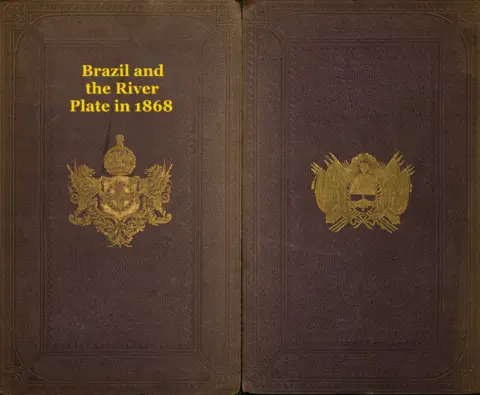
"Brazil and the River Plate in 1868" by William Hadfield is a historical account written in the late 19th century. The book explores the significant changes and developments in Brazil and the River Plate region since the author's previous visit in 1853, focusing on topics such as emigration, commerce, and the impact of the war in Paraguay. Hadfield's narrative aims to shed light on these countries, which, despite their growing importance to England, remain largely unknown to the public. The opening portion of the work sets the stage for an in-depth exploration of South America, beginning with the author's voyage from England to Brazil. Hadfield provides observations about the state of steam navigation, highlighting advances since his last trip and the increased passenger and commercial traffic between these regions and Europe. He reflects on the socio-economic conditions, including the status of African slavery in Brazil and ongoing issues related to health crises, such as cholera, which affected both Rio de Janeiro and Buenos Ayres. The introduction establishes both the personal and broader contextual significance of the author's journey, illustrating the transformations within these vibrant territories.
Introduction adapted from the source catalogue; source summaries may be automatically generated.
Free to read · English · 79,226 words · No account needed
MAKE TIME FOR A GOOD BOOK
On by default. Untick to stop anonymous reading totals. Each page counts after 10 seconds in view. How this works.
Anonymous counting is on unless you have switched it off.
The changes of climate here are sudden and said to be unhealthy. During the two months I was in the river until the occurrence of the gale nothing could be more delicious than the weather—cool, with bright sunshine and any amount of exercise agreeable. The nights were occasionally frosty, with ice in the mornings in some places. Dust storms are terrible things during the summer, but happily are rare, and generally the forerunners of a pampero, accompanied by heavy rain, which refreshes the thirsty soil. Droughts are serious afflictions to the sheep and cattle, which often perish from their effects. Water is the great desideratum for the campo, and without it the prospects of the estanciero are blighted. As I have said before, the Banda Oriental is less subject to drought, being more undulated and better watered, but the pampas, or plains of Buenos Ayres, grow a more nutritive grass and rear finer sheep and cattle.
During my stay at Buenos Ayres the Provincial Chambers met, as well as the National Chambers, and I attended a sitting of the latter, where an unusual excitement prevailed owing to a motion put on the books as to the retirement of President Mitre from office, and whether or not this would put an end to the alliance entered into for carrying on the war with Paraguay. The building is small, exactly like a theatre minus the stage, and was crowded to excess by strangers, the pit, or lower part only, being used for the business of the Senate. There was so much demonstration from the galleries as to promise a stormy meeting, but when the speeches began the speakers were patiently listened to, with occasional cheers by their respective supporters, at which the President rang his bell. Dr. Quintana and others maintained that their views were correct, and that the retirement of President Mitre would put an end to the alliance. The Government, represented by Senor Elizalde, Minister for Foreign Affairs, maintained the contrary, and defended his colleagues with considerable acumen and ability, the result being that nothing was got by the motion and things remained in statu quo. The custom is for members to speak sitting upon their benches, which greatly detracts from their oratory, and must be very inconvenient, as you can only hear a voice, and are puzzled sometimes to know where it comes from. On another occasion, when the Senate was in committee with explanations going on, half-a-dozen members would be addressing or interrogating the Minister at the same time, which appeared very absurd, as well as unfair, it being impossible to reply to more than one at a time, or at all events to collect the observations of half-a-dozen members speaking in the same breath. Senor Elizalde, however, defended his position with much coolness and ability, and was assisted by his colleague, Dr. Costa, Minister for Education, &c. The audience became so troublesome on another occasion that the Senators decided to meet with closed doors, having only reporters present, rather a trial to democratic forbearance, but it did not seem to produce any sensation out of doors. As in our own Parliament, a great loss of time is caused by the professional speech makers, and the business of legislation retarded accordingly, as they only sit in the day in these countries. Whether or not such an arrangement would suit in St. Stephen's is another matter. Outside, and apart from public sittings, no doubt a deal of intrigue and jobbery takes place in South American assemblies, as in other countries, but I think on the whole their legislation is fair and conducted with moderation. There is not the same value in “loaves and fishes” to operate with, nor the same amount of honour and reward to look forward to as in England; besides, the members of Government out here are very poorly paid, so they are obliged to look to their professions, mostly as lawyers, unless they happen to possess private fortunes. Republicanism is not endowed with more gratitude than Royalty, and deserving men who have faithfully and zealously served their country are too often left in the “cold shade,” and forgotten in both cases. The Provincial Assembly meet in another part of the city, where all the provincial business is carried on. It was formerly the town residence and head-quarters of Rozas, from which many a bloody mandate has been issued. The municipality occupy large premises in the Plaza, attached to the old Spanish cabildo, or prison, on which the date of 1722 is still to be seen.
Your reading position is saved on this browser. Take it to another device with a library code. Reading pages adapt to text, rather than matching a printed edition.
BEHIND THE BOOK
This eBook is for the use of anyone anywhere in the United States and most other parts of the world at no cost and with almost no restrictions whatsoever. You may copy it, give it away or re-use it under the terms of the Project Gutenberg License included with this eBook or online at www.gutenberg.org. If you are not located in the United States, you will have to check the laws of the country where you are located before using this eBook. Read the source licence.
The original source file, including credits and licence, is retained by this library. Request an original-format copy at no charge. Please include the book title and Project Gutenberg identifier #52965.
KEEP YOUR CURIOSITY GOING
Wilfrid Scawen Blunt
Wilfrid Scawen Blunt

E. W. (Edgar Watson) Howe
Cécile Tormay

Moritz Busch
John L. Ransom