THE CLASSIC COLLECTION✦My diaries, being a personal narrative of events 1888-1914, Part 2 (1900-1914)CLASSIC FREE BOOKS
My diaries, being a personal narrative of events 1888-1914, Part 2 (1900-1914)
Wilfrid Scawen Blunt
THE CLASSIC COLLECTION · 1869
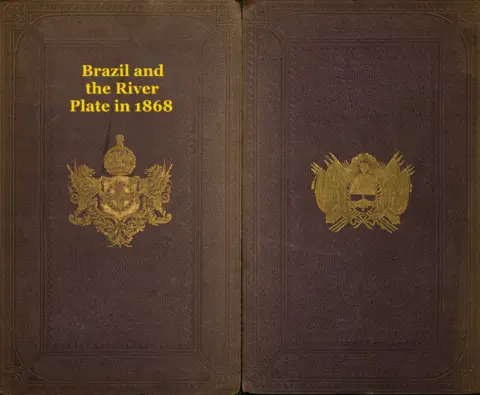
"Brazil and the River Plate in 1868" by William Hadfield is a historical account written in the late 19th century. The book explores the significant changes and developments in Brazil and the River Plate region since the author's previous visit in 1853, focusing on topics such as emigration, commerce, and the impact of the war in Paraguay. Hadfield's narrative aims to shed light on these countries, which, despite their growing importance to England, remain largely unknown to the public. The opening portion of the work sets the stage for an in-depth exploration of South America, beginning with the author's voyage from England to Brazil. Hadfield provides observations about the state of steam navigation, highlighting advances since his last trip and the increased passenger and commercial traffic between these regions and Europe. He reflects on the socio-economic conditions, including the status of African slavery in Brazil and ongoing issues related to health crises, such as cholera, which affected both Rio de Janeiro and Buenos Ayres. The introduction establishes both the personal and broader contextual significance of the author's journey, illustrating the transformations within these vibrant territories.
Introduction adapted from the source catalogue; source summaries may be automatically generated.
Free to read · English · 79,226 words · No account needed
MAKE TIME FOR A GOOD BOOK
On by default. Untick to stop anonymous reading totals. Each page counts after 10 seconds in view. How this works.
Anonymous counting is on unless you have switched it off.
Footnote 1:
Since writing the above, Messrs. Tait have parted with their exclusive interest in the line to a limited company, with a very influential board of direction, and of which Mr. Peter Tait is himself the chairman. No doubt this will lead to a yet more vigorous prosecution of an enterprise which has already and thus early secured so large a share of commercial patronage and support.
Seeing the accounts at Rio were not encouraging, I was advised to delay my trip southward, but as the River Plate was my ultimate destination, and my business pressing, I was desirous to reach Buenos Ayres as quickly as possible, taking Rio Janeiro on my return. So I continued on board the steamer, which left Rio on Sunday morning, the 12th January, 1868, and we came to anchor in Monte Video harbour at 1 p.m. on the 16th—a very good passage of four days and a few hours. The weather had been hot during the passage, giving us a foretaste of what we might look for here. The health inspector did not come off to us for three hours, a very annoying delay after the captain of a steamer has done his best to get quickly to his port, and to whom, as well as to his owners, hours are of consequence; but not so to officials in these countries. I believe I surmised correctly that the health officer was at dinner when we arrived, that he would take his siesta, and then come to look after us. As it was then getting past business hours, I preferred remaining cool and quiet on board the ship, but several of our passengers went on shore, and passed the night there, as it is difficult to get off after dark. The budget of news we received from the agents, who came on board after the health visit, made me wish I had taken the wise advice of Rio friends. The cholera was raging at Buenos Ayres and throughout the Argentine Republic, and appeared to be bad enough at Monte Video, in addition to which a revolution had broken out at Santa Fé against the Government, the rebels having actually got possession of Rosario, as well as some portion of the railway, whose metals they had partly torn up at one of the bridges, throwing them into the river below. It is difficult to account for this kind of wanton mischief, unless it was to show their contempt for civilized means of transit, for having reached Rosario, their policy should have been to keep the line open as a means of retreat in case of need, and then to have taken up the rails to impede troops who might be following them. I found Mr. and Mrs. Wheelwright at the Oriental Hotel, Monte Video, a new and handsome building erected since my last visit, and worthy any city in Europe, but unfortunately several of the inmates died of cholera there and it was afterwards deserted. The Oriental was full when we arrived, but we found comfortable quarters at the Gran Hotel Americano, also a large and handsome edifice lately built, nor can anything more strongly mark the advance of Monte Video than these two hotels in addition to those previously existing. The impressions conveyed in my former narrative as to the development of Monte Video were favourable, but I hardly expected to see the place grown half as large again since that time, which certainly is the case. Building of late years has taken extraordinary proportions here, and the price paid for choice spots in the city is something fabulous. Then again the streets have been all paved and flagged—roughly enough it must be confessed, but still they appear to answer the purpose for the peculiar description of traffic over them, and are a great improvement upon the sand and mud which existed before. During the few days I remained at Monte Video, everything was in a very miserable state, the mortality increasing and the telegrams from Buenos Ayres quite awful. I therefore resolved to return to Rio Janeiro, and wait a more favourable moment for prosecuting my mission. The heat was intense, and the minds of people so preoccupied with the pestilence as to render it impossible to follow the object of my mission with any chance of success. The City of Limerick came up from Buenos Ayres on the morning of the 24th of January, and was released from quarantine in the afternoon, when Captain Peters came on shore, and his report confirmed my previous views as to returning to Rio; so at 5 p.m. I went on board with him. We got under weigh at sunset, with a fresh breeze, and, passing Flores light, were off Maldonado light about 3 p.m.—a nasty navigation, with the island of Lobos dangerously near, on which there ought also to be a light. Daylight took us to the open sea, and four and a half days' steaming brought us again into Rio harbour on the morning of Wednesday, the 5th of February, when we were put to quarantine in what is called Three Fathom Bay, where we remained until the third morning, when we were released and steamed to the coal wharf.
Your reading position is saved on this browser. Take it to another device with a library code. Reading pages adapt to text, rather than matching a printed edition.
BEHIND THE BOOK
This eBook is for the use of anyone anywhere in the United States and most other parts of the world at no cost and with almost no restrictions whatsoever. You may copy it, give it away or re-use it under the terms of the Project Gutenberg License included with this eBook or online at www.gutenberg.org. If you are not located in the United States, you will have to check the laws of the country where you are located before using this eBook. Read the source licence.
The original source file, including credits and licence, is retained by this library. Request an original-format copy at no charge. Please include the book title and Project Gutenberg identifier #52965.
KEEP YOUR CURIOSITY GOING
Wilfrid Scawen Blunt
Wilfrid Scawen Blunt

E. W. (Edgar Watson) Howe
Cécile Tormay

Moritz Busch
John L. Ransom