A Biography of Rev. Henry Ward Beecher
William Constantine Beecher & H. W., Mrs. Beecher & Samuel Scoville
THE CLASSIC COLLECTION · 1915
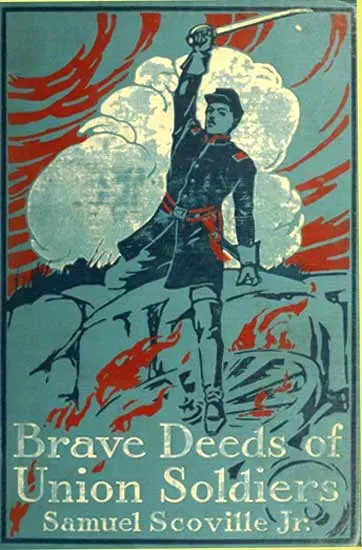
"Brave Deeds of Union Soldiers" by Samuel Scoville, Jr. is a historical account written in the early 20th century. This work chronicles acts of bravery exhibited by Union soldiers during the American Civil War, celebrating both prominent figures and ordinary individuals who displayed remarkable courage in dire situations. The author aims to inspire readers by recounting tales of valor, suggesting that heroism can emerge from anyone, regardless of status. The opening of the book introduces the concept of bravery through an account of a lesser-known confrontation during the Civil War. It highlights a regiment that faced an entrenched enemy across a swollen river, where their commanding officer, Colonel Brownlow, persistently rallied his troops to take action despite insurmountable odds. The scene unfolds as the men stripped down and embarked on a daring assault across the river, ultimately catching their adversaries off guard and capturing a number of Confederate soldiers. This narrative captivates readers by emphasizing not just the strategic importance of their mission, but the personal sacrifices and grit demonstrated by even the most ordinary soldiers in extraordinary circumstances.
Introduction adapted from the source catalogue; source summaries may be automatically generated.
Free to read · English · 70,954 words · No account needed
MAKE TIME FOR A GOOD BOOK
On by default. Untick to stop anonymous reading totals. Each page counts after 10 seconds in view. How this works.
Anonymous counting is on unless you have switched it off.
When Henry C. Foster, who afterward became famous as one of the heroes of Vicksburg, joined the Union Army, he was the rawest recruit in his regiment. His messmates still tell the story of how, before the regiment marched, he was visited by his mother who brought him an umbrella and a bottle of pennyroyal for use in wet weather and was horrified to find that soldiers are not allowed to carry umbrellas. Henry was impatient of the constant and never-ending drilling to which he was subjected. One day after a trying hour of setting-up exercises, he suddenly grounded his gun and said engagingly to the captain:
"Say, Captain, let's stop this foolishness and go over to the grocery store and have a little game of cards."
The captain stared at Foster for nearly a minute before he could get his breath, then he turned to a grinning sergeant and said:
"Sergeant, you take charge of this young cabbage-head after the regular drilling is over and drill him like blazes for about three extra hours," which the sergeant accordingly did.
In spite of his greenness and his peculiarities, however, Henry had good stuff in him and the making of a brave soldier. He was known as a dead-shot and a good soldier, although still retaining some of his peculiarities. Among others he insisted upon wearing a coonskin cap and was known throughout his company as "Old Coonskin." He soon showed such qualities of courage and self-reliance that in spite of his early record he was gradually promoted until by the time his regiment reached Vicksburg, which the Union Army was then besieging, he was a second lieutenant. The siege of Vicksburg was a long and tedious affair. The investing forces did not have sufficient artillery to make such a breach in the defenses of the Confederates that a successful attack could be made. The besiegers out in the wet and mud wearied of the slow process under which the encircling lines were brought closer and closer and longed for more active operations. Lieutenant Foster especially, just as formerly he had protested against the interminable drilling, now chafed against the enforced inaction of the troops. Finally he made up his mind that he at least would get some interest out of the siege. As one of the best shots in his regiment, he had no difficulty in being detailed for sharp-shooting duty. One dark night, loaded with ammunition and with a haversack of provisions and several canteens of water, he crawled out into the space between the Union lines and the defender's ramparts. The next morning, to his comrades' intense surprise, they found that Old Coonskin had dug for himself a deep burrow like a woodchuck close to the enemy's defenses and had thrown up a little mound with a peep-hole. There he lay for three days picking off the Confederates and scoring each successful shot with a notch on the butt of the long rifle which he had obtained especial permission to use. At first the Confederates could not locate the direction from which the fatal shots kept coming. When they did discover Foster in his burrow, volley after volley was directed at his refuge, but he kept too close to be hit and at regular intervals men who showed themselves on the ramparts were kept dropping before his unerring fire. At the end of the third day, the Confederates had learned their lesson and there were no more shots to be had and once more Old Coonskin began to be bored. It finally occurred to him that if he could in any way gain possession of a height which would allow him to shoot over the ramparts, he could make the Confederate position very uncomfortable. There was no tree or hill, however, near by which would lend itself to any such idea. Accordingly the third night Foster crawled back again to his regiment and spent a day in resting and reconnoitering and receiving the congratulations of the whole regiment for his marksmanship and daring. The next night was dark and stormy. At daylight the sentries inside the city were amazed to see a rude structure standing close beside the fatal burrow. It was in the form of a log-cabin hastily built out of railroad ties and reinforced with heavy railroad iron and containing peep-holes so that its occupant could shoot with entire safety. At first it did not seem to be any more dangerous than the burrow had been so long as the besieged kept off the breastwork. By the second day, however, it had grown visibly higher and the third night found it built up by slow degrees so that it began to look really like a low tower. Finally it reached such a height that from an upper inside shelf, protected by heavy logs and planks, Old Coonskin could lie at his ease and overlook all of the operations inside the city. Then began a reign of terror for the besieged. They had no artillery and it was necessary to concentrate an incessant fire on the tower, otherwise the sharp-shooter within could pick off his men without difficulty. It was absolutely impossible for the besieged to keep under cover and still properly man the defenses against an attack. One by one the officers went down before Old Coonskin's deadly fire and it seemed to be only a question of time and ammunition before the whole garrison succumbed to his marksmanship. In the meantime, the besieging lines drew closer and closer and the never-ceasing artillery fire and incessant attacks gradually wore down the courage and the resources of the besieged. One day within an hour eleven men went down before the deadly aim of Old Coonskin, most of them officers. Suddenly the firing ceased from the ramparts and slowly and reluctantly a white flag was hoisted, followed shortly by an envoy to the Union lines with a flag of truce. A tremendous cheer went up through the weary Union lines. Vicksburg had fallen, and to this day you never will be able to convince Old Coonskin's company that he was not the man who, along with Grant, brought about its surrender.
Your reading position is saved on this browser. Take it to another device with a library code. Reading pages adapt to text, rather than matching a printed edition.
William Constantine Beecher & H. W., Mrs. Beecher & Samuel Scoville
Samuel Scoville
Samuel Scoville
BEHIND THE BOOK
This eBook is for the use of anyone anywhere in the United States and most other parts of the world at no cost and with almost no restrictions whatsoever. You may copy it, give it away or re-use it under the terms of the Project Gutenberg License included with this eBook or online at www.gutenberg.org. If you are not located in the United States, you will have to check the laws of the country where you are located before using this eBook. Read the source licence.
The original source file, including credits and licence, is retained by this library. Request an original-format copy at no charge. Please include the book title and Project Gutenberg identifier #41036.
KEEP YOUR CURIOSITY GOING
Cécile Tormay

Moritz Busch
John L. Ransom
Frances Wright
Cécile Tormay

Mabel Potter Daggett