A Biography of Rev. Henry Ward Beecher
William Constantine Beecher & H. W., Mrs. Beecher & Samuel Scoville
THE CLASSIC COLLECTION · 1915
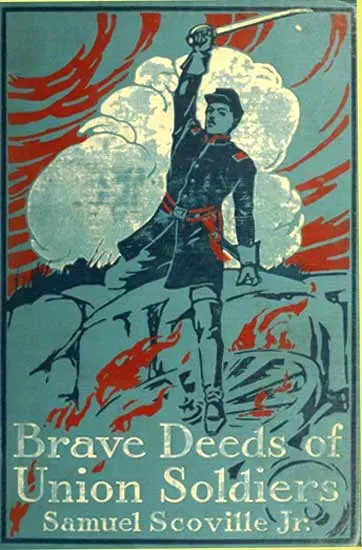
"Brave Deeds of Union Soldiers" by Samuel Scoville, Jr. is a historical account written in the early 20th century. This work chronicles acts of bravery exhibited by Union soldiers during the American Civil War, celebrating both prominent figures and ordinary individuals who displayed remarkable courage in dire situations. The author aims to inspire readers by recounting tales of valor, suggesting that heroism can emerge from anyone, regardless of status. The opening of the book introduces the concept of bravery through an account of a lesser-known confrontation during the Civil War. It highlights a regiment that faced an entrenched enemy across a swollen river, where their commanding officer, Colonel Brownlow, persistently rallied his troops to take action despite insurmountable odds. The scene unfolds as the men stripped down and embarked on a daring assault across the river, ultimately catching their adversaries off guard and capturing a number of Confederate soldiers. This narrative captivates readers by emphasizing not just the strategic importance of their mission, but the personal sacrifices and grit demonstrated by even the most ordinary soldiers in extraordinary circumstances.
Introduction adapted from the source catalogue; source summaries may be automatically generated.
Free to read · English · 70,954 words · No account needed
MAKE TIME FOR A GOOD BOOK
On by default. Untick to stop anonymous reading totals. Each page counts after 10 seconds in view. How this works.
Anonymous counting is on unless you have switched it off.
Once again the Confederates concluded that he was on some secret mission. They insisted, however, on taking him to camp with them and there he stayed two days and nights, incidentally obtaining all the information possible as to the forces and the guard about the bridge. Just before dawn on the second morning, he managed to give them the slip and started across country, wading and swimming and toiling through one swamp after another until he finally reached the river bank, traveling only by night and sleeping by day. Along this bank he went for miles until finally he found concealed in a little creek a small rowboat which was tied to a tree and in which were two oars. He spent the better part of the day in loading this up with pine knots and bits of dry driftwood which he planned to use in firing the bridge. Just at evening he pushed off into the middle of the river and started again down for the bridge. He had found by his inquiries that the Confederate camp was located on a bank some distance from the bridge, as no one expected any attack there so far within the Confederate lines. All night long he tugged at the oars and aided by the current reached the bridge about three o'clock in the morning. The bridge was an old-fashioned one erected on three piers. Pike made a careful survey of the whole length of the bridge from the river and found it absolutely unguarded although he could hear the sentry call on the hill a quarter of a mile away where the troops were encamped by the town. Concealing his skiff under an overhanging tree, he toiled up to the bridge with armful after armful of fire-wood. At each end and in the middle he made a little heap of fat-wood and pine knots with a strip of birch-bark, which burns like oiled paper, underneath each. Starting from the far end, he lit the first two piles and by the time he had crossed and was working on the last, he could hear the flames roaring behind him as they caught the dry weather-beaten planking of the bridge. And now he made a mistake which was to prove well-nigh fatal to him. As soon as the fire had obtained a headway, he should have instantly stolen back up the river in his skiff. In his anxiety to make a thorough job of it he stayed too long, forgetting that in the bright light of the fire every motion he made would be plainly visible from the hilltop. Suddenly he heard the alarm given from the camp and almost instantly it was followed by the wail of a minie ball as the sentry above fired down upon him. By this time the river was as bright as day for a quarter of a mile on both sides of the bridge. Near the Confederate camp were a number of boats and Pike was already nearly exhausted by his long row and his work in firing the bridge. He heard the shouts of men as they dashed down for their boats. If he attempted to escape by water he was certain to be overtaken. Another bullet close to his head decided him and he dashed down from the bridge into the road, and plunged into the thick woods on the farther side. All the rest of that night and through the first part of the next day he traveled, following one path after another and keeping his general direction by a pocket compass. By noon he was so tired that if it had been to save his life he could not have gone any farther. The little stock of provisions which he had carried with him had been exhausted the night before and he threw himself on a bed of dry pine-needles under a long-leafed pine which stood on the top of a little knoll and lay there for nearly an hour until part of his strength came back. The first thing to do was to find something to eat. Pike did not dare shoot anything with his revolver, even if there had been anything to shoot, for fear of attracting the attention of Confederate pursuers or bushwhackers. It was now that the corporal's wood-craft proved to be as valuable as his scout-craft. If he were to go further, he must have food and he commenced to wander back and forth through the woods, his quick eye taking in everything on the ground or among the trees. On the other side of the knoll where he had been lying, he noticed a rotten log where the dry, punky wood had been scattered as if a hen had been scratching there. Pike commenced to look carefully all along the ground and finally just on the edge of the slope where the thick underbrush began, he nearly stepped on a large brown speckled bird so much the color of the leaves that if he had not been looking for it, he never would have discovered the nest. The bird slipped into the underbrush like a shadow, leaving behind fifteen brown, mottled partridge eggs. The corporal sat down over the nest and gulped down, one after the other, those eggs, warm from the breast of the brooding bird. As he said afterward, never had he tasted anything half so good. This was a step in the right direction, but even fifteen partridge eggs are not enough for a man who hadn't eaten for nearly thirty hours. Once again he began to prowl restlessly through the woods and this time his attention was attracted by something growing on the side of a dead maple stub. It was dark red and looked like a great tongue sticking out from the bark. To his great joy, Pike recognized it at once as the beefsteak mushroom. It was a magnificent specimen which must have weighed nearly two pounds and as he pulled it off from the tree, red drops oozed out and it looked and smelled like a big, fresh beefsteak. The corporal went down the hollow into the thickest part of the swamp and there picked an armful of perfectly dry cedar and scrub-oak twigs which burn with a clear, smokeless flame. Out of these he built a little Indian cooking fire by arranging the twigs into the form of a little tepee so that a jet of clear flame came up with hardly a sign of any smoke. It was the work of only a moment to whittle and set up a forked stick and to fasten a slab of that meaty-looking fungus on a spit fixed in the fork. Fortunately he had left in his haversack a little salt and pepper with which he seasoned the broiling, hissing steak. In about ten minutes it was done to a turn. Cutting a long strip of bark from off one of the red river-birches which grew near, Pike squatted down on the ground and in fifteen minutes more there was nothing left of that savory, two-pound, broiled vegetable steak. With fifteen eggs and two pounds of beefsteak mushroom under his belt, the corporal felt like another man. He coiled himself up on the dry pine-needles in a little hollow which he found under the low-hanging boughs of a long-leaf pine and resolved to take a sleep to make up for what he had lost during the last two nights. It was early afternoon and everything was still and hot and the drowsy scent of the pine mingled with puffs of spicy fragrance from the great white blossoms of the magnolia with which the woods were starred. As he fell asleep the last thing the corporal heard was the drowsy call of flocks of golden-winged warblers on their way north. How long he slept he could not tell. He only knew that he awoke with a sudden consciousness of danger, that strange sixth sense which most Indians and a few white hunters sometimes develop. Perhaps he inherited it from old Zebulon Pike who, like Daniel Boone and Kit Carson, had the power of hearing and sensing the approach of an enemy even in their soundest sleep. The corporal was alert the second he opened his eyes, but made not a movement or a rustle. The sun was well down in the sky and there was nothing in sight, but the birds had stopped singing. Finally way down through the little tunnel which a near-by flowing stream had made through the hillocks came a sound which brought him to his feet in an instant. It was a ringing note that chimed like a distant bell. Three times it sounded and there was silence, then again three times, but a little nearer and louder, then again silence. A third time it came and this time it seemed around the bend of the bayou not half a mile away. Pike knew in a minute what it was. It was the bay of the dreaded bloodhounds, those man-hunters who had learned to trail their prey through forest and fen, no matter how much he doubled nor how fast he ran. There was but one thing to do if there was time. Springing up, the corporal ran down to the little stream and leaped in. It was hardly up to his knees, but he splashed along for a hundred yards, now and then plunging in up to his waist. It ran a hundred yards or so through the swamp and then emptied into a larger bayou. Along this Pike swam for his life as silently as a muskrat, for now he could hear the baying of the dogs close at hand and suddenly there was a chorus of deep raging barks followed by shouts and he knew that his pursuers had found his lair under the pine trees. Soon the stream ran into another one and then another until Pike had swam and waded and plunged through half a score of brooks which made a regular network through the middle of the swamp. By this time the sound of the dogs had died far away in the distance and he had every reason to believe that he had thrown them off the track. Down the last stream there was a deep, sluggish creek nearly fifty feet wide. He swam until he could go no farther. It opened out into a series of swampy meadows and to his joy he saw in the very midst of the swamp through which it ran a pile of newly-split rails. Swimming over to this he found that they had been piled on a little island about five feet above the level of the swamp and surrounded on all sides by masses of underbrush and deep sluggish water. By this time it was nearly sunset and he resolved to crawl up here and find a dry place and spend the night on this island, which could not be approached except by boat. As he climbed up to the top of the mass of rails, he heard a low, thick hiss close to his face and outstretched hand. He had never heard the sound before, but no man born needs to be taught the voice of the serpent. He started back just in time. Coiled on one of the rails was a great cotton-mouth moccasin whose bloated swollen body must have been nearly five feet in length and as big around as his arm. The great creature slowly opened its mouth, showing the pure white lining which has given it the name and hissed again menacingly. The corporal was in a predicament. Behind him was the cold, dark river in which he no longer had the strength to swim. In the approaching darkness, he might not be able to find any other island of refuge on which to pass the night. There was nothing for him but to fight the grim snake for the possession of the rails. He dropped back and twisted off the thick branch of a near-by willow-tree and began again to climb up toward the snake cautiously, but as rapidly as possible, for the light was beginning to die out in the sky and Pike preferred not to do his fighting in the dark in this case if possible. As he reached the top of the pile, the king of the island was ready for him and struck viciously at him as he approached. The movable poison fangs protruded like poisoned spear-heads from the wide-open mouth and from them could be seen oozing the yellow drops of the fatal venom which makes the cotton-mouth more dreaded even than the rattler or the copperhead. The fatal head flashed out not six inches from Corporal Pike's face, but it had miscalculated the distance and before it could again coil, he had struck with all his might at the monstrous body just where it joined the heart-shaped head. Fortunately for him, his aim was good and the crippled snake writhed and hissed and struck in vain in a horrible mass at Pike's feet. Two more blows made it harmless and inserting the stick under the heavy body, the corporal heaved it far over into the water and it floated away. Pike then made a careful examination of the rails and the island on which he stood so as to make sure that the moccasin had not left any of his family behind. He found no others, however, and before it was dark the corporal moved the rails and piled them around him in a kind of barricade which shut him off from view from the water and shore and which he sincerely hoped would discourage the visits of any more moccasins. Inside of this he laid three rails lengthwise and wrung out his sodden coat and coiled up for the night on his hard bed. He woke up surrounded by the gleaming mist of the early morning and shaking with the cold after sleeping all night in his soaked clothing. As he was too cold to sleep and it was light enough now to see, he decided to start off for dry land again. For over two hours he swam and waded along big and little bayous until, just as the sun was getting up, he came out through the morass and found himself at the rear of a lonely plantation. Just in front of him an old negro was at work hoeing in a field. The corporal crept up near him through the bushes and looked all around cautiously to see whether there were any white men in sight. Seeing none, he decided to take a chance on the negro being friendly.
Your reading position is saved on this browser. Take it to another device with a library code. Reading pages adapt to text, rather than matching a printed edition.
William Constantine Beecher & H. W., Mrs. Beecher & Samuel Scoville
Samuel Scoville
Samuel Scoville
BEHIND THE BOOK
This eBook is for the use of anyone anywhere in the United States and most other parts of the world at no cost and with almost no restrictions whatsoever. You may copy it, give it away or re-use it under the terms of the Project Gutenberg License included with this eBook or online at www.gutenberg.org. If you are not located in the United States, you will have to check the laws of the country where you are located before using this eBook. Read the source licence.
The original source file, including credits and licence, is retained by this library. Request an original-format copy at no charge. Please include the book title and Project Gutenberg identifier #41036.
KEEP YOUR CURIOSITY GOING
Cécile Tormay

Moritz Busch
John L. Ransom
Frances Wright
Cécile Tormay

Mabel Potter Daggett