A Biography of Rev. Henry Ward Beecher
William Constantine Beecher & H. W., Mrs. Beecher & Samuel Scoville
THE CLASSIC COLLECTION · 1915
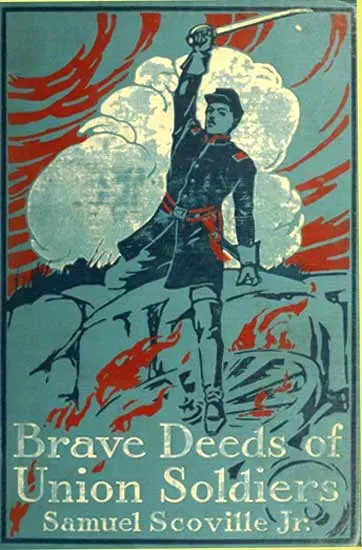
"Brave Deeds of Union Soldiers" by Samuel Scoville, Jr. is a historical account written in the early 20th century. This work chronicles acts of bravery exhibited by Union soldiers during the American Civil War, celebrating both prominent figures and ordinary individuals who displayed remarkable courage in dire situations. The author aims to inspire readers by recounting tales of valor, suggesting that heroism can emerge from anyone, regardless of status. The opening of the book introduces the concept of bravery through an account of a lesser-known confrontation during the Civil War. It highlights a regiment that faced an entrenched enemy across a swollen river, where their commanding officer, Colonel Brownlow, persistently rallied his troops to take action despite insurmountable odds. The scene unfolds as the men stripped down and embarked on a daring assault across the river, ultimately catching their adversaries off guard and capturing a number of Confederate soldiers. This narrative captivates readers by emphasizing not just the strategic importance of their mission, but the personal sacrifices and grit demonstrated by even the most ordinary soldiers in extraordinary circumstances.
Introduction adapted from the source catalogue; source summaries may be automatically generated.
Free to read · English · 70,954 words · No account needed
MAKE TIME FOR A GOOD BOOK
On by default. Untick to stop anonymous reading totals. Each page counts after 10 seconds in view. How this works.
Anonymous counting is on unless you have switched it off.
It was their whistle which so startled Andrews and his men when they were breaking the second rail. Fuller and Murphy saw what they had done and managed to reverse the engine in time to prevent a wreck. Again at this point ordinary men would have given up the chase for it was impossible to go farther in that engine or to get it over the broken rail, but these Confederates were not ordinary men. Leaving their escort they started down the track again on foot alone, doggedly and relentlessly after their stolen General. Before they had gone far they met the mixed train that had told Andrews of the express. They signaled so frantically that it stopped and when the crew learned that the so-called "powder-train" was on its way to destroy the great bridges which formed the backbone of their railway, they consented to turn back. So uncoupling the locomotive and the tender and filling them with armed soldiers and civilians from among the passengers, Fuller and Murphy made their sixth start. On foot, by hand-car, in two locomotives, on foot again and now once more in a locomotive, they began what was to be the last lap of this race on which a city and a state depended.
Beyond Adairsville the Confederates could see far ahead in the distance Andrews and his men making desperate efforts to raise the rail. With long screams from her whistle, the Confederate engine fairly leaped over the tracks. The rail bent slowly, but the spikes still held. Two minutes, or even a minute more would break the track and the road and bridges would be defenseless before the Union raiders. But it was not to be. Andrews and his men tugged at the stubborn rail until the pursuing engine was so close that the bullets were dropping all around them and then sprang into the engine and thundered off again. If only a little time could be gained the Union men could burn the Oostinaula Bridge. So while the engine was running at a speed of nearly a mile a minute, the men in the last car crowded into the next and the last car was dropped off in the hope that it would block the road for the pursuer. But the engine behind pushed it ahead until the next station was reached where it could be switched off the main track. This slowed the chaser's speed, however, so that the General was able to take on wood and water and also to cut the wires beyond the station so that the news of their coming would not be telegraphed ahead and give the station-master a chance to either side-track them or block the track. The pursuing engine began to gain again and the little band of Union soldiers moved into the first car and the end of the second car was smashed and it was cut loose. Railroad ties were also dropped across the track and time enough was gained once more for the General to take on wood and water at two more stations and to cut the wires beyond each. Twice they stopped and tried in vain to raise a rail, but the pursuers came within rifle range each time before they could finish. The rain prevented the burning of the bridges and now slowly and surely the pursuing engine began to gain. The raiders tried every way to block the track. At one point they spied a spare rail near a sharp curve. Stopping the engine they fitted it into the track in such a way that it seemed certain to derail the Confederate engine. The latter came thundering on at full speed, struck the hidden rail, and leaped at least six inches from the rail, but came down safely and went whirling along as if nothing had happened. Not once in a hundred times could an engine have kept the track after such a collision. This was the time. Now they were too close to the General to allow of any more stoppages even for wood and water. Andrews decided to risk everything on one last stroke. A mile or so ahead was a wooden-covered bridge. At his orders out of the last car his men swarmed into the engine filling every inch of space, even the tender and the cow-catcher being covered with men. All of the fuel left was piled into the one remaining car, smeared with oil and set afire. Both the doors were opened and the draught as it was whirled along soon fanned the fire into furious flames. They dashed into the dark of the covered bridge with the car spurting flame from both sides. Right in the middle of the bridge it was uncoupled and left burning fast and furiously. It did not seem possible that any engine could pass through such a barrier. There was just enough pressure left in the boiler to reach the next wood-yard and the Union scouts looked back anxiously at the bridge. In a minute they heard around a far-away curve the whistle which sounded to them like the screech of a demon. The Confederates had dashed into the bridge and pushed the flaming car ahead of them to the next switch. The Union scouts had played their last card. There would be no chance of taking in wood before they were overtaken. One thing only was left. They stopped the engine, sprang out, reversed the locomotive and sent it dashing back to collide with their pursuer and then separated to try to make their way back some three hundred miles through the enemy's country to the Union lines. The Confederates, when they saw the engine coming, reversed their own and kept just ahead of this last attack of the old General until its fires died down and it came to a stop.
Your reading position is saved on this browser. Take it to another device with a library code. Reading pages adapt to text, rather than matching a printed edition.
William Constantine Beecher & H. W., Mrs. Beecher & Samuel Scoville
Samuel Scoville
Samuel Scoville
BEHIND THE BOOK
This eBook is for the use of anyone anywhere in the United States and most other parts of the world at no cost and with almost no restrictions whatsoever. You may copy it, give it away or re-use it under the terms of the Project Gutenberg License included with this eBook or online at www.gutenberg.org. If you are not located in the United States, you will have to check the laws of the country where you are located before using this eBook. Read the source licence.
The original source file, including credits and licence, is retained by this library. Request an original-format copy at no charge. Please include the book title and Project Gutenberg identifier #41036.
KEEP YOUR CURIOSITY GOING
Cécile Tormay

Moritz Busch
John L. Ransom
Frances Wright
Cécile Tormay

Mabel Potter Daggett