A Biography of Rev. Henry Ward Beecher
William Constantine Beecher & H. W., Mrs. Beecher & Samuel Scoville
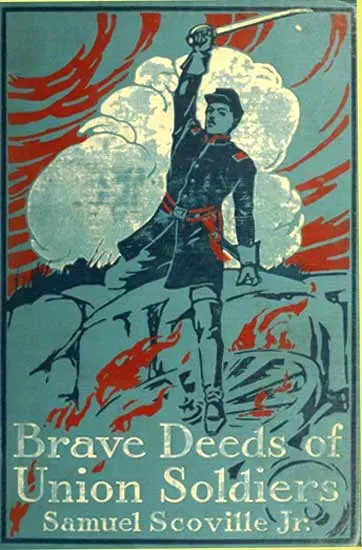
THE CLASSIC COLLECTION · 1915
"Brave Deeds of Union Soldiers" by Samuel Scoville, Jr. is a historical account written in the early 20th century. This work chronicles acts of bravery exhibited by Union soldiers during the American Civil War, celebrating both prominent figures and ordinary individuals who displayed remarkable courage in dire situations. The author aims to inspire readers by recounting tales of valor, suggesting that heroism can emerge from anyone, regardless of status. The opening of the book introduces the concept of bravery through an account of a lesser-known confrontation during the Civil War. It highlights a regiment that faced an entrenched enemy across a swollen river, where their commanding officer, Colonel Brownlow, persistently rallied his troops to take action despite insurmountable odds. The scene unfolds as the men stripped down and embarked on a daring assault across the river, ultimately catching their adversaries off guard and capturing a number of Confederate soldiers. This narrative captivates readers by emphasizing not just the strategic importance of their mission, but the personal sacrifices and grit demonstrated by even the most ordinary soldiers in extraordinary circumstances.
Introduction adapted from the source catalogue; source summaries may be automatically generated.
Free to read · English · 70,954 words · No account needed
MAKE TIME FOR A GOOD BOOK
On by default. Untick to stop anonymous reading totals. Each page counts after 10 seconds in view. How this works.
Anonymous counting is on unless you have switched it off.
On June 30, 1862, was fought the stubborn battle of Glendale, one of the Seven Days' Battles between McClellan, the general of the Union forces, and Lee, the Confederate commander. This battle was part of McClellan's campaign against Richmond, the capital of the Confederacy which he had within his grasp when he was out-generaled by Lee, who that month for the first time had been placed in supreme command of the Confederate Army. With him were his two great generals, Stonewall Jackson and Longstreet. McClellan was within sight of the promised land. The spires of Richmond showed against the sky. Instead of fighting he hesitated and procrastinated away every chance of victory. Lee was even then planning that wonderful strategy which was to halt a victorious army, turn it away from the beleaguered capital of the Confederacy and send it stumbling back North in a series of defeats. It was necessary for him to have a conference with Stonewall Jackson, his great fighting right-hand in military matters. Jackson rode almost alone fifty miles and attended a conference with Lee, Longstreet and Generals D. H. and A. P. Hill. To each of them General Lee assigned the part that he was to play. In the meantime, knowing that McClellan always read and pondered the Richmond papers, he arranged that simultaneously every paper should publish as news the pretended facts that strong reinforcements had been sent to the Shenandoah Valley. McClellan fell into the trap and instead of pressing forward to attack Richmond, which was now only guarded by a small force, he, as usual, waited for reinforcements and allowed his antagonists to march around him and start flanking battles which threatened to cut off his line of communications. The battle of Gaines Mill was fought in which battle General Fitz John Porter with thirty-one thousand men stubbornly faced Lee and Jackson's forces of fifty-five thousand and with sullen obstinacy only retreated when it was absolutely impossible longer to hold his ground. This defeat, which occurred simply because McClellan could not bring himself to send Porter the necessary reinforcements, made General McClellan resolve to withdraw, although even then, with a superior army, he could have fought his way to Richmond. From June 25th to July 1, 1862, occurred the Seven Days' Battles fought by the retreating Union Army. By one of the few mistakes which General Lee made in that campaign, the Union Army was allowed a respite of twenty-four hours to organize its retreat and were well on their way before pursuit was given. On June 29th there was a battle between the rear guard of the Union force and the Confederate's under General Magruder in which the Confederates were defeated. The next day came the battle of Glendale. Generals Longstreet and A. P. Hill commanded the Confederate Army while the rear guard of the retreating Union forces was made up of General McCall's division and that of General Heintzelman and a part of the corps under General Sumner which had done such gallant fighting the day before. It was a stern and stubborn battle. If the Confederates could cut through the rear guard, they would have the retreating army at their mercy. On the other hand, if they could be held back, the main army would have time to occupy a favorable position and entrench and could be saved. For a time it seemed as if the Confederate attack could not be checked. Every available man was called into action. Back at the rear were posted the hospital corps where the sick and wounded lay. With them were stationed the band and the drum-corps made up of drummer boys who were supposed to keep out of actual fighting as much as possible. Among them was a little Jewish boy named Benjamin Levy, who was only sixteen years old and small for his age. Benjamin stayed back with the hospital while the roar of the battle grew louder and louder. Finally there was a tremendous chorus of yells and groans and shouts mingled with the rattle of rifle-shots and the heavy thudding sounds which sabres and bayonets make as they slash and pierce living flesh. Little groups of wounded men came straggling back or were carried back to the hospital and each one told a fresh story of the fierce fight which was going on at the near-by front. Benjamin could stand it no longer. The last wounded man that came in hobbled along with a broken leg, using his rifle for a crutch. The boy helped him to a near-by cot and made him as comfortable as he could.
Your reading position is saved on this browser. Take it to another device with a library code. Reading pages adapt to text, rather than matching a printed edition.
William Constantine Beecher & H. W., Mrs. Beecher & Samuel Scoville
Samuel Scoville
Samuel Scoville
BEHIND THE BOOK
This eBook is for the use of anyone anywhere in the United States and most other parts of the world at no cost and with almost no restrictions whatsoever. You may copy it, give it away or re-use it under the terms of the Project Gutenberg License included with this eBook or online at www.gutenberg.org. If you are not located in the United States, you will have to check the laws of the country where you are located before using this eBook. Read the source licence.
The original source file, including credits and licence, is retained by this library. Request an original-format copy at no charge. Please include the book title and Project Gutenberg identifier #41036.
KEEP YOUR CURIOSITY GOING
Cécile Tormay

Moritz Busch
John L. Ransom
Frances Wright
Cécile Tormay

Mabel Potter Daggett