A Biography of Rev. Henry Ward Beecher
William Constantine Beecher & H. W., Mrs. Beecher & Samuel Scoville
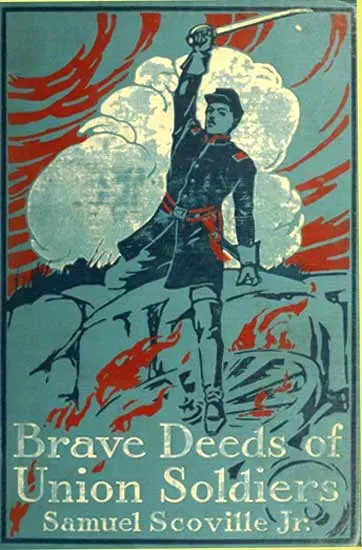
THE CLASSIC COLLECTION · 1915
"Brave Deeds of Union Soldiers" by Samuel Scoville, Jr. is a historical account written in the early 20th century. This work chronicles acts of bravery exhibited by Union soldiers during the American Civil War, celebrating both prominent figures and ordinary individuals who displayed remarkable courage in dire situations. The author aims to inspire readers by recounting tales of valor, suggesting that heroism can emerge from anyone, regardless of status. The opening of the book introduces the concept of bravery through an account of a lesser-known confrontation during the Civil War. It highlights a regiment that faced an entrenched enemy across a swollen river, where their commanding officer, Colonel Brownlow, persistently rallied his troops to take action despite insurmountable odds. The scene unfolds as the men stripped down and embarked on a daring assault across the river, ultimately catching their adversaries off guard and capturing a number of Confederate soldiers. This narrative captivates readers by emphasizing not just the strategic importance of their mission, but the personal sacrifices and grit demonstrated by even the most ordinary soldiers in extraordinary circumstances.
Introduction adapted from the source catalogue; source summaries may be automatically generated.
Free to read · English · 70,954 words · No account needed
MAKE TIME FOR A GOOD BOOK
On by default. Untick to stop anonymous reading totals. Each page counts after 10 seconds in view. How this works.
Anonymous counting is on unless you have switched it off.
He reached back for the Springfield rifle which he had dropped when first struck and fitting it carefully to his right shoulder, fired a well-aimed shot at a Confederate gunner who was serving one of the cannons on the breastworks. As the man toppled over the corporal smiled grimly and in spite of offers of help from all sides, loaded and fired his gun twice again. By this time the fire had died down and the corporal suddenly sprang to his feet and started for the breastworks.
"Hurry up, fellows," he shouted to his men; "don't let a one-armed man
do all the work."
With a tremendous cheer the whole force sprang again to their feet and swarmed over the ramparts in a rush which there was no stopping. James was right with them, two of his men hoisting and pushing him up, for he found that although he could shoot, it was more difficult to climb with one arm. As the last Confederates who were left surrendered, James sat down against one of the captured cannon and smiled wanly at the man who had helped him and said:
"Now I'll take a rest and later on I'll go to the rear with you if you
like."
This he did and a regular surgeon completed an operation which he said had, under the circumstances, been most efficiently performed. Corporal James always said that the medal of honor which the government gave him was worth far more than the arm which he gave the government.
In the days of David there came a great famine. Year after year the crops failed and the people starved. At last the priests and soothsayers told David that this doom had fallen upon the nation because of a broken oath. Many centuries before Joshua, one of the great generals of the world, was fighting his way into the Promised Land. He was contending with huge black giant tribes like the Anakim, and against blue-eyed Amorite mountaineers with their war-chariots of iron, whose five kings he was to utterly destroy on that great day when he said in the sight of the host of Israel, "Sun, stand thou still upon Gibeon and thou Moon in the valley of Ajalon," and the sun stood still and the moon stayed until the people had revenged themselves upon their enemies. He had captured the fortified city of Jericho and had razed it to the ground and laid that terrible curse which was afterward fulfilled on the man who should again lay the foundation and rebuild the city. He had destroyed the city of Ai, little but inhabited by fierce fighters who had hurled back even the numberless hordes of Israel. The terror and the dread of the invaders had spread through the length and breadth of the land. On the slopes of Mount Hermon lived the Hivites. They were not great in war, but like the men of Tyre they asked to be let alone to carry on the trade and commerce in which they were so expert. Not far away from Ai was their chief city of Gibeon and the elders of that city planned to obtain from Joshua safety by stratagem. They sent embassadors whose skin bottles were old and rent and bound up and whose shoes were worn through and clouted and whose garments were old and worn and their provision dry and mouldy. These came to Joshua pretending to be embassadors from a far country who desired to make a league with them. Not knowing that their city was in the very path of his march, Joshua and the princes of the congregation made peace with them. Later on they found that they had been deceived, but the word of the nation had been passed and the sworn peace could not be broken. So it happened from that day that the Gibeonites became hewers of wood and drawers of water for the congregation and lived in peace with the Israelites under their sworn protection. The centuries passed and at last Saul, the first king of Israel, began his reign. In spite of the oath of his forefathers, he slew the Gibeonites and sought to root them out of the land. It was this broken oath that had brought upon the nation the years of famine and suffering. Under the advice of their priests David sent for the remnants of the Gibeonites and asked them what atonement could be made for the cruel and treacherous deed of King Saul who had long been dead, but whose sin lived on after him. The Gibeonites said that they would have no silver or gold of Saul or of his house, but demanded that seven men of the race of Saul be delivered unto them. It was done and they hung these seven prisoners as a vengeance on the bloody house of Saul. Two of them were the sons of Rizpah whom she bore unto Saul, the king. When they were hanged, she took sackcloth and spread it on the rocks and guarded those bodies night and day and suffered neither the birds of the air to rest upon them by day or the beasts of the field by night. Sleeplessly she guarded all that was left of her sons until the news of her faithfulness was brought to David, who gave back to her the bodies for burial and for the last rites of sepulchre and sanctuary which mean so much to all believers.
Your reading position is saved on this browser. Take it to another device with a library code. Reading pages adapt to text, rather than matching a printed edition.
William Constantine Beecher & H. W., Mrs. Beecher & Samuel Scoville
Samuel Scoville

Samuel Scoville
BEHIND THE BOOK
This eBook is for the use of anyone anywhere in the United States and most other parts of the world at no cost and with almost no restrictions whatsoever. You may copy it, give it away or re-use it under the terms of the Project Gutenberg License included with this eBook or online at www.gutenberg.org. If you are not located in the United States, you will have to check the laws of the country where you are located before using this eBook. Read the source licence.
The original source file, including credits and licence, is retained by this library. Request an original-format copy at no charge. Please include the book title and Project Gutenberg identifier #41036.
KEEP YOUR CURIOSITY GOING
Cécile Tormay

Moritz Busch
John L. Ransom
Frances Wright
Cécile Tormay

Mabel Potter Daggett