A Biography of Rev. Henry Ward Beecher
William Constantine Beecher & H. W., Mrs. Beecher & Samuel Scoville
THE CLASSIC COLLECTION · 1915
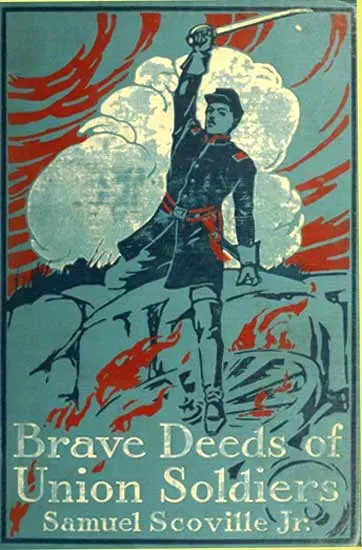
"Brave Deeds of Union Soldiers" by Samuel Scoville, Jr. is a historical account written in the early 20th century. This work chronicles acts of bravery exhibited by Union soldiers during the American Civil War, celebrating both prominent figures and ordinary individuals who displayed remarkable courage in dire situations. The author aims to inspire readers by recounting tales of valor, suggesting that heroism can emerge from anyone, regardless of status. The opening of the book introduces the concept of bravery through an account of a lesser-known confrontation during the Civil War. It highlights a regiment that faced an entrenched enemy across a swollen river, where their commanding officer, Colonel Brownlow, persistently rallied his troops to take action despite insurmountable odds. The scene unfolds as the men stripped down and embarked on a daring assault across the river, ultimately catching their adversaries off guard and capturing a number of Confederate soldiers. This narrative captivates readers by emphasizing not just the strategic importance of their mission, but the personal sacrifices and grit demonstrated by even the most ordinary soldiers in extraordinary circumstances.
Introduction adapted from the source catalogue; source summaries may be automatically generated.
Free to read · English · 70,954 words · No account needed
MAKE TIME FOR A GOOD BOOK
On by default. Untick to stop anonymous reading totals. Each page counts after 10 seconds in view. How this works.
Anonymous counting is on unless you have switched it off.
Eugene M. Tinkham, of the 148th New York Infantry, was in that corps directly under the eye of Grant himself which attacked and attacked the Confederate position throughout that bloody morning, only to be driven back each time with tremendous losses. The 148th Infantry, in which Tinkham was a corporal, charged right up to the very mouth of the guns. Flesh and blood could not stand, however, against the volleys of grape and canister which ripped bloody, struggling lanes right through the masses of the charging men. As the corps of which Tinkham's regiment was a part was stopped by the wall of dead and wounded men piled up in front of them, the Confederates with a fierce Rebel yell charged over the breastworks on the confused attackers. For a minute the New York regiment held its own, but were finally slowly forced back fighting every foot to the shelter of their own rifle-pits. There they made a stand and the Confederate sally stopped and the men in gray dashed back to their own fortifications. In this charge, Tinkham received a bayonet wound through his left shoulder while a jagged piece of canister had ripped through his left arm. Not until he found himself back in the rifle-pit, however, did he even know that he was wounded. His bayonet and the barrel of his rifle were red clear up to the stock and he did not at first realize that the blood dripping from his left sleeve was his own. It was only as he lay on the dry sand and saw the red stain beside him grow larger and larger that he realized that he was hurt. One of the few men who had returned with him stripped off his coat, cut away the sleeve of his shirt and made a couple of rough bandages and extemporized a rude tourniquet from the splinters of one of the wheels of a battered field-piece which had flown into the pit. When that was over, Tinkham lay back and shut his eyes and felt the weakness which comes over a man who has lost much blood. To-day there was not the tonic of victory which sometimes keeps even wounded men up. He had seen his comrades, men with whom he had eaten and slept and fought for over two years, thrown away, as it seemed to him, uselessly. He was yet to learn, what the army learned first and the country last, that Grant was big enough and far-sighted enough to know that some victories must be wrought from failure as well as success. This was one of the hammer-strokes which seemed to bound back from the enemy's armor without leaving a mark, yet the impact weakened Lee even when it seemed that he was most impervious to it. It was absolutely necessary to Grant's far-reaching plans that Lee be fought on every possible occasion. Whether he won or lost, Grant's only hope lay on keeping Lee on the defensive. None of this, of course, could a wounded corporal in a battered, beaten and defeated regiment realize. All he knew was that his friends were gone, that he was wounded and, worst of all, had been forced to again and again retreat. He shut his eyes and there was a sound in his ears like the tolling of a great bell. It seemed to swell and rise until it drowned even the rattle and roar of the battle which was still going on. When Tinkham opened his eyes everything seemed to waver and quiver before him. Suddenly there came a short, thin, wailing sound which cut like a knife through the midst of the unconsciousness which was stealing over him. It was the cries of two wounded men lying far out in the field over which he had come. Tinkham raised his hand and strained his eyes. He could recognize two of his own file, men who a moment before had been by his side and who now lay moaning their lives away out on that shell-swept field. Tinkham listened to it as long as he could. Then he set his teeth, scrambled to his feet and in spite of his comrades who thought that he was delirious, climbed stiffly over the edge of the rifle-pit and began to creep out between the lines toward the wounded men. At first every motion was an agony. He was weakened by the loss of blood and he could bear no weight on his left arm, yet there was such a fatal storm of bullets and grape-shot whizzing over him that he knew that, if he rose to his feet, there would be little chance of his ever reaching his friends alive. Slowly and doggedly he sidled along like a disabled crab. Sometimes he would have to stop and rest. Many times bullets whizzed close to him and cut the turf all around where he lay. As soon as he had rested a few seconds, he would fix his eye on some little tuft of grass or stone or weed and make up his mind that he would crawl until he reached that before he rested again. It was a long journey before he reached his goal. On the way he had taken three full canteens of water from silent figures which would never need them more. When at last he reached the men, they recognized him and the tears ran down their faces as they called his name.
Your reading position is saved on this browser. Take it to another device with a library code. Reading pages adapt to text, rather than matching a printed edition.
William Constantine Beecher & H. W., Mrs. Beecher & Samuel Scoville
Samuel Scoville
Samuel Scoville
BEHIND THE BOOK
This eBook is for the use of anyone anywhere in the United States and most other parts of the world at no cost and with almost no restrictions whatsoever. You may copy it, give it away or re-use it under the terms of the Project Gutenberg License included with this eBook or online at www.gutenberg.org. If you are not located in the United States, you will have to check the laws of the country where you are located before using this eBook. Read the source licence.
The original source file, including credits and licence, is retained by this library. Request an original-format copy at no charge. Please include the book title and Project Gutenberg identifier #41036.
KEEP YOUR CURIOSITY GOING
Cécile Tormay

Moritz Busch
John L. Ransom
Frances Wright
Cécile Tormay

Mabel Potter Daggett