A Biography of Rev. Henry Ward Beecher
William Constantine Beecher & H. W., Mrs. Beecher & Samuel Scoville
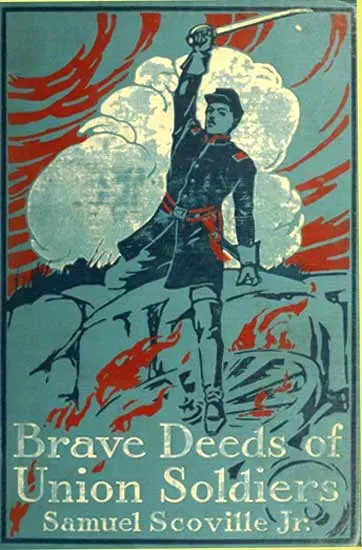
THE CLASSIC COLLECTION · 1915
"Brave Deeds of Union Soldiers" by Samuel Scoville, Jr. is a historical account written in the early 20th century. This work chronicles acts of bravery exhibited by Union soldiers during the American Civil War, celebrating both prominent figures and ordinary individuals who displayed remarkable courage in dire situations. The author aims to inspire readers by recounting tales of valor, suggesting that heroism can emerge from anyone, regardless of status. The opening of the book introduces the concept of bravery through an account of a lesser-known confrontation during the Civil War. It highlights a regiment that faced an entrenched enemy across a swollen river, where their commanding officer, Colonel Brownlow, persistently rallied his troops to take action despite insurmountable odds. The scene unfolds as the men stripped down and embarked on a daring assault across the river, ultimately catching their adversaries off guard and capturing a number of Confederate soldiers. This narrative captivates readers by emphasizing not just the strategic importance of their mission, but the personal sacrifices and grit demonstrated by even the most ordinary soldiers in extraordinary circumstances.
Introduction adapted from the source catalogue; source summaries may be automatically generated.
Free to read · English · 70,954 words · No account needed
MAKE TIME FOR A GOOD BOOK
On by default. Untick to stop anonymous reading totals. Each page counts after 10 seconds in view. How this works.
Anonymous counting is on unless you have switched it off.
He seemed to have voiced the exact sentiments of the other two who had sidled up and with out-stretched necks were examining in the faint light the curve around Double-Trouble. The last man spent no time in any argument.
"Good-bye, General," he called in a low voice. "Go as far as you
like--but go without me."
That was the last Morford and the other six ever saw of those men. They reached home in safety after some days of wandering, but decided to choose another territory where the scouting would not be quite so strenuous. Morford and his men made themselves comfortable that night. They drank deep from the spring and then had a much-needed scrub. After a hearty meal they turned in and slept like dead men through the next day on the crisp springy moss, first rolling a big boulder against the side of Double-Trouble so that no one could pass.
Late the next afternoon they awoke and found that the path was not so bad the second time as it had been the first. Down the mountainside by the same concealed route they marched in single file and just at dark crossed the river and entered the little village of Harrison. There they were met by an old man with whom Morford had previously communicated. He had obtained by strategy the countersign which would take them through the soldiers, the guards and to the very entrance of the jail itself. Curiously enough, some Confederate officer had fixed as the countersign that very one with which Gideon had conquered so many years ago. "The Sword of Gideon" was the open sesame which would take them past the guards and unlock the gates which ringed about the doomed men. Morford accepted it as a good omen. The night before he had told his companions the old story of Gideon's test and it came to them all as a direct message that God was fighting on their side as he had fought of old against even greater odds. Morford planned to use Gideon's tactics. He decided to surprise and confuse his enemy and escape in the confusion. He tied the hands of two of his band behind their backs and with the other four marched directly to the Confederate camp, gave the countersign, and stated that he had prisoners to deliver to the jail. The sleepy sentry passed him through without any comment and they marched until they came to the high board fence with a double row of spikes on top which surrounded the prison-yard. This fence at one point touched the edge of a marsh filled with rank grass, briars and tussocks. To this point Morford had gone earlier in the evening and had bored two auger-holes in one of the boards and then with a small saw dipped in oil had carefully sawed out one of the old timbers, leaving a space just large enough to admit of a man passing through. There was only one entrance to the prison grounds which was through the main gate besides which night and day sat two guards. Morford rang at this gate and when it was opened, presented himself with his pretended prisoners. One of the guards accompanied them to the main jail toward which Morford marched with his prisoners and two men, leaving the other two behind with the remaining guard. Morford had no more than passed around the corner when these two suddenly seized the unsuspecting guard at the gate, pressed a revolver against his temple and in an instant gagged him, tied him up hand and foot with rope which they had brought and started to the jail to assist the others. Usually the jail was only guarded by the jailer and one deputy or assistant who lived there with him. To-night, however, there was a death-watch of three extra men heavily armed stationed around in the corridor in front of the cells of the condemned men. The jailer opened the door and the sentry who had accompanied Morford from the gate explained that these were two prisoners coming under guard from Chattanooga, and Morford and his men were admitted. Every detail had been planned out ahead and the prisoners tottered into the corridor in an apparently exhausted condition and approached the guards who were waiting in front of the cells, or rather cages, in which were the condemned men. Suddenly just as the supposed prisoners came close, the ropes dropped off their hands and each of said hands grasped a particularly dangerous looking revolver which was aimed directly at the heads of the astonished guards.
Your reading position is saved on this browser. Take it to another device with a library code. Reading pages adapt to text, rather than matching a printed edition.
William Constantine Beecher & H. W., Mrs. Beecher & Samuel Scoville
Samuel Scoville
Samuel Scoville
BEHIND THE BOOK
This eBook is for the use of anyone anywhere in the United States and most other parts of the world at no cost and with almost no restrictions whatsoever. You may copy it, give it away or re-use it under the terms of the Project Gutenberg License included with this eBook or online at www.gutenberg.org. If you are not located in the United States, you will have to check the laws of the country where you are located before using this eBook. Read the source licence.
The original source file, including credits and licence, is retained by this library. Request an original-format copy at no charge. Please include the book title and Project Gutenberg identifier #41036.
KEEP YOUR CURIOSITY GOING
Cécile Tormay

Moritz Busch
John L. Ransom
Frances Wright
Cécile Tormay

Mabel Potter Daggett