READ · DISCOVER · ENJOYClassic literature · Always free
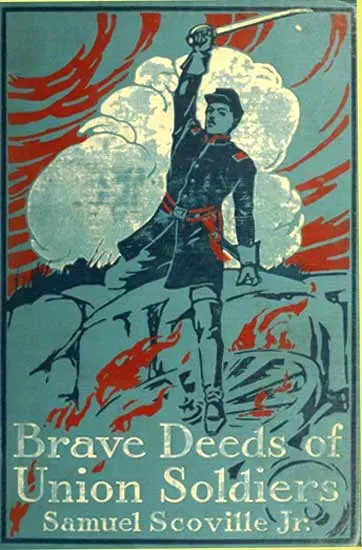
Brave Deeds of Union Soldiers — digital edition cover

THE CLASSIC COLLECTION · 1915

Brave Deeds of Union Soldiers

"Brave Deeds of Union Soldiers" by Samuel Scoville, Jr. is a historical account written in the early 20th century. This work chronicles acts of bravery exhibited by Union soldiers during the American Civil War, celebrating both prominent figures and ordinary individuals who displayed remarkable courage in dire situations. The author aims to inspire readers by recounting tales of valor, suggesting that heroism can emerge from anyone, regardless of status. The opening of the book introduces the concept of bravery through an account of a lesser-known confrontation during the Civil War. It highlights a regiment that faced an entrenched enemy across a swollen river, where their commanding officer, Colonel Brownlow, persistently rallied his troops to take action despite insurmountable odds. The scene unfolds as the men stripped down and embarked on a daring assault across the river, ultimately catching their adversaries off guard and capturing a number of Confederate soldiers. This narrative captivates readers by emphasizing not just the strategic importance of their mission, but the personal sacrifices and grit demonstrated by even the most ordinary soldiers in extraordinary circumstances.

Introduction adapted from the source catalogue; source summaries may be automatically generated.

Start reading ↓

Free to read · English · 70,954 words · No account needed

MAKE TIME FOR A GOOD BOOK

Brave Deeds of Union Soldiers

On by default. Untick to stop anonymous reading totals. Each page counts after 10 seconds in view. How this works.

Anonymous counting is on unless you have switched it off.

Brave Deeds of Union Soldiers

He turn'd him on the other side,
And at Lord Scroope his glove flung he--
"If ye like na my visit in merry England,
In fair Scotland come visit me!"

"All sore astonish'd stood Lord Scroope,
He stood as still as rock of stane;
He scarcely dared to trew his eyes,
When through the water they had gone.

"He is either himsell a devil fra hell,
Or else his mother a witch maun be;
I wadna have ridden that wan water,
For a' the gowd in Christentie."

The memory of that brave rescue nearly three hundred years before, as the scout afterward told his friends, was what inspired him to save his fellow-scouts as Buccleuch had saved the first William Kinmont. By saving the lives of these three men he would pay with interest for the life of his ancestor. Shakespeare writes somewhere that the good which men do is oft buried with their bones, but that their evil deeds live on forever. No more mistaken lines have ever been written. Evil brings about its own death. No good deed is ever forgotten or ever buried. Hundreds of years later it may flash out through the dust of centuries and light the path of high endeavor.

Morford scoured Chattanooga and finally found nine men who were ready to go with him and try to rescue the condemned scouts. Leaving Chattanooga they traveled by night and hid by day in caves and thickets among the mountains. Occasionally they would meet or get word from men whom they knew to be Union sympathizers. Finally they hid on the top of Bear Mountain which towered above the river and which separated them from Harrison where was located the jail. Although they had traveled fast and far they were only just in time. The second noon after the night when they reached the mountain had been fixed for the execution. On Bear Mountain they hid in a cave which Morford himself had discovered when hunting there many years before. It could only be reached by a narrow path which ran along a shelf of rock which jutted out over a precipice three hundred feet deep. The path turned sharply and led under an enormous overhanging ledge and ended in a deep cave with a little mountain spring bubbling up on a mossy slope only ten feet wide which led up to the cave's entrance. Inside was a dry, high cavern large enough to hold fifty men. It could not be reached from above by reason of the over-hanging ledge. At that point the path stopped and where the slope ended was a sheer drop to the rocks below which extended around the farther side of the slope so that the only entrance was around the path's bend along which only one man could pass at a time. Morford reached the foot of Bear Mountain just at sunset and led his little band up the steep side by a winding deer-path, the entrance to which was concealed in a tangled thicket of green briar and could only be reached by crawling underneath the sharp thorns like snakes. The path to the cave was no place for a man with weak nerves. It was bad enough as it skirted the precipice, but where it took a sharp bend around the jutting point of rock, it narrowed to nothing more than a foothold not three inches wide. He who would pass into the cave must turn with his back to the precipice and edge his way with arms outstretched along the smooth face of the rock for nearly ten feet. The point at the turn was the worst. There it was necessary to take one foot off the ledge and grope for a tiny foothold below the path while one shuffled around the curve. It was not absolutely necessary for Morford and his men to spend the night in this cave. There were other places where they could have stayed in safety, as no one suspected their presence. Morford, however, had made up his mind to choose his men with the utmost care. It was necessary in order to save the lives of the three condemned scouts to pass through the camp of the soldiers and the ring of guards encircling the jail, break open the jail, rescue the prisoners and break out again. It was a desperate chance and Morford's only hope of success was to have men who would show absolute coolness and daring throughout the whole adventure. The nine men whom he had selected all bore a high reputation for courage, but Morford decided like Gideon of old to cut out every factor of weakness and leave only the picked men. When Gideon was chosen of God to rescue the children of Israel from the unnumbered host of Midianites and Amalekites and the other Bedouin hordes of the desert which were encamped in the great valley that lay at the hill of Moreh, he started with a force of thirty-two thousand. When this army looked down upon the innumerable hosts of the fierce desert warriors, it began to weaken and Gideon sent back twenty-two thousand soldiers who had showed signs of fear. The night before the day fixed for battle, Gideon decided to select from this ten thousand a picked band of men who would be not only brave, but watchful and ready for any emergency. As his army swarmed down to the water-hole Gideon watched the men as they drank. They had kept watch and ward on that bare sun-smitten mountain top all through the long, hot day. As they came to the water some of the thirsty men dashed forward out of the ranks and fell on their faces and lapped the water like dogs without a thought that there might be an ambush at the ford and without a care that they were lying absolutely defenseless before any enemy who might attack them. Others kneeled on their hands and knees and drank. Of the ten thousand only three hundred had bravery and self-control enough to maintain the discipline of a vigilant army. Without laying down their weapons they drank as a deer drinks, watching on every side for fear of a surprise. With one hand they scooped up the water, in the other they held fast their weapon. It was slower, but it was safer. These three hundred men Gideon chose for that band which for three thousand years has been the symbol of bravery and watchfulness. With this little force just before dawn he burst down upon the sleeping Midianites which were as the sand by the sea for multitude. The three hundred were divided into three companies. Each man carried a sword, a trumpet, and an earthenware pitcher with a lighted lamp inside. From three separate directions they rushed down upon the sleeping foe and sounded the trumpets and brake the pitchers and held the flashing lamps on high and then shouting as their watchword, "The Sword of the Lord and of Gideon," they burst into the great camp of the invaders. Roused from sleep, hearing the trumpet notes and the crash of the breaking pitchers and seeing the flash of lights from all sides and mighty voices shouting the fierce slogan, the Midianites scattered like sheep and all that great host ran and cried and fled and every man's sword was against his fellow in the darkness, and when day dawned the ground was covered with dead men, the camp was abandoned and nothing was left of that mighty army but a fringe of fugitives scattered in every direction.

Your reading position is saved on this browser. Take it to another device with a library code. Reading pages adapt to text, rather than matching a printed edition.

More from this author

BEHIND THE WORDS

About Samuel Scoville

Samuel Scoville (1872–1950). Explore A Biography of Rev. Henry Ward Beecher, The Inca Emerald, Brave Deeds of Union Soldiers and other works in this collection. These books span history, religion & spirituality, adventure.

Explore this author’s books →

THE READERS’ VERDICT

How did this story stay with you?

Not rated yet
Your rating for Brave Deeds of Union Soldiers

Be the first to share your verdict.

One rating per browser, which you can change or remove. A necessary browser identifier remembers your vote. How ratings work

A GOOD STORY DESERVES COMPANY

Pass this book along.

A great read is even better when it’s shared.

SEND A LITTLE INSPIRATION

Share this book

BEHIND THE BOOK

Edition & source details.

Title
Brave Deeds of Union Soldiers
Author
Samuel Scoville
Publication year
1915
Digital edition publisher
Project Gutenberg
Gutenberg release date
2012-10-12
Language
English
Source edition imprint
Not stated in source catalogue
Source identifier
Project Gutenberg #41036
Contributors
No additional named contributors in source metadata

Public-domain source & licence

This eBook is for the use of anyone anywhere in the United States and most other parts of the world at no cost and with almost no restrictions whatsoever. You may copy it, give it away or re-use it under the terms of the Project Gutenberg License included with this eBook or online at www.gutenberg.org. If you are not located in the United States, you will have to check the laws of the country where you are located before using this eBook. Read the source licence.

Full source licence and obtaining an original copy

The original source file, including credits and licence, is retained by this library. Request an original-format copy at no charge. Please include the book title and Project Gutenberg identifier #41036.

the full Project Gutenberg License must appear
prominently whenever any copy of a Project Gutenberg work (any work
on which the phrase “Project Gutenberg” appears, or with which the
phrase “Project Gutenberg” is associated) is accessed, displayed,
performed, viewed, copied or distributed:

This eBook is for the use of anyone anywhere in the United States and most
other parts of the world at no cost and with almost no restrictions
whatsoever. You may copy it, give it away or re-use it under the terms
of the Project Gutenberg™ License included with this eBook or online
at www.gutenberg.org. If you
are not located in the United States, you will have to check the laws
of the country where you are located before using this eBook.

1.E.2. If an individual Project Gutenberg electronic work is
derived from texts not protected by U.S. copyright law (does not
contain a notice indicating that it is posted with permission of the
copyright holder), the work can be copied and distributed to anyone in
the United States without paying any fees or charges. If you are
redistributing or providing access to a work with the phrase “Project
Gutenberg” associated with or appearing on the work, you must comply
either with the requirements of paragraphs 1.E.1 through 1.E.7 or
obtain permission for the use of the work and the Project Gutenberg
trademark as set forth in paragraphs 1.E.8 or 1.E.9.

1.E.3. If an individual Project Gutenberg electronic work is posted
with the permission of the copyright holder, your use and distribution
must comply with both paragraphs 1.E.1 through 1.E.7 and any
additional terms imposed by the copyright holder. Additional terms
will be linked to the Project Gutenberg License for all works
posted with the permission of the copyright holder found at the
beginning of this work.

1.E.4. Do not unlink or detach or remove the full Project Gutenberg
License terms from this work, or any files containing a part of this
work or any other work associated with Project Gutenberg.

1.E.5. Do not copy, display, perform, distribute or redistribute this
electronic work, or any part of this electronic work, without
prominently displaying the sentence set forth in paragraph 1.E.1 with
active links or immediate access to the full terms of the Project
Gutenberg License.

1.E.6. You may convert to and distribute this work in any binary,
compressed, marked up, nonproprietary or proprietary form, including
any word processing or hypertext form. However, if you provide access
to or distribute copies of a Project Gutenberg work in a format
other than “Plain Vanilla ASCII” or other format used in the official
version posted on the official Project Gutenberg website
(www.gutenberg.org), you must, at no additional cost, fee or expense
to the user, provide a copy, a means of exporting a copy, or a means
of obtaining a copy upon request, of the work in its original “Plain
Vanilla ASCII” or other form. Any alternate format must include the
full Project Gutenberg License as specified in paragraph 1.E.1.

1.E.7. Do not charge a fee for access to, viewing, displaying,
performing, copying or distributing any Project Gutenberg works
unless you comply with paragraph 1.E.8 or 1.E.9.

1.E.8. You may charge a reasonable fee for copies of or providing
access to or distributing Project Gutenberg electronic works
provided that:

• You pay a royalty fee of 20% of the gross profits you derive from
the use of Project Gutenberg works calculated using the method
you already use to calculate your applicable taxes. The fee is owed
to the owner of the Project Gutenberg trademark, but he has
agreed to donate royalties under this paragraph to the Project
Gutenberg Literary Archive Foundation. Royalty payments must be paid
within 60 days following each date on which you prepare (or are
legally required to prepare) your periodic tax returns. Royalty
payments should be clearly marked as such and sent to the Project
Gutenberg Literary Archive Foundation at the address specified in
Section 4, “Information about donations to the Project Gutenberg
Literary Archive Foundation.”

• You provide a full refund of any money paid by a user who notifies
you in writing (or by e-mail) within 30 days of receipt that s/he
does not agree to the terms of the full Project Gutenberg™
License. You must require such a user to return or destroy all
copies of the works possessed in a physical medium and discontinue
all use of and all access to other copies of Project Gutenberg™
works.

• You provide, in accordance with paragraph 1.F.3, a full refund of
any money paid for a work or a replacement copy, if a defect in the
electronic work is discovered and reported to you within 90 days of
receipt of the work.

• You comply with all other terms of this agreement for free
distribution of Project Gutenberg™ works.


1.E.9. If you wish to charge a fee or distribute a Project
Gutenberg™ electronic work or group of works on different terms than
are set forth in this agreement, you must obtain permission in writing
from the Project Gutenberg Literary Archive Foundation, the manager of
the Project Gutenberg™ trademark. Contact the Foundation as set
forth in Section 3 below.

1.F.

1.F.1. Project Gutenberg volunteers and employees expend considerable
effort to identify, do copyright research on, transcribe and proofread
works not protected by U.S. copyright law in creating the Project
Gutenberg™ collection. Despite these efforts, Project Gutenberg™
electronic works, and the medium on which they may be stored, may
contain “Defects,” such as, but not limited to, incomplete, inaccurate
or corrupt data, transcription errors, a copyright or other
intellectual property infringement, a defective or damaged disk or
other medium, a computer virus, or computer codes that damage or
cannot be read by your equipment.

1.F.2. LIMITED WARRANTY, DISCLAIMER OF DAMAGES - Except for the “Right
of Replacement or Refund” described in paragraph 1.F.3, the Project
Gutenberg Literary Archive Foundation, the owner of the Project
Gutenberg™ trademark, and any other party distributing a Project
Gutenberg™ electronic work under this agreement, disclaim all
liability to you for damages, costs and expenses, including legal
fees. YOU AGREE THAT YOU HAVE NO REMEDIES FOR NEGLIGENCE, STRICT
LIABILITY, BREACH OF WARRANTY OR BREACH OF CONTRACT EXCEPT THOSE
PROVIDED IN PARAGRAPH 1.F.3. YOU AGREE THAT THE FOUNDATION, THE
TRADEMARK OWNER, AND ANY DISTRIBUTOR UNDER THIS AGREEMENT WILL NOT BE
LIABLE TO YOU FOR ACTUAL, DIRECT, INDIRECT, CONSEQUENTIAL, PUNITIVE OR
INCIDENTAL DAMAGES EVEN IF YOU GIVE NOTICE OF THE POSSIBILITY OF SUCH
DAMAGE.

1.F.3. LIMITED RIGHT OF REPLACEMENT OR REFUND - If you discover a
defect in this electronic work within 90 days of receiving it, you can
receive a refund of the money (if any) you paid for it by sending a
written explanation to the person you received the work from. If you
received the work on a physical medium, you must return the medium
with your written explanation. The person or entity that provided you
with the defective work may elect to provide a replacement copy in
lieu of a refund. If you received the work electronically, the person
or entity providing it to you may choose to give you a second
opportunity to receive the work electronically in lieu of a refund. If
the second copy is also defective, you may demand a refund in writing
without further opportunities to fix the problem.

1.F.4. Except for the limited right of replacement or refund set forth
in paragraph 1.F.3, this work is provided to you ‘AS-IS’, WITH NO
OTHER WARRANTIES OF ANY KIND, EXPRESS OR IMPLIED, INCLUDING BUT NOT
LIMITED TO WARRANTIES OF MERCHANTABILITY OR FITNESS FOR ANY PURPOSE.

1.F.5. Some states do not allow disclaimers of certain implied
warranties or the exclusion or limitation of certain types of
damages. If any disclaimer or limitation set forth in this agreement
violates the law of the state applicable to this agreement, the
agreement shall be interpreted to make the maximum disclaimer or
limitation permitted by the applicable state law. The invalidity or
unenforceability of any provision of this agreement shall not void the
remaining provisions.

1.F.6. INDEMNITY - You agree to indemnify and hold the Foundation, the
trademark owner, any agent or employee of the Foundation, anyone
providing copies of Project Gutenberg™ electronic works in
accordance with this agreement, and any volunteers associated with the
production, promotion and distribution of Project Gutenberg™
electronic works, harmless from all liability, costs and expenses,
including legal fees, that arise directly or indirectly from any of
the following which you do or cause to occur: (a) distribution of this
or any Project Gutenberg work, (b) alteration, modification, or
additions or deletions to any Project Gutenberg work, and (c) any
Defect you cause.

Section 2. Information about the Mission of Project Gutenberg

Project Gutenberg is synonymous with the free distribution of
electronic works in formats readable by the widest variety of
computers including obsolete, old, middle-aged and new computers. It
exists because of the efforts of hundreds of volunteers and donations
from people in all walks of life.

Volunteers and financial support to provide volunteers with the
assistance they need are critical to reaching Project Gutenberg’s
goals and ensuring that the Project Gutenberg collection will
remain freely available for generations to come. In 2001, the Project
Gutenberg Literary Archive Foundation was created to provide a secure
and permanent future for Project Gutenberg and future
generations. To learn more about the Project Gutenberg Literary
Archive Foundation and how your efforts and donations can help, see
Sections 3 and 4 and the Foundation information page at www.gutenberg.org.

Section 3. Information about the Project Gutenberg Literary Archive Foundation

The Project Gutenberg Literary Archive Foundation is a non-profit
501(c)(3) educational corporation organized under the laws of the
state of Mississippi and granted tax exempt status by the Internal
Revenue Service. The Foundation’s EIN or federal tax identification
number is 64-6221541. Contributions to the Project Gutenberg Literary
Archive Foundation are tax deductible to the full extent permitted by
U.S. federal laws and your state’s laws.

The Foundation’s business office is located at 41 Watchung Plaza #516,
Montclair NJ 07042, USA, +1 (862) 621-9288. Email contact links and up
to date contact information can be found at the Foundation’s website
and official page at www.gutenberg.org/contact

Section 4. Information about Donations to the Project Gutenberg
Literary Archive Foundation

Project Gutenberg™ depends upon and cannot survive without widespread
public support and donations to carry out its mission of
increasing the number of public domain and licensed works that can be
freely distributed in machine-readable form accessible by the widest
array of equipment including outdated equipment. Many small donations
($1 to $5,000) are particularly important to maintaining tax exempt
status with the IRS.

The Foundation is committed to complying with the laws regulating
charities and charitable donations in all 50 states of the United
States. Compliance requirements are not uniform and it takes a
considerable effort, much paperwork and many fees to meet and keep up
with these requirements. We do not solicit donations in locations
where we have not received written confirmation of compliance. To SEND
DONATIONS or determine the status of compliance for any particular state
visit www.gutenberg.org/donate.

While we cannot and do not solicit contributions from states where we
have not met the solicitation requirements, we know of no prohibition
against accepting unsolicited donations from donors in such states who
approach us with offers to donate.

International donations are gratefully accepted, but we cannot make
any statements concerning tax treatment of donations received from
outside the United States. U.S. laws alone swamp our small staff.

Please check the Project Gutenberg web pages for current donation
methods and addresses. Donations are accepted in a number of other
ways including checks, online payments and credit card donations. To
donate, please visit: www.gutenberg.org/donate.

Section 5. General Information About Project Gutenberg electronic works

Professor Michael S. Hart was the originator of the Project
Gutenberg concept of a library of electronic works that could be
freely shared with anyone. For forty years, he produced and
distributed Project Gutenberg eBooks with only a loose network of
volunteer support.

Project Gutenberg eBooks are often created from several printed
editions, all of which are confirmed as not protected by copyright in
the U.S. unless a copyright notice is included. Thus, we do not
necessarily keep eBooks in compliance with any particular paper
edition.

Most people start at our website which has the main PG search
facility: www.gutenberg.org.

This website includes information about Project Gutenberg,
including how to make donations to the Project Gutenberg Literary
Archive Foundation, how to help produce our new eBooks, and how to
subscribe to our email newsletter to hear about new eBooks.


KEEP YOUR CURIOSITY GOING

Your next chapter awaits.

Your privacy choices

Reading is always free. You can change these settings at any time.

Book banners link to our books on simonward.net. They do not use advertising cookies or tracking.

Privacy & cookie policy · Reading data and privacy controls