A Biography of Rev. Henry Ward Beecher
William Constantine Beecher & H. W., Mrs. Beecher & Samuel Scoville
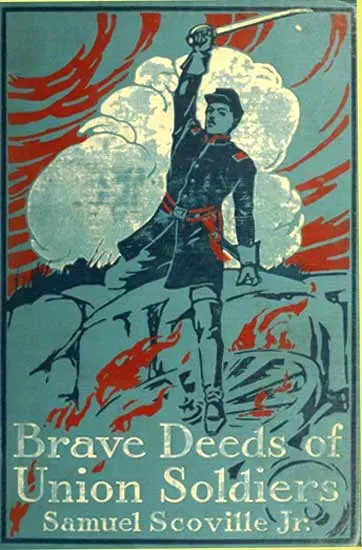
THE CLASSIC COLLECTION · 1915
"Brave Deeds of Union Soldiers" by Samuel Scoville, Jr. is a historical account written in the early 20th century. This work chronicles acts of bravery exhibited by Union soldiers during the American Civil War, celebrating both prominent figures and ordinary individuals who displayed remarkable courage in dire situations. The author aims to inspire readers by recounting tales of valor, suggesting that heroism can emerge from anyone, regardless of status. The opening of the book introduces the concept of bravery through an account of a lesser-known confrontation during the Civil War. It highlights a regiment that faced an entrenched enemy across a swollen river, where their commanding officer, Colonel Brownlow, persistently rallied his troops to take action despite insurmountable odds. The scene unfolds as the men stripped down and embarked on a daring assault across the river, ultimately catching their adversaries off guard and capturing a number of Confederate soldiers. This narrative captivates readers by emphasizing not just the strategic importance of their mission, but the personal sacrifices and grit demonstrated by even the most ordinary soldiers in extraordinary circumstances.
Introduction adapted from the source catalogue; source summaries may be automatically generated.
Free to read · English · 70,954 words · No account needed
MAKE TIME FOR A GOOD BOOK
On by default. Untick to stop anonymous reading totals. Each page counts after 10 seconds in view. How this works.
Anonymous counting is on unless you have switched it off.
"Lead your men down that path and close in on 'em. Hurry up. My men will come from this side and we'll beat you down."
By this time the Confederate officer was on his feet again and started to rally his men. Morford made a rush toward them, firing his revolver as he came, waving his arms in both directions, shouting to his imaginary forces and bellowing at the top of his tremendous voice--"Come on, boys, we've got them now. Surround 'em. Don't let a man escape!"
The negro workmen felt that this was no place for neutrals and they dropped their shovels and made a rush for the mouth of the Gap. The Confederate soldiers stood for a minute, but as they saw Morford rushing toward them, they broke and followed the workmen. The scout chased them until he saw that they were well on their way and then started back along the ridge chuckling to himself over the way in which they had scattered. He laughed too soon. The Confederates had not gone far before they found out the trick which had been played upon them. They turned back and in a short time fifty men were riding along the ridge at full speed to capture the Yankee who had fooled them so. Unfortunately for Morford, he had kept to the path along the ridge which was better going, but which offered very little chance of escape, since on one side was a sheer precipice while on the other was a long, bare slope which offered no place for concealment. From the top of a little knoll he caught sight of the Confederates before they saw him. At that time they were only a half mile behind. The scout tried to escape by running far out on a rocky spur which jutted out over the Gap and which was filled with trees, hoping that he might dodge in among these, double on his pursuers and so get away. The same officer, however, whom he had unhorsed caught sight of him as he ran from one tree to another and with a tremendous shout, the whole band galloped after him at full speed. Morford had hoped that as the way led up a steep hill covered with rocks, his pursuers would have to dismount, but they were riding horses which had been bred in the mountains and which were trained to go up and down hill-paths like goats. They gained on him fast. Spreading out they cut off every chance of his escaping back to the slope or skirting their ranks. There was nothing left for him to do except to go on and on to the very edge of the precipice. The scout knew that if he were caught he would be hung on the nearest tree and that knowledge was a considerable incentive to keep ahead of his pursuers as long as possible. He ran as he had never run before and as he could follow paths too narrow for the horses, for a while he managed to hold his lead. He could see, however, that some of the band had ridden around the slope and held the whole base of the spur so that it would be only a question of time before he would be hunted out and caught. He was running now along the very edge of the precipice which dropped six hundred feet to the rocks below. The gorge narrowed until finally at one point it was not more than twenty feet wide. This was too wide, however, for the scout to clear, even if he were not wearing heavy boots and carrying a rifle. Several feet below where he stood, on the opposite shelf a hickory tree had grown out so that some of the branches extended within ten feet of his side of the gorge. Below that tree was a fissure through the rock down which a desperate man might possibly clamber. It was a slight chance, but the only one which he had. At this point he was hidden from the Confederates by a wall of rock. Without allowing himself to stop, for fear that he would lose his nerve, Morford took a run and launched himself through the air ten feet out and ten feet down against the spreading boughs of the hickory tree. He broke through them with a rush but wound his arms desperately around the bending limbs and though they bent and cracked, the tough wood held and he found himself firmly hugging the shaggy bark of the trunk with all his might. He slid down, ripping his clothes and skin, until finally his feet touched the beginning of a possible path down to the gorge. He could hear the shouts of his pursuers only a few rods away. If they had gone to the edge, nothing could have saved him, as they would have shot him down before he could have escaped, but they beat carefully through the trees and rocks for fear lest he should crawl back through their line. Without stopping to weigh his chances, Morford let himself drop from one shelf of rock to another, clinging to every little crevice and every twig and plant which he could find. Several times he thought he was gone as his feet swung off into the space below, but always he managed to get a hand-grip on some rock which held, and almost before he realized the terrible chance he had taken, he had passed down the side of the cliff and was safe around a bend in the rock which hid him from view. From there the path was easier and in a short time he found himself in the gorge far below. There he crawled carefully along behind rocks and took advantage of every bit of cover and in a few minutes was far on his way, leaving the Confederates to hunt for hours every square yard of ground on the rocky promontory whence he had come.
Your reading position is saved on this browser. Take it to another device with a library code. Reading pages adapt to text, rather than matching a printed edition.
William Constantine Beecher & H. W., Mrs. Beecher & Samuel Scoville
Samuel Scoville
Samuel Scoville
BEHIND THE BOOK
This eBook is for the use of anyone anywhere in the United States and most other parts of the world at no cost and with almost no restrictions whatsoever. You may copy it, give it away or re-use it under the terms of the Project Gutenberg License included with this eBook or online at www.gutenberg.org. If you are not located in the United States, you will have to check the laws of the country where you are located before using this eBook. Read the source licence.
The original source file, including credits and licence, is retained by this library. Request an original-format copy at no charge. Please include the book title and Project Gutenberg identifier #41036.
KEEP YOUR CURIOSITY GOING
Cécile Tormay

Moritz Busch
John L. Ransom
Frances Wright
Cécile Tormay

Mabel Potter Daggett