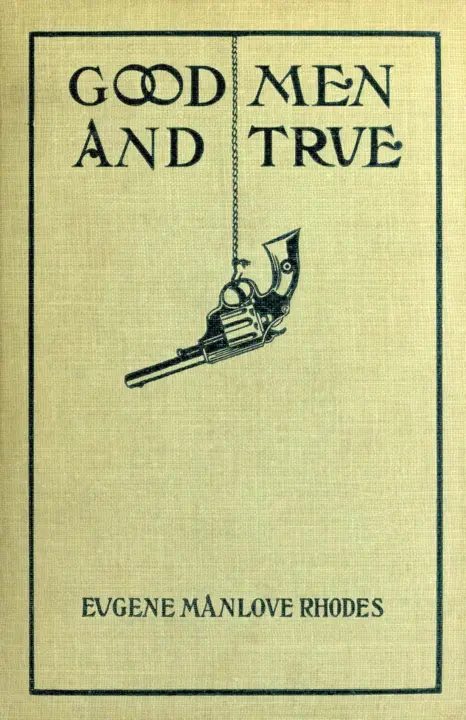
Good men and true, and Hit the line hard
Eugene Manlove Rhodes
THE CLASSIC COLLECTION · 1913
"Bransford in Arcadia" by Eugene Manlove Rhodes is a novel written in the early 20th century. A lively Western with humor and romance, it follows cowboy Jeff Bransford as he navigates frontier justice, a crooked land contest instigated by Stephen W. Lake, and a sudden, disarming attraction to the spirited Ellinor Hoffman. Set across the New Mexico ranges and small towns, it blends banter, action, and moral choices with a light touch and sharp dialogue.
The opening of Bransford in Arcadia sets the scene on a roundup camp where cowboys trade wit about law, women, and the West before Wes Pringle tells how homesteader John Taylor’s claim (“the Butterbowl”) is jeopardized by Lake’s legal maneuver. To thwart the injustice, Jeff secretly steams open the Escondido mail and swaps Lake’s decision, buying time so the Taylors can preempt the land; later, when confronted by a land-office official and a U.S. marshal in Roswell, he bluffs them into backing off. The story then shifts to Rainbow Rim, where Ellinor witnesses Jeff’s breathtaking ride and dunk in a spring; the two share first aid, laughter, his “little eohippus” credo, lunch, and a song, hinting at a bond while skirting Lake’s orbit. Trying (and failing) to avoid Arcadia’s masquerade, Jeff is “kidnapped” by his roan into attending in a football disguise; inside, he fends off a Red Devil (likely Lake) and finds Ellinor dressed as a Quakeress, slipping with her into the garden for a private talk as the festivities whirl on.
Introduction adapted from the source catalogue; source summaries may be automatically generated.
Free to read · English · 49,563 words · No account needed
MAKE TIME FOR A GOOD BOOK
On by default. Untick to stop anonymous reading totals. Each page counts after 10 seconds in view. How this works.
Anonymous counting is on unless you have switched it off.
The broad fields were dwarfed to play-garden prettiness by the vastness of overwhelming desert, to right, to left, before; whose nearer blotches of black and gray and brown faded, far off, to a nameless shimmer, its silent leagues dwindling to immeasurable blur, merging indistinguishable in the burning sunset.
"East by up," overguarding the oasis, the colossal bulk of Rainbow walled out the world with grim-tiered cliffs, cleft only by the deep-gashed gates of Rainbow Pass, where the swift river broke through to the rich fields of Rainbow's End, bringing fulfilment of the fabled pot of gold--or, unused, to shrink and fail and die in the thirsty sand.
Below, the whilom channel wandered forlorn--Rainbow no longer, but Lost River--to a disconsolate delta, waterless save as infrequent floods found turbulent way to the Sink, when wild horse and antelope revisited their old haunts for the tender green luxury of these brief, belated springs.
Incidentally, Miss Hoffman's outpost commanded a good view of Arcadia road, winding white through the black tar-brush. Had she looked, she might have seen a slow horseman, tiny on the bare plain below the tar-brush, larger as he climbed the gentle slope along that white-winding road.
But she bent industrious to her work, smiling to herself, half-singing, half-humming a foolish and lilty little tune:
"A tisket, a tasket--a green and yellow basket; I wrote a letter to my love and on the road I lost it-- I crissed it, I crossed it--I locked it in a casket; I missed it, I lost it----"
And here Miss Hoffman did an unaccountable thing. Wise Penelope unraveled by night the work she wove by day. Like her in this, Miss Ellinor Hoffman now placidly snipped and ripped the basting threads, unraveled them patiently, and set to work afresh.
"Now, there's no such thing as a Ginko tree;
There never was--though there ought to be.
And 'tis also true, though most absurd,
There's no such thing as a Wallabye bird!"
Miss Hoffman was all in white, with a white middy blouse trimmed in scarlet, a scarlet ribbon in her dark hair: a fine-linked gold chain showed at her neck. A very pretty picture she made, cool and fresh against the deep shade and the green--but of course she did not know it. She held the shaping kimono at arm's length, admiring the delicate color, and fell to work again.
"Oh, the jolly miller, he lives by himself! As the wheel rolls around he gathers in his pelf, A hand in the hopper and another in the bag-- As the wheel rolls around he calls out, 'Grab!'"
So intent and preoccupied was she, that she did not hear the
approaching horse.
Your reading position is saved on this browser. Take it to another device with a library code. Reading pages adapt to text, rather than matching a printed edition.
Eugene Manlove Rhodes
Eugene Manlove Rhodes
Eugene Manlove Rhodes
Eugene Manlove Rhodes
BEHIND THE BOOK
This eBook is for the use of anyone anywhere in the United States and most other parts of the world at no cost and with almost no restrictions whatsoever. You may copy it, give it away or re-use it under the terms of the Project Gutenberg License included with this eBook or online at www.gutenberg.org. If you are not located in the United States, you will have to check the laws of the country where you are located before using this eBook. Read the source licence.
The original source file, including credits and licence, is retained by this library. Request an original-format copy at no charge. Please include the book title and Project Gutenberg identifier #78657.
KEEP YOUR CURIOSITY GOING
Coulson Kernahan

Maurice Baring
Frances Wright
Cécile Tormay

Frederic Jesup Stimson

W. H. P. (William Henry Pope) Jarvis