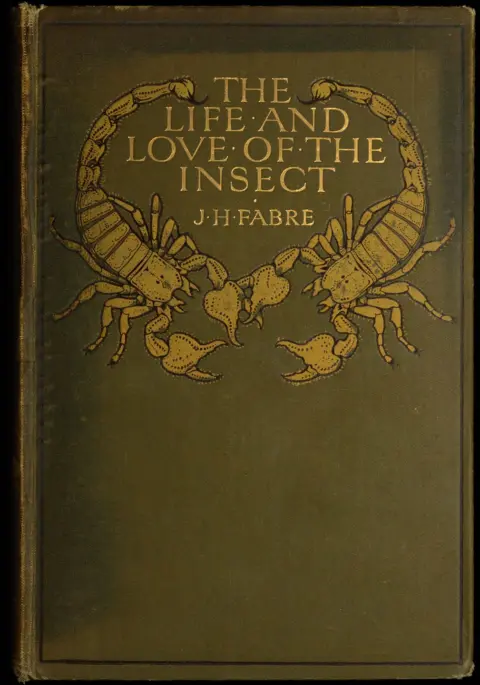
The Life and Love of the Insect
Jean-Henri Fabre
THE CLASSIC COLLECTION · 1915
"Bramble-Bees and Others" by Jean-Henri Fabre is a scientific publication written in the early 20th century. The book consists of an insightful collection of essays focusing on the fascinating behaviors and natural history of various wild bees, notably those that dwell in bramble stems. Fabre meticulously documents the life cycles, nesting habits, and ecological interactions of these insects, thereby illuminating the intricate world of entomology. The opening of "Bramble-Bees and Others" introduces readers to the first chapter titled "Bramble-Dwellers," where Fabre delves into the specifics of certain Hymenoptera that reside in old bramble stems. He describes the ideal habitats provided by these stumps, which serve as shelters for various bee species. Furthermore, Fabre differentiates between industrious insects, which construct their own living spaces, and those who repurpose abandoned structures. The narrative is rich with observations detailing the nesting habits of the Three-pronged Osmia, including their foraging methods and the significance of the environment in their life cycles, providing a compelling glimpse into the broader themes of survival and adaptation within the insect world.
Introduction adapted from the source catalogue; source summaries may be automatically generated.
Free to read · English · 89,527 words · No account needed
MAKE TIME FOR A GOOD BOOK
On by default. Untick to stop anonymous reading totals. Each page counts after 10 seconds in view. How this works.
Anonymous counting is on unless you have switched it off.
If, in order to see the Osmia's nest as a whole, we split a reed lengthwise, taking care not to disturb its contents; or, better still, if we select for examination the string of cells built in a glass tube, we are forthwith struck by one detail, namely, the uneven distances between the partitions, which are placed almost at right angles to the axis of the cylinder. It is these distances which fix the size of the chambers, which, with a similar base, have different heights and consequently unequal holding-capacities. The bottom partitions, the oldest, are farther apart; those of the front part, near the orifice, are closer together. Moreover, the provisions are plentiful in the loftier cells, whereas they are niggardly and reduced to one-half or even one-third in the cells of lesser height.
Here are a few examples of these inequalities. A glass tube with a diameter of 12 millimetres (.468 inch.--Translator's Note.), inside measurement, contains ten cells. The five lower ones, beginning with the bottom-most, have as the respective distances between their partitions, in millimetres:
11, 12, 16, 13, 11. (.429,.468,.624,.507,.429 inch.--Translator's Note.)
The five upper ones measure between their partitions:
7, 7, 5, 6, 7. (.273,.273,.195,.234,.273 inch.--Translator's Note.)
A reed-stump 11 millimetres (.429 inch.--Translator's Note.) across the inside contains fifteen cells; and the respective distances between the partitions of those cells, starting from the bottom, are:
13, 12, 12, 9, 9, 11, 8, 8, 7, 7, 7, 6, 6, 6, 7. (.507,.468,.468, .351,.351,.429,.312,.312,.273,.273,.273,.234,.234,.234, .273 inch.--Translator's Note.)
When the diameter of the tunnel is less, the partitions can be still further apart, though they retain the general characteristic of being closer to one another the nearer they are to the orifice. A reed of five millimetres (.195 inch.--Translator's Note.) in diameter, gives me the following distances, always starting from the bottom:
22, 22, 20, 20, 12, 14. (.858,.858,.78,.78,.468,.546 inch.--Translator's
Note.)
Another, of 9 millimetres (.351 inch.--Translator's Note.), gives me:
15, 14, 11, 10, 10, 9, 10. (.585,.546,.429,.39,.39,.351,.39
inch.--Translator's Note.)
A glass tube of 8 millimetres (.312 inch.--Translator's Note.) yields:
15, 14, 20, 10, 10, 10. (.585,.546,.78,.39,.39,.39 inch.--Translator's
Note.).
I could fill pages and pages with such figures, if I cared to print all my notes. Do they prove that the Osmia is a geometrician, employing a strict measure based on the length of her body? Certainly not, because many of those figures exceed the length of the insect; because sometimes a higher number follows suddenly upon a lower; because the same string contains a figure of one value and another figure of but half that value. They prove only one thing: the marked tendency of the insect to shorten the distance between the party-walls as the work proceeds. We shall see later that the large cells are destined for the females and the small ones for the males.
Your reading position is saved on this browser. Take it to another device with a library code. Reading pages adapt to text, rather than matching a printed edition.
Jean-Henri Fabre
Jean-Henri Fabre
Jean-Henri Fabre
Jean-Henri Fabre
BEHIND THE BOOK
This eBook is for the use of anyone anywhere in the United States and most other parts of the world at no cost and with almost no restrictions whatsoever. You may copy it, give it away or re-use it under the terms of the Project Gutenberg License included with this eBook or online at www.gutenberg.org. If you are not located in the United States, you will have to check the laws of the country where you are located before using this eBook. Read the source licence.
The original source file, including credits and licence, is retained by this library. Request an original-format copy at no charge. Please include the book title and Project Gutenberg identifier #3421.
KEEP YOUR CURIOSITY GOING

David Patterson (Spirit) Hatch

David Patterson (Spirit) Hatch

David Patterson (Spirit) Hatch

Ralph Waldo Emerson

Maurice Baring

Oscar Wilde & James McNeill Whistler