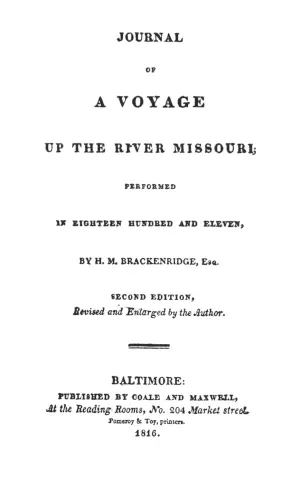
Brackenridge’s Journal of a voyage up the river Missouri, 1811; Franchère’s Voyage to Northwest Coast, 1811-1814
Their government is oligarchical, but great respect is paid to popular opinion. It is utterly impossible to be a great man amongst them, without being a distinguished warrior; and though respect is paid to birth, it must be accompanied by other merit, to procure much influence. They are divided into different bands or classes; that of the pheasant, which is composed of the oldest men; that of the bear, the buffaloe, the elk, the dog, &c. Each of these has its leader, who generally takes the name of the class, exclusively.[45] Initiation into these classes, on arriving at the proper age, and after having given proofs of being worthy of it, is attended with great ceremony. The band of dogs, is considered the most brave and effective in war, being composed of young men under thirty. War parties are usually proposed by some individual warrior, and according to the confidence placed in him, his followers are numerous or otherwise. In these excursions they wander to a great distance, seldom venturing to return home without {156} a scalp, or stolen horses. Frequently when unsuccessful they “cast their robes,” as they express it, and vow to kill the first person they meet, provided he be not of their own nation. In crossing the river, they use canoes made of the buffaloe hide, or a few pieces of wood fastened together. They usually leave some token, as a stake, which is marked so as to convey some idea of their numbers, the direction which they have taken, &c. To avoid surprise, they always encamp at the edge of a wood; and when the party is small, they construct a kind of fortress, with wonderful expedition, of billets of wood, apparently piled up in a careless manner, but so arranged as to be very strong, and by this means to withstand an assault from a much superior force. They are excellent horsemen--they will shoot an arrow at full speed, and again pick it up from the ground without stopping: sometimes they will lean entirely upon one leg, throwing their bodies to that side, so as to present nothing but the leg and thigh, on the other. In pursuit of the buffaloe, they will gallop down steep hills, broken almost into precipices. Some of their horses are very fine, run swiftly, and are {157} soon worn out, from the difficulty of procuring food for them in winter, the smaller branches of the cotton-wood tree being almost the only fodder which they give them. Their hunting is regulated by the warriors chosen for the occasion, who urge on such as are tardy, and repress often with blows, those who would rush on too soon. When a herd of buffaloe is discovered, they approach in proper order, within half a mile, they then separate and dispose themselves, so as in some measure, to surround them, when at the word, they rush forward at full speed, and continue the chase as long as their horses can stand it: a hunter usually shoots two arrows into a buffaloe, and then goes in pursuit of another; if he kills more than three in the hunt, he is considered as having acquitted himself well. The tongue is the prize of the person who has slain the animal; and he that has the greater number, is considered the best hunter of the day. Their weapons consist of guns, war clubs, spears, bows, and lances. They have two kinds of arrows, one for the purpose of the chase, and the other for war; the latter differs in this particular, that the barb or point is fastened so slightly, that when it enters the {158} body, it remains in, and cannot be drawn out with the wood; therefore, when it is not in a vital part, the arrow is pushed entirely through. They do not poison them. Their bows are generally very small; an elk’s horn, or two ribs of a buffaloe, often constitute the materials of which they are made. Those of wood are of willow, the back covered with sinews. Their daily sports, in which, when the weather is favorable, they are engaged from morning till night, are principally of two kinds. A level piece of ground appropriated for the purpose, (and beaten by frequent use,) is the place where they are carried on. The first is played by two persons, each provided with a long pole; one of them rolls a hoop, which, after having reached about two-thirds of the distance, is followed at half speed, and as they perceive it about to fall, they cast their poles under it; the pole on which the hoop falls, so as to be nearest to certain corresponding marks on the hoop and pole, gains for that time. This game excites great interest, and produces a gentle, but animated exercise. The other differs from it in this, that instead of poles, they have short pieces of wood, with barbs at one end, and a {159} cross piece at the other, held in the middle with one hand; but instead of the hoop before mentioned, they throw a small ring, and endeavor to put the point of the barb through it. This is a much more violent exercise than the other.[46]