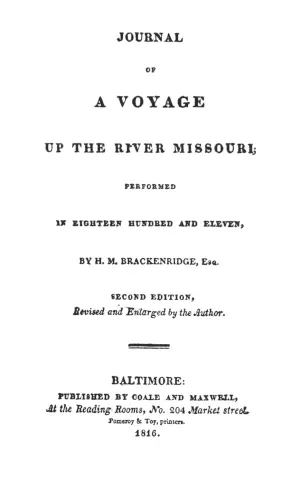
Brackenridge’s Journal of a voyage up the river Missouri, 1811; Franchère’s Voyage to Northwest Coast, 1811-1814
The party of Mr. Hunt consists of about eighty men, chiefly Canadians, the rest are American-hunters.
Tuesday 4th. Set off at seven--wind contrary, though not so strong as yesterday. After doubling a point, we found that from the course of the river, the wind would be favorable, and accordingly sailed for eight or ten miles. We saw at the mouth of a small creek, a herd of buffaloe of all sizes, crowded together, to the number of several hundred. We immediately debarked, but they disappeared before we succeeded in killing any of them. The appearance of the country has varied but little for several days past. Bleak and dreary--the bottoms narrow; in some places none at all, and clay bluffs.
Wednesday 5th. This morning after proceeding a short distance we were compelled, by rain, to put to shore, where we continued until towards evening, and seeing no probability that the weather would clear up, crossed {124} over to the S. W. side, where Hunt and his party were encamped. On the side we had left, the hills approach close to the river, and bare of vegetation; the earth a stiff clay, which being now moistened by the rain is exceedingly slippery. On the other side there is a handsome plain, with a row of trees along the margin of the river, and a handsome wood along the borders of a little rivulet which flows across the plain. The upland rises at the distance of a quarter of a mile, to the height of sixty or seventy feet, in a number of projecting points, or hills. On ascending this ground we found ourselves on an extended plain, upon which at the distance of a few miles the hills rose in strange, irregular broken masses. Mr. Bradbury and I took a stroll from the camp, in quest of specimens and adventures. Before reaching the upland we observed on the river bottom a large encampment of Sioux, where they had probably remained during winter, from the traces of tents, the quantity of bones, and the appearance of the ground. Their position was well chosen; the wood of the Missouri, and that of the streamlet I have just mentioned, at {125} right angles with it, formed two sides of the camp, on the other sides there is an open plain. In this place it would have been difficult to have attacked them by surprise. On coming to the upland we found the points of the hills stony, and large masses of detached rock here and there on the more elevated places. The grass short, intermixed with many beautiful small flowers, but no weeds. A few prickly pears (cactus) were seen, but of a small size, not exceeding a few inches in length, and the thorns not strong. The upland was at every little distance, indented with ravines, or hollows, some of them bare of soil and still subject to the washing of the rains, others well covered with grass. Upon one of these projecting points, we observed at some distance a small group of buffaloes lying down. Stealing along the brow of the hill, we ascended from a ravine, approached within thirty or forty yards, and taking aim together, fired at a cow that happened to be nearest to us; she started up and bellowed, the others seemed to be but little alarmed, until we rose up and advanced towards them, when they trotted off slowly to the hills, leaving the cow who went {126} off in a different direction. The wounded buffaloe, or deer, always leave the herd. I pursued her for some distance, but found that she was not mortally wounded. The flight of these alarmed other herds which were feeding at a distance; there was something picturesque in the appearance of these herds of buffaloe, slowly winding round the sides of the distant hills, disappearing in some hollow and again emerging to view. Wide and beaten roads formed by the passing of the buffaloe, may every where be seen. While Mr. Bradbury was engaged in collecting specimens, I ran to a point at the distance of a mile, where I saw some antelopes, and had the good fortune, by ascending a ravine to approach within sixty yards. They proved to be six females and one male; the latter at every instant performed a circuit in a small trot, and then suddenly stopped short, as if to see that nothing came near. The tail like that of the goat, and perfectly white, the limbs small and delicate, the horns like those of the deer, with several prongs, but they are never shed, and the female has them as well as the male, though of a smaller size. On shewing myself they flew off, and I {127} had scarce time to reach the spot they left, until they reappeared upon another point, as far off as when I first saw them. We saw in the course of the evening, several wolves, villages of prairie dogs, a herd of elk, and a hare of the species called lepus variabilis, its color was at this time grey, but becomes white in winter.