READ · DISCOVER · ENJOYClassic literature · Always free
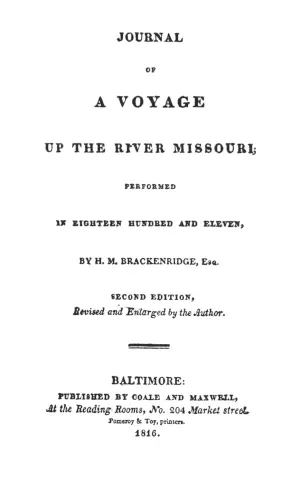
Brackenridge’s Journal of a voyage up the river Missouri, 1811; Franchère’s Voyage to Northwest Coast, 1811-1814 — digital edition cover

THE CLASSIC COLLECTION · 1904

Brackenridge’s Journal of a voyage up the river Missouri, 1811; Franchère’s Voyage to Northwest Coast, 1811-1814

Brackenridge's Journal of a voyage up the river Missouri, 1811; Franchère's… by H. M. Brackenridge and Gabriel Franchère is a collection of historical travel narratives written in the early 20th century. It reprints firsthand accounts of early 19th-century exploration and the fur trade, from a voyage up the Missouri with Manuel Lisa to the Astorian venture on the Northwest Coast, highlighting river navigation, frontier settlements, encounters with Indigenous nations, and the emerging American West. The opening of the volume frames the texts with an editor’s preface that sketches both writers’ careers and the significance of their narratives, then begins with Brackenridge’s own preface and journal. He explains the Missouri Fur Company’s aims and setbacks, Manuel Lisa’s leadership, and his plan to overtake Wilson Hunt’s party for safer passage through Sioux country. The narrative then launches from St. Charles, detailing difficult river work, storms, islands and tributaries, hunters’ camps, wildlife encounters, and scattered settlements, culminating in a stop at Fort Osage with observations of the Osage people and the factory before pushing onward, still intent on catching Hunt upriver.

Introduction adapted from the source catalogue; source summaries may be automatically generated.

Start reading ↓

Free to read · English · 132,116 words · No account needed

MAKE TIME FOR A GOOD BOOK

Brackenridge’s Journal of a voyage up the river Missouri, 1811; Franchère’s Voyage to Northwest Coast, 1811-1814

On by default. Untick to stop anonymous reading totals. Each page counts after 10 seconds in view. How this works.

Anonymous counting is on unless you have switched it off.

Brackenridge’s Journal of a voyage up the river Missouri, 1811; Franchère’s Voyage to Northwest Coast, 1811-1814

Mr. Hunt was surprised beyond measure, when we informed him of the resolution we had taken of abandoning the country: he blamed us severely for having acted with so much precipitation, {179} pointing out that the success of the late coasting voyage, and the arrangements we had made with the Russians, promised a most advantageous trade, which it was a thousand pities to sacrifice, and lose the fruits of the hardships he had endured and the dangers he had braved, at one fell swoop, by this rash measure. Nevertheless, seeing the partners were determined to abide by their first resolution, and not being able, by himself alone, to fulfil his engagements to Governor Barnoff, he consented to embark once more, in order to seek a vessel to transport our heavy goods, and such of us as wished to return by sea. He sailed, in fact, on the Albatross, at the end of the month. My friend Clapp embarked with him: they were, in the first instance, to run down the coast of California, in the hope of meeting there some of the American vessels which frequently visit that coast to obtain provisions from the Spaniards.

Some days after the departure of Mr. Hunt, the old one-eyed chief Comcomly came to tell us that an Indian of Gray’s Harbor, who had sailed {180} on the Tonquin in 1811, and who was the only soul that had escaped the massacre of the crew of that unfortunate vessel, had returned to his tribe. As the distance from the River Columbia to Gray’s Harbor was not great, we sent for this native. At first he made considerable difficulty about following our people, but was finally persuaded. He arrived at Astoria, and related to us the circumstances of that sad catastrophe, nearly as follows: [95]

“After I had embarked on the Tonquin,” said he, “that vessel sailed for Nootka.[96] Having arrived opposite a large village called Newity, we dropped anchor. The natives having invited Mr. M’Kay to land, he did so, and was received in the most cordial manner: they even kept him several days at their village, and made him lie, {181} every night, on a couch of sea-otter skins. Meanwhile the captain was engaged in trading with such of the natives as resorted to his ship: but having had a difficulty with one of the principal chiefs in regard to the price of certain goods, he ended by putting the latter out of the ship, and in the act of so repelling him, struck him on the face with the roll of furs which he had brought to trade. This act was regarded by that chief and his followers as the most grievous insult, and they resolved to take vengeance for it. To arrive more surely at their purpose, they dissembled their resentment, and came, as usual, on board the ship. One day, very early in the morning, a large pirogue, containing about a score of natives, came alongside: every man had in his hand a packet of furs, and held it over his head as a sign that they came to trade. The watch let them come on deck. A little after, arrived a second pirogue, carrying about as many men as the other. The sailors believed that these also came to exchange their furs, and allowed them to mount the ship’s side like the first. Very {182} soon, the pirogues thus succeeding one another, the crew saw themselves surrounded by a multitude of savages, who came upon the deck from all sides. Becoming alarmed at the appearance of things, they went to apprize the captain and Mr. M’Kay, who hastened to the poop. I was with them,” said the narrator, “and fearing, from the great multitude of Indians whom I saw already on the deck, and from the movements of those on shore, who were hurrying to embark in their canoes, to approach the vessel, and from the women being left in charge of the canoes of those who had arrived, that some evil design was on foot, I communicated my suspicions to Mr. M’Kay, who himself spoke to the captain. The latter affected an air of security, and said that with the firearms on board, there was no reason to fear even a greater number of Indians. Meanwhile these gentlemen had come on deck unarmed, without even their sidearms. The trade, nevertheless, did not advance; the Indians offered less than was asked, and pressing with their furs close to the captain, Mr. M’Kay, and {183} Mr. Lewis, repeated the word Makoke! Makoke! ‘Trade! Trade!’ I urged the gentlemen to put to sea, and the captain, at last, seeing the number of Indians increase every moment, allowed himself to be persuaded: he ordered a part of the crew to raise the anchor, and the rest to go aloft and unfurl the sails. At the same time he warned the natives to withdraw, as the ship was going to sea. A fresh breeze was then springing up, and in a few moments more their prey would have escaped them; but immediately on receiving this notice, by a preconcerted signal, the Indians, with a terrific yell, drew forth the knives and war-bludgeons they had concealed in their bundles of furs, and rushed upon the crew of the ship. Mr. Lewis was struck, and fell over a bale of blankets. Mr. M’Kay, however, was the first victim whom they sacrificed to their fury. Two savages, whom, from the crown of the poop, where I was seated, I had seen follow this gentleman step by step, now cast themselves upon him, and having given him a blow on the head with a potumagan (a kind of sabre which is described {184} a little below), felled him to the deck, then took him up and flung him into the sea, where the women left in charge of the canoes, quickly finished him with their paddles. Another set flung themselves upon the captain, who defended himself for a long time with his pocket-knife, but, overpowered by numbers, perished also under the blows of these murderers. I next saw (and that was the last occurrence of which I was witness before quitting the ship) the sailors who were aloft slip down by the rigging, and get below through the steerage hatchway. They were five, I think, in number, and one of them, in descending, received a knife-stab in the back. I then jumped overboard, to escape a similar fate to that of the captain and Mr. M’Kay: the women in the canoes, to whom I surrendered myself as a slave, took me in, and bade me hide myself under some mats which were in the pirogues; which I did. Soon after, I heard the discharge of firearms, immediately upon which the Indians fled from the vessel, and pulled for the shore as fast as possible, nor did they venture {185} to go alongside the ship again the whole of that day. The next day, having seen four men lower a boat, and pull away from the ship, they sent some pirogues in chase: but whether those men were overtaken and murdered, or gained the open sea and perished there, I never could learn. Nothing more was seen stirring on board the Tonquin; the natives pulled cautiously around her, and some of the more daring went on board; at last, the savages, finding themselves absolute masters of the ship, rushed on board in a crowd to pillage her. But very soon, when there were about four or five hundred either huddled together on deck, or clinging to the sides, all eager for plunder, the ship blew up with a horrible noise. I was on the shore,” said the Indian, “when the explosion took place, saw the great volume of smoke burst forth in the spot where the ship had been, and high in the air above, arms, legs, heads and bodies, flying in every direction. The tribe acknowledged a loss of over two hundred of their people on that occasion. As for me I remained their prisoner, and have been their slave for two {186} years. It is but now that I have been ransomed by my friends. I have told you the truth, and hope you will acquit me of having in any way participated in that bloody affair.”

Your reading position is saved on this browser. Take it to another device with a library code. Reading pages adapt to text, rather than matching a printed edition.

More from this author

BEHIND THE WORDS

About Gabriel Franchère

Gabriel Franchère (1786–1863). Explore Brackenridge’s Journal of a voyage up the river Missouri, 1811; Franchère’s Voyage to Northwest Coast, 1811-1814, Narrative of a Voyage to the Northwest Coast of America in the years 1811, 1812, 1813, and 1814 or the First American Settlement on the Pacific in this collection. These books span history, travel & exploration, adventure.

Explore this author’s books →

About H. M. (Henry Marie) Brackenridge

H. M. (Henry Marie) Brackenridge (1786–1871). Explore Brackenridge’s Journal of a voyage up the river Missouri, 1811; Franchère’s Voyage to Northwest Coast, 1811-1814 in this collection. These books span history, travel & exploration.

Explore this author’s books →

THE READERS’ VERDICT

How did this story stay with you?

Not rated yet
Your rating for Brackenridge’s Journal of a voyage up the river Missouri, 1811; Franchère’s Voyage to Northwest Coast, 1811-1814

Be the first to share your verdict.

One rating per browser, which you can change or remove. A necessary browser identifier remembers your vote. How ratings work

A GOOD STORY DESERVES COMPANY

Pass this book along.

A great read is even better when it’s shared.

SEND A LITTLE INSPIRATION

Share this book

BEHIND THE BOOK

Edition & source details.

Title
Brackenridge’s Journal of a voyage up the river Missouri, 1811; Franchère’s Voyage to Northwest Coast, 1811-1814
Author
H. M. (Henry Marie) Brackenridge & Gabriel Franchère
Publication year
1904
Digital edition publisher
Project Gutenberg
Gutenberg release date
2025-06-01
Language
English
Source edition imprint
$aCleveland :$bThe Arthur H. Clark Company, $c1904.
Source identifier
Project Gutenberg #76209
Contributors
Reuben Gold Thwaites (edt); J. V. (Jedediah Vincent) Huntington (trl)

Public-domain source & licence

This eBook is for the use of anyone anywhere in the United States and most other parts of the world at no cost and with almost no restrictions whatsoever. You may copy it, give it away or re-use it under the terms of the Project Gutenberg License included with this eBook or online at www.gutenberg.org. If you are not located in the United States, you will have to check the laws of the country where you are located before using this eBook. Read the source licence.

Full source licence and obtaining an original copy

The original source file, including credits and licence, is retained by this library. Request an original-format copy at no charge. Please include the book title and Project Gutenberg identifier #76209.

the full Project Gutenberg License must appear
prominently whenever any copy of a Project Gutenberg work (any work
on which the phrase “Project Gutenberg” appears, or with which the
phrase “Project Gutenberg” is associated) is accessed, displayed,
performed, viewed, copied or distributed:

This eBook is for the use of anyone anywhere in the United States and most
other parts of the world at no cost and with almost no restrictions
whatsoever. You may copy it, give it away or re-use it under the terms
of the Project Gutenberg™ License included with this eBook or online
at www.gutenberg.org. If you
are not located in the United States, you will have to check the laws
of the country where you are located before using this eBook.

1.E.2. If an individual Project Gutenberg electronic work is
derived from texts not protected by U.S. copyright law (does not
contain a notice indicating that it is posted with permission of the
copyright holder), the work can be copied and distributed to anyone in
the United States without paying any fees or charges. If you are
redistributing or providing access to a work with the phrase “Project
Gutenberg” associated with or appearing on the work, you must comply
either with the requirements of paragraphs 1.E.1 through 1.E.7 or
obtain permission for the use of the work and the Project Gutenberg
trademark as set forth in paragraphs 1.E.8 or 1.E.9.

1.E.3. If an individual Project Gutenberg electronic work is posted
with the permission of the copyright holder, your use and distribution
must comply with both paragraphs 1.E.1 through 1.E.7 and any
additional terms imposed by the copyright holder. Additional terms
will be linked to the Project Gutenberg License for all works
posted with the permission of the copyright holder found at the
beginning of this work.

1.E.4. Do not unlink or detach or remove the full Project Gutenberg
License terms from this work, or any files containing a part of this
work or any other work associated with Project Gutenberg.

1.E.5. Do not copy, display, perform, distribute or redistribute this
electronic work, or any part of this electronic work, without
prominently displaying the sentence set forth in paragraph 1.E.1 with
active links or immediate access to the full terms of the Project
Gutenberg License.

1.E.6. You may convert to and distribute this work in any binary,
compressed, marked up, nonproprietary or proprietary form, including
any word processing or hypertext form. However, if you provide access
to or distribute copies of a Project Gutenberg work in a format
other than “Plain Vanilla ASCII” or other format used in the official
version posted on the official Project Gutenberg website
(www.gutenberg.org), you must, at no additional cost, fee or expense
to the user, provide a copy, a means of exporting a copy, or a means
of obtaining a copy upon request, of the work in its original “Plain
Vanilla ASCII” or other form. Any alternate format must include the
full Project Gutenberg License as specified in paragraph 1.E.1.

1.E.7. Do not charge a fee for access to, viewing, displaying,
performing, copying or distributing any Project Gutenberg works
unless you comply with paragraph 1.E.8 or 1.E.9.

1.E.8. You may charge a reasonable fee for copies of or providing
access to or distributing Project Gutenberg electronic works
provided that:

• You pay a royalty fee of 20% of the gross profits you derive from
the use of Project Gutenberg works calculated using the method
you already use to calculate your applicable taxes. The fee is owed
to the owner of the Project Gutenberg trademark, but he has
agreed to donate royalties under this paragraph to the Project
Gutenberg Literary Archive Foundation. Royalty payments must be paid
within 60 days following each date on which you prepare (or are
legally required to prepare) your periodic tax returns. Royalty
payments should be clearly marked as such and sent to the Project
Gutenberg Literary Archive Foundation at the address specified in
Section 4, “Information about donations to the Project Gutenberg
Literary Archive Foundation.”

• You provide a full refund of any money paid by a user who notifies
you in writing (or by e-mail) within 30 days of receipt that s/he
does not agree to the terms of the full Project Gutenberg™
License. You must require such a user to return or destroy all
copies of the works possessed in a physical medium and discontinue
all use of and all access to other copies of Project Gutenberg™
works.

• You provide, in accordance with paragraph 1.F.3, a full refund of
any money paid for a work or a replacement copy, if a defect in the
electronic work is discovered and reported to you within 90 days of
receipt of the work.

• You comply with all other terms of this agreement for free
distribution of Project Gutenberg™ works.


1.E.9. If you wish to charge a fee or distribute a Project
Gutenberg™ electronic work or group of works on different terms than
are set forth in this agreement, you must obtain permission in writing
from the Project Gutenberg Literary Archive Foundation, the manager of
the Project Gutenberg™ trademark. Contact the Foundation as set
forth in Section 3 below.

1.F.

1.F.1. Project Gutenberg volunteers and employees expend considerable
effort to identify, do copyright research on, transcribe and proofread
works not protected by U.S. copyright law in creating the Project
Gutenberg™ collection. Despite these efforts, Project Gutenberg™
electronic works, and the medium on which they may be stored, may
contain “Defects,” such as, but not limited to, incomplete, inaccurate
or corrupt data, transcription errors, a copyright or other
intellectual property infringement, a defective or damaged disk or
other medium, a computer virus, or computer codes that damage or
cannot be read by your equipment.

1.F.2. LIMITED WARRANTY, DISCLAIMER OF DAMAGES - Except for the “Right
of Replacement or Refund” described in paragraph 1.F.3, the Project
Gutenberg Literary Archive Foundation, the owner of the Project
Gutenberg™ trademark, and any other party distributing a Project
Gutenberg™ electronic work under this agreement, disclaim all
liability to you for damages, costs and expenses, including legal
fees. YOU AGREE THAT YOU HAVE NO REMEDIES FOR NEGLIGENCE, STRICT
LIABILITY, BREACH OF WARRANTY OR BREACH OF CONTRACT EXCEPT THOSE
PROVIDED IN PARAGRAPH 1.F.3. YOU AGREE THAT THE FOUNDATION, THE
TRADEMARK OWNER, AND ANY DISTRIBUTOR UNDER THIS AGREEMENT WILL NOT BE
LIABLE TO YOU FOR ACTUAL, DIRECT, INDIRECT, CONSEQUENTIAL, PUNITIVE OR
INCIDENTAL DAMAGES EVEN IF YOU GIVE NOTICE OF THE POSSIBILITY OF SUCH
DAMAGE.

1.F.3. LIMITED RIGHT OF REPLACEMENT OR REFUND - If you discover a
defect in this electronic work within 90 days of receiving it, you can
receive a refund of the money (if any) you paid for it by sending a
written explanation to the person you received the work from. If you
received the work on a physical medium, you must return the medium
with your written explanation. The person or entity that provided you
with the defective work may elect to provide a replacement copy in
lieu of a refund. If you received the work electronically, the person
or entity providing it to you may choose to give you a second
opportunity to receive the work electronically in lieu of a refund. If
the second copy is also defective, you may demand a refund in writing
without further opportunities to fix the problem.

1.F.4. Except for the limited right of replacement or refund set forth
in paragraph 1.F.3, this work is provided to you ‘AS-IS’, WITH NO
OTHER WARRANTIES OF ANY KIND, EXPRESS OR IMPLIED, INCLUDING BUT NOT
LIMITED TO WARRANTIES OF MERCHANTABILITY OR FITNESS FOR ANY PURPOSE.

1.F.5. Some states do not allow disclaimers of certain implied
warranties or the exclusion or limitation of certain types of
damages. If any disclaimer or limitation set forth in this agreement
violates the law of the state applicable to this agreement, the
agreement shall be interpreted to make the maximum disclaimer or
limitation permitted by the applicable state law. The invalidity or
unenforceability of any provision of this agreement shall not void the
remaining provisions.

1.F.6. INDEMNITY - You agree to indemnify and hold the Foundation, the
trademark owner, any agent or employee of the Foundation, anyone
providing copies of Project Gutenberg™ electronic works in
accordance with this agreement, and any volunteers associated with the
production, promotion and distribution of Project Gutenberg™
electronic works, harmless from all liability, costs and expenses,
including legal fees, that arise directly or indirectly from any of
the following which you do or cause to occur: (a) distribution of this
or any Project Gutenberg work, (b) alteration, modification, or
additions or deletions to any Project Gutenberg work, and (c) any
Defect you cause.

Section 2. Information about the Mission of Project Gutenberg

Project Gutenberg is synonymous with the free distribution of
electronic works in formats readable by the widest variety of
computers including obsolete, old, middle-aged and new computers. It
exists because of the efforts of hundreds of volunteers and donations
from people in all walks of life.

Volunteers and financial support to provide volunteers with the
assistance they need are critical to reaching Project Gutenberg’s
goals and ensuring that the Project Gutenberg collection will
remain freely available for generations to come. In 2001, the Project
Gutenberg Literary Archive Foundation was created to provide a secure
and permanent future for Project Gutenberg and future
generations. To learn more about the Project Gutenberg Literary
Archive Foundation and how your efforts and donations can help, see
Sections 3 and 4 and the Foundation information page at www.gutenberg.org.

Section 3. Information about the Project Gutenberg Literary Archive Foundation

The Project Gutenberg Literary Archive Foundation is a non-profit
501(c)(3) educational corporation organized under the laws of the
state of Mississippi and granted tax exempt status by the Internal
Revenue Service. The Foundation’s EIN or federal tax identification
number is 64-6221541. Contributions to the Project Gutenberg Literary
Archive Foundation are tax deductible to the full extent permitted by
U.S. federal laws and your state’s laws.

The Foundation’s business office is located at 41 Watchung Plaza #516,
Montclair NJ 07042, USA, +1 (862) 621-9288. Email contact links and up
to date contact information can be found at the Foundation’s website
and official page at www.gutenberg.org/contact

Section 4. Information about Donations to the Project Gutenberg
Literary Archive Foundation

Project Gutenberg™ depends upon and cannot survive without widespread
public support and donations to carry out its mission of
increasing the number of public domain and licensed works that can be
freely distributed in machine-readable form accessible by the widest
array of equipment including outdated equipment. Many small donations
($1 to $5,000) are particularly important to maintaining tax exempt
status with the IRS.

The Foundation is committed to complying with the laws regulating
charities and charitable donations in all 50 states of the United
States. Compliance requirements are not uniform and it takes a
considerable effort, much paperwork and many fees to meet and keep up
with these requirements. We do not solicit donations in locations
where we have not received written confirmation of compliance. To SEND
DONATIONS or determine the status of compliance for any particular state
visit www.gutenberg.org/donate.

While we cannot and do not solicit contributions from states where we
have not met the solicitation requirements, we know of no prohibition
against accepting unsolicited donations from donors in such states who
approach us with offers to donate.

International donations are gratefully accepted, but we cannot make
any statements concerning tax treatment of donations received from
outside the United States. U.S. laws alone swamp our small staff.

Please check the Project Gutenberg web pages for current donation
methods and addresses. Donations are accepted in a number of other
ways including checks, online payments and credit card donations. To
donate, please visit: www.gutenberg.org/donate.

Section 5. General Information About Project Gutenberg electronic works

Professor Michael S. Hart was the originator of the Project
Gutenberg concept of a library of electronic works that could be
freely shared with anyone. For forty years, he produced and
distributed Project Gutenberg eBooks with only a loose network of
volunteer support.

Project Gutenberg eBooks are often created from several printed
editions, all of which are confirmed as not protected by copyright in
the U.S. unless a copyright notice is included. Thus, we do not
necessarily keep eBooks in compliance with any particular paper
edition.

Most people start at our website which has the main PG search
facility: www.gutenberg.org.

This website includes information about Project Gutenberg,
including how to make donations to the Project Gutenberg Literary
Archive Foundation, how to help produce our new eBooks, and how to
subscribe to our email newsletter to hear about new eBooks.


KEEP YOUR CURIOSITY GOING

Your next chapter awaits.

Your privacy choices

Reading is always free. You can change these settings at any time.

Book banners link to our books on simonward.net. They do not use advertising cookies or tracking.

Privacy & cookie policy · Reading data and privacy controls
