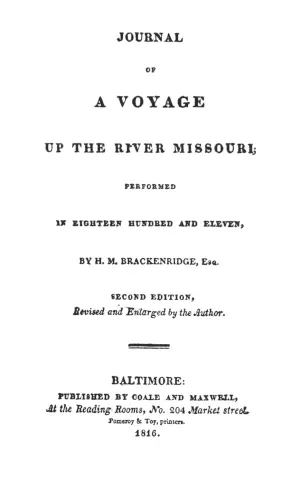
Brackenridge’s Journal of a voyage up the river Missouri, 1811; Franchère’s Voyage to Northwest Coast, 1811-1814
{144} The festival over, our people resumed their ordinary occupations: while some cut timber for building, and others made charcoal for the blacksmith, the carpenter constructed a barge, and the cooper made barrels for the use of the posts we proposed to establish in the interior. On the 18th, in the evening, two canoes full of white men arrived at the establishment. Mr. M’Dougal, the resident agent, being confined to his room by sickness, the duty of receiving the strangers devolved on me. My astonishment was not slight, when one of the party called me by name, as he extended his hand, and I recognised Mr. Donald M’Kenzie, the same who had quitted Montreal, with Mr. W. P. Hunt, in the month of July, 1810. He was accompanied by a Mr. Robert M’Lellan, a partner, Mr. John Reed, a clerk, and eight voyageurs, or boatmen. After having reposed themselves a little from their fatigues, these gentlemen recounted to us the history of their journey, of which the following is the substance.[77]
Messrs. Hunt and M’Kenzie, quitting Canada, {145} proceeded by way of Mackinac and St. Louis, and ascended the Missouri, in the autumn of 1810, to a place on that river called Nadoway, where they wintered. Here they were joined by Mr. R. M’Lellan, by a Mr. Crooks, and a Mr. Müller, traders with the Indians of the South, and all having business relations with Mr. Astor.
In the spring of 1811, having procured two large keel-boats, they ascended the Missouri to the country of the Arikaras, or Rice Indians, where they disposed of their boats and a great part of their luggage, to a Spanish trader, by name Manuel Lisa. Having purchased of him, and among the Indians, 130 horses, they resumed their route, in the beginning of August, to the number of some sixty-five persons, to proceed across the mountains to the river Columbia. Wishing to avoid the Blackfeet Indians, a war-like and ferocious tribe, who put to death all the strangers that fall into their hands, they directed their course southwardly, until they arrived at the 40th degree of latitude. Thence they turned {146} to the northwest, and arrived, by-and-by, at an old fort, or trading post, on the banks of a little river flowing west. This post, which was then deserted, had been established, as they afterward learned, by a trader named Henry. Our people, not doubting that this stream would conduct them to the Columbia, and finding it navigable, constructed some canoes to descend it. Having left some hunters (or trappers) near the old fort, with Mr. Miller, who, dissatisfied with the expedition, was resolved to return to the United States, the party embarked; but very soon finding the river obstructed with rapids and water-falls, after having upset some of the canoes, lost one man by drowning, and also a part of their baggage, perceiving that the stream was impracticable, they resolved to abandon their canoes and proceed on foot. The enterprise was one of great difficulty, considering the small stock of provisions they had left. Nevertheless, as there was no time to lose in deliberation, after depositing in a cache the superfluous part of their baggage, they divided themselves into four companies, {147} under the command of Messrs. M’Kenzie, Hunt, M’Lellan and Crooks, and proceeded to follow the course of the stream, which they named Mad river, on account of the insurmountable difficulties it presented. Messrs. M’Kenzie and M’Lellan took the right bank, and Messrs. Hunt and Crooks the left. They counted on arriving very quickly at the Columbia; but they followed this Mad river for twenty days, finding nothing at all to eat, and suffering horribly from thirst. The rocks between which the river flows being so steep and abrupt as to prevent their descending to quench their thirst (so that even their dogs died of it), they suffered the torments of Tantalus, with this difference, that he had the water which he could not reach above his head, while our travellers had it beneath their feet. Several, not to die of this raging thirst, drank their own urine: all, to appease the cravings of hunger, ate beaver skins roasted in the evening at the camp-fire. They even were at last constrained to eat their moccasins. Those on the left, or southeast bank, suffered, however, less {148} than the others, because they occasionally fell in with Indians, utterly wild indeed, and who fled at their approach, carrying off their horses. According to all appearances these savages had never seen white men. Our travellers, when they arrived in sight of the camp of one of these wandering hordes, approached it with as much precaution, and with the same stratagem that they would have used with a troop of wild beasts. Having thus surprised them, they would fire upon the horses, some of which would fall; but they took care to leave some trinkets on the spot, to indemnify the owners for what they had taken from them by violence. This resource prevented the party from perishing of hunger.