THE CLASSIC COLLECTION✦The Torch Bearer: A Camp Fire Girls’ StoryCLASSIC FREE BOOKS
The Torch Bearer: A Camp Fire Girls’ Story
I. T. (Ida Treadwell) Thurston
THE CLASSIC COLLECTION · 1896
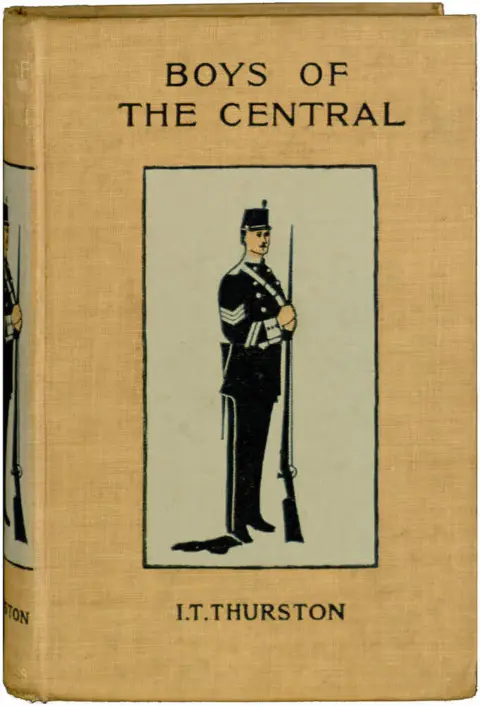
"Boys of the Central: A High-School Story" by I. T. Thurston is a novel written in the late 19th century. The story takes place in a traditional high school setting, following the experiences of a group of boys in section D, particularly focusing on two characters: the vulnerable Freeman and the morally upright Stanley Clark. The narrative explores themes of bullying, courage, loyalty, and the social dynamics of adolescence. The opening portion introduces readers to section D during an algebra recitation, highlighting the struggles of Freeman, who faces bullying from fellow classmate Crawford. Despite his quick mind, Freeman falters during class, leading to the embarrassment that invites verbal threats from Crawford when he tries to help. As friendships and rivalries unfold, the text establishes tensions that hint at the challenges of growing up, including the pressure to conform and the conflicts between the morally steadfast boys and the unruly ones like Crawford. In this first chapter, we see the early formation of social cliques and the dramatic impact of peer relationships, setting the stage for further developments in the story.
Introduction adapted from the source catalogue; source summaries may be automatically generated.
Free to read · English · 62,239 words · No account needed
MAKE TIME FOR A GOOD BOOK
On by default. Untick to stop anonymous reading totals. Each page counts after 10 seconds in view. How this works.
Anonymous counting is on unless you have switched it off.
“There he is. Catch him--catch him!” shouted Lee, pointing to a white figure just crawling out from under the mass of fallen snow.
“Surrender! Surrender!” shouted a score of voices, as the boys
surrounded Griffin.
“Oh, well, of course we must surrender, since you’ve got possession of the fort; but you had to take it by trickery--not in fair fight,” Griffin said, sullenly.
“All’s fair in love and war,” quoted Graham, gaily. “It was a perfectly fair stratagem, and certainly a successful one, I think.”
“Who cares what you think! Take that for a last shot!” and Griffin, losing all control of his hot temper at these words from Graham, whom he had never forgiven for winning the election, suddenly raised his arm and flung a snowball he was holding in his hand--straight at Graham’s face.
Clark was standing near Griffin, and as his quick eye saw the look on the latter’s face and the sudden movement, he sprang forward, and struck up Griffin’s arm, and the ball, instead of knocking Graham over, went crashing through a big window in a fine house across the street.
A change came over every face, as the rattle of the falling glass was
heard.
“You’re in for it, now, Grif,” said one.
“’Twasn’t my fault. ’Twas Clark’s. What did you knock my arm up for?” he added, turning angrily on Clark, and looking more than half inclined to strike him.
Clark did not flinch, as he answered gravely:--
“That ball might have hurt Graham pretty badly, Griffin.”
“Hurt him! I should say so!” cried Hamlin. “A ball that would break a window at this distance would have killed a fellow, sure. You must have thrown it with tremendous force, Griffin.”
Griffin dropped his eyes and said, sulkily:--
“Well, what’s to be done about it? I’ve no money to pay for plate-glass windows, and anyway, I think Clark’s the one to foot the bill--unless we bluff it out. Here comes the man, now.”
The gentleman who was coming quickly towards the group might have been excused for feeling that the limit of patience was reached in his case, since this was the third time that season that his windows had been broken by boys playing on the vacant lots. He was plainly very angry, as he began abruptly:--
“Which of you broke my window?”
For a second, nobody answered, and the man was about to express his opinion pretty freely, when Clark stepped forward.
“I am partly responsible for it, sir,” he said.
“Oh, you are--are you? Well, are you going to pay for it?”
Your reading position is saved on this browser. Take it to another device with a library code. Reading pages adapt to text, rather than matching a printed edition.
BEHIND THE BOOK
This eBook is for the use of anyone anywhere in the United States and most other parts of the world at no cost and with almost no restrictions whatsoever. You may copy it, give it away or re-use it under the terms of the Project Gutenberg License included with this eBook or online at www.gutenberg.org. If you are not located in the United States, you will have to check the laws of the country where you are located before using this eBook. Read the source licence.
The original source file, including credits and licence, is retained by this library. Request an original-format copy at no charge. Please include the book title and Project Gutenberg identifier #63156.
KEEP YOUR CURIOSITY GOING
Coulson Kernahan

Maurice Baring
Frances Wright
Cécile Tormay

Frederic Jesup Stimson

W. H. P. (William Henry Pope) Jarvis