THE CLASSIC COLLECTION✦Ten Girls from HistoryCLASSIC FREE BOOKS
Ten Girls from History
Kate Dickinson Sweetser
THE CLASSIC COLLECTION · 1907
"Boys and Girls from Thackeray" by Kate Dickinson Sweetser is a collection of literary adaptations crafted in the early 20th century. This work presents engaging stories derived from the childhood and youth of notable characters created by William Makepeace Thackeray, such as Henry Esmond and Becky Sharp. The purpose of this compilation is to introduce Thackeray’s work to younger audiences, showcasing the delightful pastimes and experiences of his characters, making his literature accessible and appealing to a new generation of readers. At the start of the compilation, the author highlights Thackeray's fondness for depicting the early lives of his characters, especially with the introduction of Henry Esmond, a lonely boy of about twelve years old who resides in the Castlewood estate. As Henry navigates his new environment following the arrival of the new Viscount and Viscountess Castlewood, he experiences kindness for the first time from Lady Castlewood, establishing a sense of belonging. The opening vividly illustrates the contrast between Henry’s earlier isolation and the warmth offered by his new family, setting the stage for the themes of friendship, belonging, and the trials of youth that resonate throughout Thackeray's narratives.
Introduction adapted from the source catalogue; source summaries may be automatically generated.
Free to read · English · 103,497 words · No account needed
MAKE TIME FOR A GOOD BOOK
On by default. Untick to stop anonymous reading totals. Each page counts after 10 seconds in view. How this works.
Anonymous counting is on unless you have switched it off.
Again and again Harry Warrington and his brother had pored over the English map, and determined upon the course which they should take upon arriving at Home. All Americans of English ancestry who love their mother country have rehearsed their English travels, and visited in fancy the spots with which their hopes, their parents' fond stories, their friends' descriptions, have rendered them familiar. There are few things to me more affecting in the history of the quarrel which divided the two great nations than the recurrence of that word Home, as used by the younger towards the elder country. Harry Warrington had his chart laid out. Before London, and its glorious temples of St. Paul's and St. Peter's; its grim Tower, where the brave and loyal had shed their blood, from Wallace down to Balmerino and Kilmarnock, pitied by gentle hearts; before the awful window at Whitehall, whence the martyr Charles had issued, to kneel once more, and then ascended to Heaven; before playhouses, parks, and palaces, wondrous resorts of wit, pleasure and splendour; before Shakespeare's resting-place under the tall spire which rises by Avon, amidst the sweet Warwickshire pastures; before Derby, and Falkirk, and Culloden, where the cause of honour and loyalty had fallen, it might be to rise no more: before all these points in their pilgrimage there was one which the young Virginian brothers held even more sacred, and that was the home of their family, that old Castlewood in Hampshire, about which their parents had talked so fondly. From Bristol to Bath, from Bath to Salisbury, to Winchester, to Hexton, to Home; they knew the way, and had mapped the journey many and many a time.
We must fancy our American traveller to be a handsome young fellow, whose suit of sables only makes him look the more interesting. The plump landlady looked kindly after the young gentleman as he passed through the inn-hall from his post-chaise, and the obsequious chamberlain bowed him upstairs to the "Rose" or the "Dolphin." The trim chambermaid dropped her best curtsey for his fee, and Gumbo, in the inn-kitchen, where the townsfolk drank their mug of ale by the great fire, bragged of his young master's splendid house in Virginia, and of the immense wealth to which he was heir. The post-chaise whirled the traveller through the most delightful home scenery his eyes had ever lighted on. If English landscape is pleasant to the American of the present day, who must needs contrast the rich woods and growing pastures and picturesque ancient villages of the old country with the rough aspect of his own, how much pleasanter must Harry Warrington's course have been, whose journeys had lain through swamps and forest solitudes from one Virginian ordinary to another log-house at the end of the day's route, and who now lighted suddenly upon the busy, happy, splendid scene of English summer? And the high-road, a hundred years ago, was not that grass-grown desert of the present time. It was alive with constant travel and traffic: the country towns and inns swarmed with life and gaiety. The ponderous waggon, with its bells and plodding team; the light post-coach that achieved the journey from the "White Hart," Salisbury, to the "Swan with Two Necks," London, in two days; the strings of pack-horses that had not yet left the road; my lord's gilt post-chaise and six, with the outriders galloping on ahead; the country squire's great coach and heavy Flanders mares; the farmers trotting to market, or the parson jolting to the cathedral town on Dumpling, his wife behind on the pillion--all these crowding sights and brisk people greeted the young traveller on his summer journey. Hodge, the farmer's boy, took off his hat, and Polly, the milk-maid, bobbed a curtsey, as the chaise whirled over the pleasant village-green, and the white-headed children lifted their chubby faces and cheered. The church-spires glistened with gold, the cottage-gables glared in sunshine, the great elms murmured in summer, or cast purple shadows over the grass. Young Warrington never had had such a glorious day, or witnessed a scene so delightful. To be nineteen years of age, with high health, high spirits, and a full purse, to be making your first journey, and rolling through the country in a post-chaise at nine miles an hour--Oh, happy youth! almost it makes one young to think of him!
Your reading position is saved on this browser. Take it to another device with a library code. Reading pages adapt to text, rather than matching a printed edition.
Kate Dickinson Sweetser
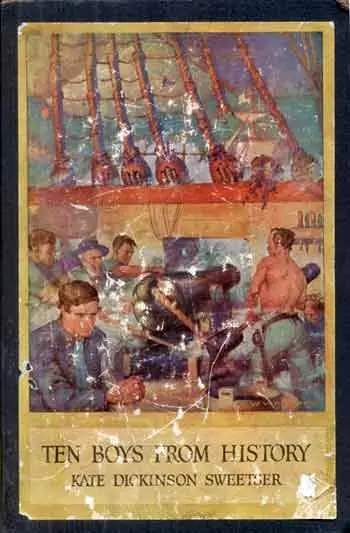
Kate Dickinson Sweetser
Kate Dickinson Sweetser
Kate Dickinson Sweetser
BEHIND THE BOOK
This eBook is for the use of anyone anywhere in the United States and most other parts of the world at no cost and with almost no restrictions whatsoever. You may copy it, give it away or re-use it under the terms of the Project Gutenberg License included with this eBook or online at www.gutenberg.org. If you are not located in the United States, you will have to check the laws of the country where you are located before using this eBook. Read the source licence.
The original source file, including credits and licence, is retained by this library. Request an original-format copy at no charge. Please include the book title and Project Gutenberg identifier #10111.
KEEP YOUR CURIOSITY GOING

Abby Morton Diaz
Helen Hunt Jackson
Mary Frances Blaisdell
Stuart Dodgson Collingwood

Kate Douglas Smith Wiggin
Hesba Stretton