THE CLASSIC COLLECTION✦Ten Girls from HistoryCLASSIC FREE BOOKS
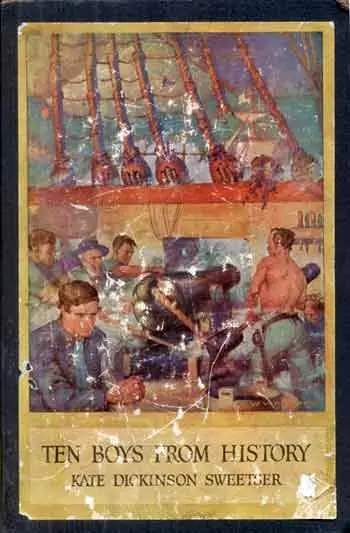
Ten Girls from History
Kate Dickinson Sweetser
THE CLASSIC COLLECTION · 1907
"Boys and Girls from Thackeray" by Kate Dickinson Sweetser is a collection of literary adaptations crafted in the early 20th century. This work presents engaging stories derived from the childhood and youth of notable characters created by William Makepeace Thackeray, such as Henry Esmond and Becky Sharp. The purpose of this compilation is to introduce Thackeray’s work to younger audiences, showcasing the delightful pastimes and experiences of his characters, making his literature accessible and appealing to a new generation of readers. At the start of the compilation, the author highlights Thackeray's fondness for depicting the early lives of his characters, especially with the introduction of Henry Esmond, a lonely boy of about twelve years old who resides in the Castlewood estate. As Henry navigates his new environment following the arrival of the new Viscount and Viscountess Castlewood, he experiences kindness for the first time from Lady Castlewood, establishing a sense of belonging. The opening vividly illustrates the contrast between Henry’s earlier isolation and the warmth offered by his new family, setting the stage for the themes of friendship, belonging, and the trials of youth that resonate throughout Thackeray's narratives.
Introduction adapted from the source catalogue; source summaries may be automatically generated.
Free to read · English · 103,497 words · No account needed
MAKE TIME FOR A GOOD BOOK
On by default. Untick to stop anonymous reading totals. Each page counts after 10 seconds in view. How this works.
Anonymous counting is on unless you have switched it off.
And the courtly artist daintily enveloped the drawing in a sheet of paper, put it away in his hat, and vowed subsequently that the great painter had been delighted with the young man's performance. Smee was not only charmed with Clive's skill as an artist, but thought his head would be an admirable one to paint. Such a rich complexion, such fine turns in his hair! Such eyes! To see real blue eyes was so rare now-a-days! And the Colonel too, if the Colonel would but give him a few sittings, the grey uniform of the Bengal Cavalry, the silver lace, the little bit of red ribbon just to warm up the picture! It was seldom, Mr. Smee declared, that an artist could get such an opportunity for colour. But no cajoleries could induce the Colonel to sit to any artist save one. There hangs in Clive's room now, a head, painted at one sitting, of a man rather bald, with hair touched with grey, with a large moustache and a sweet mouth half smiling beneath it, and melancholy eyes. Clive shows that portrait of their grandfather to his children, and tells them that the whole world never saw a nobler gentleman.
Well, then; Clive having decided to become an artist, on a day marked with a white stone, Colonel Newcome with his son and Mr. Smee, R. A., walked to Gandish's and entered the would-be artist on the roll call of that famous academy, and of J. J. as well, for the Colonel had insisted upon paying his expenses as an art student together with his son.
Mr. Gandish was an excellent master and the two lads made great progress under his excellent training. Clive used to give droll accounts of the young disciples at Gandish's, who were of various ages and conditions, and in whose company the young fellow took his place with that good temper and gaiety which seldom deserted him and put him at ease wherever his fate led him. Not one of the Gandishites but liked Clive, and at that period of his existence he enjoyed himself in all kinds of ways, making himself popular with dancing folks and with drawing folks, and the jolly king of his company everywhere. He gave entertainments in the rooms in Fitzroy Square which were devoted to his use, inviting his father and Mr. Binnie now and then, but the good Colonel did not often attend those parties. He saw that his presence rather silenced the young men, and went away to play his rubber of whist at the club. And although time hung a bit heavily on the good Colonel's hands, now that Clive's interests were separate from his own, yet of nights as he heard Clive's companions tramping by his bedchamber door, where he lay wakeful within, he was happy to think his son was happy. As for Clive, those were glorious days for him. If he was successful in the Academy, he was doubly victorious out of it. His person was handsome, his courage high, his gaiety and frankness delightful and winning. His money was plenty and he spent it like a young king. He was not the most docile of Mr. Gandish's pupils, and if the truth must be told about him, though one of the most frank, generous and kind-hearted persons, was somewhat haughty and imperious. He had been known to lament since that he was taken from school too early where a further course of thrashings would, he believed, have done him good. He lamented that he was not sent to college, where if a young man receives no other discipline at least he meets his equals in society and assuredly finds his betters; whereas in Mr. Gandish's studio our young gentleman scarcely found a comrade that was not in one way or other his flatterer, his inferior, his honest or dishonest admirer. The influence of his family's rank and wealth acted more or less on all these simple folks, who would run on his errands and vied with each other winning his favour. His very goodness of heart rendered him a more easy prey to their flattery, and his kind and jovial disposition led him into company from which he had much better have been away. In fact, as the Colonel did not attempt in any way to check him in his youthful career of extravagance and experiences which were the result of an excessive high spirit, our young gentleman at this time brought down upon himself much adverse criticism for his behaviour, especially from his uncles. Because of this and other reasons there was not much friendliness exhibited by the several branches of the family for Clive and his father. Colonel Newcome, in spite of coldness, felt it his duty to make constant attempts to remain on friendly terms at least with the wives of his stepbrothers. But after he had called twice or thrice upon his sister-in-law in Brianstone Square, bringing as was his wont a present for this little niece or a book for that, Mrs. Newcome gave him to understand that the occupation of an English matron would not allow her to pass the mornings in idle gossip, and with curtseys and fine speeches actually bowed her brother out of doors; and the honest gentleman meekly left her, though with bewilderment as he thought of the different hospitality to which he had been accustomed in the East, where no friend's house was ever closed to him, where no neighbour was so busy but he had time to make Thomas Newcome welcome.
Your reading position is saved on this browser. Take it to another device with a library code. Reading pages adapt to text, rather than matching a printed edition.
Kate Dickinson Sweetser
Kate Dickinson Sweetser
Kate Dickinson Sweetser
Kate Dickinson Sweetser
BEHIND THE BOOK
This eBook is for the use of anyone anywhere in the United States and most other parts of the world at no cost and with almost no restrictions whatsoever. You may copy it, give it away or re-use it under the terms of the Project Gutenberg License included with this eBook or online at www.gutenberg.org. If you are not located in the United States, you will have to check the laws of the country where you are located before using this eBook. Read the source licence.
The original source file, including credits and licence, is retained by this library. Request an original-format copy at no charge. Please include the book title and Project Gutenberg identifier #10111.
KEEP YOUR CURIOSITY GOING

Abby Morton Diaz
Helen Hunt Jackson
Mary Frances Blaisdell
Stuart Dodgson Collingwood

Kate Douglas Smith Wiggin
Hesba Stretton