THE CLASSIC COLLECTION✦Ten Girls from HistoryCLASSIC FREE BOOKS
Ten Girls from History
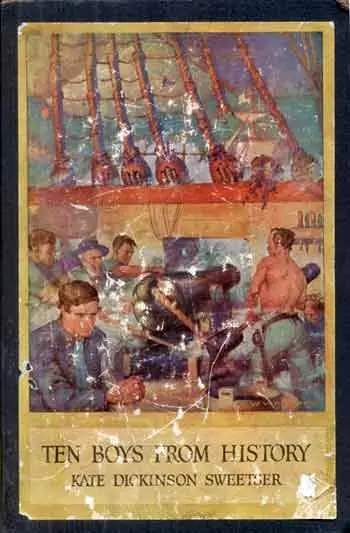
Kate Dickinson Sweetser
THE CLASSIC COLLECTION · 1907
"Boys and Girls from Thackeray" by Kate Dickinson Sweetser is a collection of literary adaptations crafted in the early 20th century. This work presents engaging stories derived from the childhood and youth of notable characters created by William Makepeace Thackeray, such as Henry Esmond and Becky Sharp. The purpose of this compilation is to introduce Thackeray’s work to younger audiences, showcasing the delightful pastimes and experiences of his characters, making his literature accessible and appealing to a new generation of readers. At the start of the compilation, the author highlights Thackeray's fondness for depicting the early lives of his characters, especially with the introduction of Henry Esmond, a lonely boy of about twelve years old who resides in the Castlewood estate. As Henry navigates his new environment following the arrival of the new Viscount and Viscountess Castlewood, he experiences kindness for the first time from Lady Castlewood, establishing a sense of belonging. The opening vividly illustrates the contrast between Henry’s earlier isolation and the warmth offered by his new family, setting the stage for the themes of friendship, belonging, and the trials of youth that resonate throughout Thackeray's narratives.
Introduction adapted from the source catalogue; source summaries may be automatically generated.
Free to read · English · 103,497 words · No account needed
MAKE TIME FOR A GOOD BOOK
On by default. Untick to stop anonymous reading totals. Each page counts after 10 seconds in view. How this works.
Anonymous counting is on unless you have switched it off.
Then came the birth of Mrs. Newcome's twin boys, Hobson and Bryan, and now there was no reason why young Newcome, their step-brother, should not go to school, and to Grey Friars Thomas Newcome was accordingly sent, exchanging--O ye gods! with what delight--the splendour of Clapham for the rough, plentiful fare of the new place. The pleasures of school-life were such to him that he did not care to go home for a holiday; for by playing tricks and breaking windows, by taking the gardener's peaches and the housekeeper's jam, by upsetting his two little brothers in a go-cart (of which injury the Baronet's nose bore marks to his dying day), by going to sleep during the sermons, and treating reverend gentlemen with levity, he drew down on himself the merited anger of his step-mother; and many punishments. To please Mrs. Newcome, his father whipped Tommy for upsetting his little brothers in the go-cart; but, upon being pressed to repeat the whipping for some other prank, Mr. Newcome refused, saying that the boy got flogging enough at school, with which opinion Master Tommy fully agreed. His step-mother, however, determined to make the young culprit smart for his offences, and one day, when Mr. Newcome was absent, and Tommy refractory as usual, summoned the butler and footman to flog the young criminal. But he dashed so furiously against the butler's shins as to cause that menial to limp and suffer for many days after; and, seizing the decanter, he threatened to discharge it at Mrs. Newcome's head before he would submit to the punishment she desired administered. When Mr. Newcome returned, he was indignant at his wife's treatment of Tommy, and said so, to her great displeasure. This affair, indeed, almost caused a break in their relations, and friends and clergy were obliged to interfere to allay the domestic quarrel. At length Mrs. Newcome, who was not unkind, and could be brought to own that she was sometimes in fault, was induced to submit to the decrees of her husband, whom she had vowed to love and honour. When Tommy fell ill of scarlet fever she nursed him through his illness, and uttered no reproach to her husband when the twins took the disease. And even though Tommy in his delirium vowed that he would put on his clothes and run away to his old nurse Sarah, Mrs. Newcome's kindness to him never faltered. What the boy threatened in his delirium, a year later he actually achieved. He ran away from home, and appeared one morning, gaunt and hungry, at Sarah's cottage two hundred miles away from Clapham. She housed the poor prodigal with many tears and kisses, and put him to bed and to sleep; from which slumber he was aroused by the appearance of his father, whose instinct, backed by Mrs. Newcome's intelligence, had made him at once aware whither the young runaway had fled. Seeing a horsewhip in his parent's hand, Tommy, scared out of a sweet sleep and a delightful dream of cricket, knew his fate; and getting out of bed, received his punishment without a word. Very likely the father suffered more than the child; for, when the punishment was over, the little man yet quivering with the pain, held out his little bleeding hand, and said, "I can--I can take it from you, sir," saying which his face flushed, and his eyes filled, whereupon the father burst into a passion of tears, and embraced the boy, and kissed him, besought him to be rebellious no more, flung the whip away from him, and swore, come what would, he would never strike him again. The quarrel was the means of a great and happy reconciliation. But the truce was only a temporary one. War very soon broke out again between the impetuous lad and his rigid, domineering step-mother. It was not that he was very bad, nor she so very stern, but the two could not agree. The boy sulked and was miserable at home, and, after a number of more serious escapades than he had before indulged in, he was sent to a tutor for military instruction, where he was prepared for the army and received a fairly good professional education. He cultivated mathematics and fortification, and made rapid progress in his study of the French language. But again did our poor Tommy get into trouble, and serious trouble indeed this time, for it involved his French master's pretty young daughter as well as himself. Frantic with wrath and despair at the unfortunate climax of events, young Newcome embarked for India, and quitted the parents whom he was never more to see. His name was no more mentioned at Clapham, but he wrote constantly to his father, who sent Tom liberal private remittances to India, and was in turn made acquainted with the fact of his son's marriage, and later received news of the birth of his grandson, Clive.
Your reading position is saved on this browser. Take it to another device with a library code. Reading pages adapt to text, rather than matching a printed edition.
Kate Dickinson Sweetser
Kate Dickinson Sweetser
Kate Dickinson Sweetser
Kate Dickinson Sweetser
BEHIND THE BOOK
This eBook is for the use of anyone anywhere in the United States and most other parts of the world at no cost and with almost no restrictions whatsoever. You may copy it, give it away or re-use it under the terms of the Project Gutenberg License included with this eBook or online at www.gutenberg.org. If you are not located in the United States, you will have to check the laws of the country where you are located before using this eBook. Read the source licence.
The original source file, including credits and licence, is retained by this library. Request an original-format copy at no charge. Please include the book title and Project Gutenberg identifier #10111.
KEEP YOUR CURIOSITY GOING

Abby Morton Diaz
Helen Hunt Jackson
Mary Frances Blaisdell
Stuart Dodgson Collingwood

Kate Douglas Smith Wiggin
Hesba Stretton