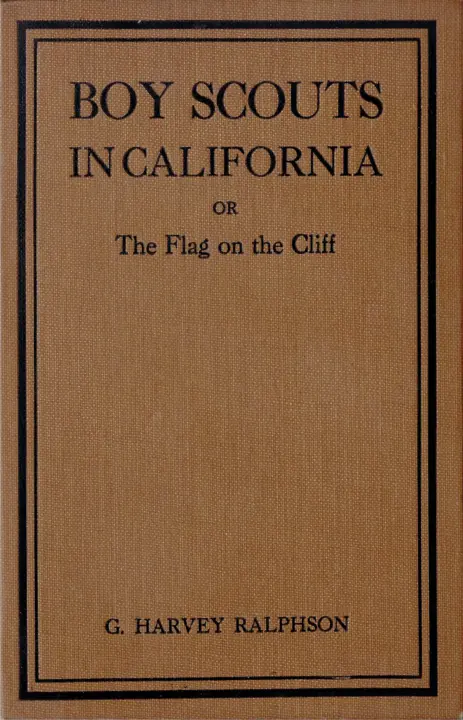
Boy Scouts in California; or, The Flag on the Cliff
G. Harvey (George Harvey) Ralphson
THE CLASSIC COLLECTION · 1913
"Boy Scouts in the North Sea; Or, the Mystery of 'U-13'" by G. Harvey Ralphson is a novel written in the early 20th century. The story revolves around a group of young American Boy Scouts who find themselves caught in the midst of war while trying to return home. Led by Ned Nestor and accompanied by his friends Jimmie McGraw, Jack Bosworth, and Harry Stevens, they become embroiled in an intriguing adventure involving espionage, a mysterious package connected to a German submarine known as "U-13," and unexpected dangers across the waters of Europe. At the start of the novel, the boys are traveling through a flooded region as they make their way back from an earlier mission in Belgium. As they board a train to Holland, they are subjected to a search by soldiers who discover a mysterious package in their belongings bearing the mark "U-13." Just as they are about to be interrogated, the package is stolen right before their eyes, immensely heightening their curiosity and sense of danger. Following the commotion, they meet a new companion named Robert Mackinder but soon find themselves pursued for the package and have to navigate a network of intrigue that includes their past encounters with the enigmatic figure trying to claim the package. The opening sets the stage for a thrilling series of events, as the boys encounter challenges that test their resourcefulness and camaraderie.
Introduction adapted from the source catalogue; source summaries may be automatically generated.
Free to read · English · 48,916 words · No account needed
MAKE TIME FOR A GOOD BOOK
On by default. Untick to stop anonymous reading totals. Each page counts after 10 seconds in view. How this works.
Anonymous counting is on unless you have switched it off.
One of the men pointed to the uniforms and to the medals upon the sleeves of the boys’ jackets. Gradually his companion seemed to be convinced by the flow of words. At length he nodded his head, as if surrendering his last doubts. The two men fell to examining the luggage.
“Go as far as you like, Old Scout!” scorned Jimmie, as he observed the rough manner in which his belongings were being tossed about. “I’ll bet I’d punch your dome a little, though, if you could talk English!”
“Ah, ha!” cried one of the soldiers, tapping his comrade on the shoulder, as if his argument had been conclusively supported. “Anglaise!”
A torrent of words from the other seemed to meet a receptive ear. The first speaker nodded energetically. His satisfaction was all too evident. From his appearance he was expecting nothing short of a medal.
“Judging from their motions,” Jimmie remarked, “these two fellows are about to fight a duel. I’ll bet on the shorter one!”
“Not much!” declared Harry. “They’re merely telling one another what a nice day it was yesterday and how fine the weather’ll be when it clears up. They are using the sign language, that’s all!”
“Don’t you kid yourself!” protested Jimmie, uneasily. “I smell Old Man Trouble coming around the corner right now!”
“Go on, Jimmie!” scorned Jack. “You’re dreaming again!”
“I know I am!” replied the younger lad. “Last night I dreamed of eating salt mackerel and my dream book says that means trouble!”
“Here they come now!” cautioned Ned. “Hush a minute, boys!”
Addressing the boys in German the soldier was evidently asking some question which demanded an answer. Ned as spokesman shook his head. The other soldier spoke rapidly in the French language.
“Excuse me, gentlemen,” Ned said, lifting a protesting hand, “we cannot understand the language you are using. We speak only English!”
“Ah, ha! Anglaise!” cried the soldier, gesticulating.
“There, you put your foot in it!” declared Jimmie. “Why didn’t you say: ‘Come across with some good old United States, Bo’?”
“They probably don’t understand your slang, Jimmie!” replied Ned.
“So-o-o,” exclaimed one of the men in poor English, “you speak English, do you? And from what part of England do you come?”
“We are not from England at all,” explained Ned, “but from the United States. We are being sent home by the kindness of a German officer, who has been most considerate. See, here are our passports!”
“Bah!” scornfully protested the man. “Passports are most easily forged. And information may be carried still more easily!”
“But I assure you,” continued Ned, “we are speaking the truth!”
Your reading position is saved on this browser. Take it to another device with a library code. Reading pages adapt to text, rather than matching a printed edition.
G. Harvey (George Harvey) Ralphson
G. Harvey (George Harvey) Ralphson
G. Harvey (George Harvey) Ralphson
G. Harvey (George Harvey) Ralphson
BEHIND THE BOOK
This eBook is for the use of anyone anywhere in the United States and most other parts of the world at no cost and with almost no restrictions whatsoever. You may copy it, give it away or re-use it under the terms of the Project Gutenberg License included with this eBook or online at www.gutenberg.org. If you are not located in the United States, you will have to check the laws of the country where you are located before using this eBook. Read the source licence.
The original source file, including credits and licence, is retained by this library. Request an original-format copy at no charge. Please include the book title and Project Gutenberg identifier #60345.
KEEP YOUR CURIOSITY GOING
Coulson Kernahan

Maurice Baring
Frances Wright
Cécile Tormay

Frederic Jesup Stimson

W. H. P. (William Henry Pope) Jarvis