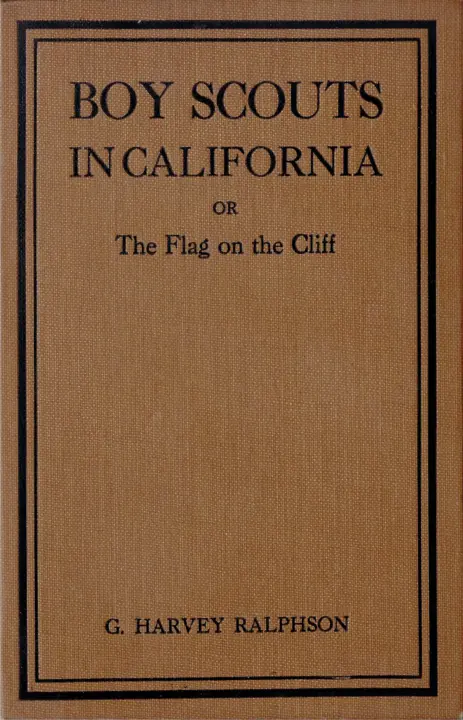
Boy Scouts in California; or, The Flag on the Cliff
G. Harvey (George Harvey) Ralphson
THE CLASSIC COLLECTION · 1911
"Boy Scouts in the Canal Zone; Or, The Plot Against Uncle Sam" by G. Harvey Ralphson is a thrilling adventure novel written in the early 20th century. This story follows a group of enthusiastic Boy Scouts, primarily led by Ned Nestor, who embark on a mission to help thwart a dangerous plot against the Gatun Dam in the Panama Canal Zone. The book is heavy on action, camaraderie, and the themes of patriotism, with a focus on the resourcefulness and bravery of young scouts who get caught up in a national intrigue. The opening of the narrative introduces the Black Bear Patrol, a group of scouts excited about their next adventure after a recent excursion in Mexico. They are eager to accompany Lieutenant Gordon on a secret mission tied to suspicious activities in the Canal Zone. As they prepare for the trip, discussions arise regarding a potential threat to the Gatun Dam, leading to speculation about who could be behind such a dangerous plot. The tone quickly escalates to one of urgency as they learn of a theft involving Frank Shaw's valuable emerald necklace, prompting them to engage in a mystery that intertwines their adventures with espionage and suspense. Through banter and camaraderie, the boys display their youthful energy and determination as they set the stage for a more significant confrontation against hidden adversaries.
Introduction adapted from the source catalogue; source summaries may be automatically generated.
Free to read · English · 49,121 words · No account needed
MAKE TIME FOR A GOOD BOOK
On by default. Untick to stop anonymous reading totals. Each page counts after 10 seconds in view. How this works.
Anonymous counting is on unless you have switched it off.
Then, as the Boy Scouts looked, thinking of the glory of a camp in the thicket--of a retired nook on some dry knoll--the jungle disappeared as if by magic, and the train was winding up grassy hills. Beyond, higher up, the scattered houses of a city of fair size came into view.
"That's Gatun," cried Fenton. "I've read half a dozen descriptions of it lately. Great town, that."
"The houses look like boxes from here," Jimmie observed.
"Of course," Peter replied, "they are all two-story houses, square, with double balconies all screened in. Might be Philadelphia, eh?"
There were smooth roads in front of the houses, and there were yards where flowers were growing, and where neatly dressed children were playing. Jimmie turned from the homelike scene to Frank.
"I thought there would be something new down here," he complained. "This is just like a town up the Hudson."
"Jimmie expected to find people living in tents made out of animal skins," laughed George. "He thinks the natives eat folks alive."
"You wait until you get out of the country," Frank said, "before you talk of cottages up the Hudson. There will be something stirring before we get off the Isthmus."
"I hope so," Jimmie replied. "There surely will be if we camp back there in the jungle, among the snakes and lizards."
"Why not camp on the hills back there?" asked Jack.
"We may soon camp anywhere we like," said Ned. "The Zone government understands that we are a lot of kids out after specimens."
"Specimens of what?" asked Jimmie.
"Tall, slender men with black hair turning gray," replied Frank.
"Quit your kiddin'," grinned Jimmie.
The boys left the train at a modern depot, passed through the train-shed, crossed a level sward, and looked down into a mighty chasm.
"Great Scott!" cried Frank. "Is that the bottom of the world?"
He pointed below as he spoke.
"There seems to be a thin crust of rock between the bottom and the other side of the world," laughed George. "See! There are tunnels and pits down there. The men are still digging. Look like ants, don't they?"
It was a wonderful sight, and the Boy Scouts gazed long at the scene of activity before turning away toward the Gatun dam itself. This, Peter Fenton explained, was one of the big cuts of the canal, and ran from the marshy valley above down through the rocky ridge which held the rains in check and made a swamp of the upland.
Your reading position is saved on this browser. Take it to another device with a library code. Reading pages adapt to text, rather than matching a printed edition.
G. Harvey (George Harvey) Ralphson
G. Harvey (George Harvey) Ralphson
G. Harvey (George Harvey) Ralphson
G. Harvey (George Harvey) Ralphson
BEHIND THE BOOK
This eBook is for the use of anyone anywhere in the United States and most other parts of the world at no cost and with almost no restrictions whatsoever. You may copy it, give it away or re-use it under the terms of the Project Gutenberg License included with this eBook or online at www.gutenberg.org. If you are not located in the United States, you will have to check the laws of the country where you are located before using this eBook. Read the source licence.
The original source file, including credits and licence, is retained by this library. Request an original-format copy at no charge. Please include the book title and Project Gutenberg identifier #26540.
KEEP YOUR CURIOSITY GOING
Coulson Kernahan

Maurice Baring
Frances Wright
Cécile Tormay

Frederic Jesup Stimson

W. H. P. (William Henry Pope) Jarvis