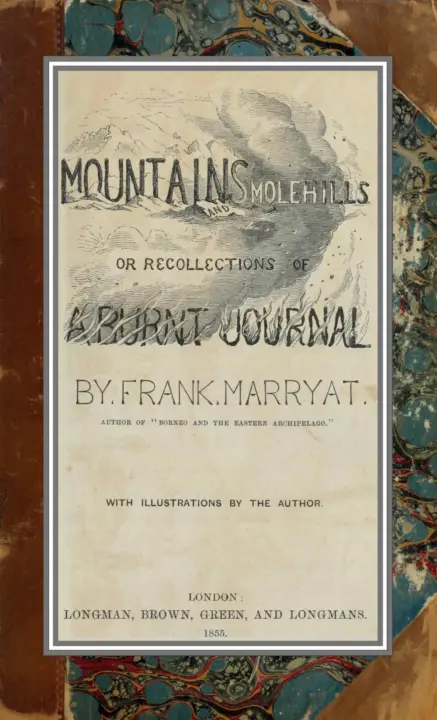
Mountains and molehills; or, Recollections of a burnt journal
Frank Marryat
THE CLASSIC COLLECTION · 1848
"Borneo and the Indian Archipelago" by Frank Marryat is a historical narrative documenting the author's experiences and observations while serving as a midshipman on H. M. S. Samarang during its surveying expedition in the mid-19th century. This work provides an intricate exploration of the cultures, landscapes, and maritime activities encountered across Borneo and the surrounding islands. The opening portion sets the stage for the journey of H. M. S. Samarang, detailing the departure from Portsmouth and the initial stages of the expedition. Marryat introduces his voyage through various locations, including the Canary Islands and Cape of Good Hope, and vividly describes the crew's interactions and encounters along the way. Notably, he emphasizes the importance of accurate representation in drawings, highlighting his own collection of illustrations depicting local costumes and scenery as a vital component of his observations. As the narrative unfolds, it hints at significant encounters with natives, piracy, and the civilizing efforts led by figures such as Mr. Brooke in Sarawak, establishing a rich backdrop for the following chapters.
Introduction adapted from the source catalogue; source summaries may be automatically generated.
Free to read · English · 73,820 words · No account needed
MAKE TIME FOR A GOOD BOOK
On by default. Untick to stop anonymous reading totals. Each page counts after 10 seconds in view. How this works.
Anonymous counting is on unless you have switched it off.
The next morning, at daylight, we repaired to our boats, and when all was ready took leave of the old rajah. The rajah's eldest son had promised to accompany us to the mouth of the river, and show us how the natives hunted the wild pigs, which are very numerous in all the jungles of Borneo.
We got under weigh and proceeded down the river accompanied by a large canoe, which was occupied by the rajah's son, six or seven hunters, and a pack of the dogs used in hunting the wild boar on this island. These dogs were small, but very wiry, with muzzles like foxes, and curling tails. Their hair was short, and of a tan colour. Small as they are, they are very bold, and one of them will keep a wild pig at bay till the hunters come up to him.
We arrived at the hunting ground at the mouth of the river in good time, before the scent was off, and landed in the Tam-bang. Our captain having a survey to make of an island at the mouth of the river, to our great delight took away the barge and gig, leaving Mr. Brooke, Hentig, Captain Keppell, Adams, and myself, to accompany the rajah's son. Having arranged that the native boat should pull along the coast in the direction that we were to walk, and having put on board the little that we had collected for our dinners, we shouldered our guns and followed the hunters and dogs. The natives who accompanied us were naked, and armed only with a spear. They entered the jungle with the dogs, rather too fatiguing an exercise for us, and we contented ourselves with walking along the beach abreast of them, waiting very patiently for the game to be started. In a very few minutes the dogs gave tongue, and as the noise continued we presumed that a boar was on foot; nor were we wrong in our conjecture; the barking of the dogs ceased, and one of the hunters came out of the jungle to us with a fine pig on his back, which he had transfixed with his spear. Nor were we long without our share of the sport, for we suddenly came upon a whole herd which had been driven out of the jungle, and our bullets did execution. We afterwards had more shots, and with what we killed on the beach, and the natives secured in the jungle, as the evening advanced we found ourselves in possession of eight fine grown animals. These the rajah's son and his hunters very politely requested our acceptance of. We now had quite sufficient materials for our dinner, and as we were literally as hungry as hunters, we were most anxious to fall to, and looked upon our pigs with very cannibal eyes. The first thing necessary was to light a fire, and for the first time I had an opportunity of seeing the Dyak way of obtaining it. It differs slightly from the usual manner, and is best explained by a sketch. Captain Keppell, who was always the life and soul of every thing, whether it was a fight or a pic nic, was unanimously elected caterer, and in that capacity he was most brilliant. I must digress a little to bestow upon that officer the meed of universal opinion; for his kindness, mirth, and goodness of heart, have rendered him a favourite wherever he has been known, not only a favourite with the officers, but even more so, if possible, with the men. In the expeditions in which Keppell has been commanding officer, where the men were worn out with continued exertion at the oar, and with the many obstacles to be overcome, Keppell's voice would be heard, and when heard, the men were encouraged and renewed their endeavours. Keppell's stock, when provisions were running short, and with small hopes of a fresh supply, was freely shared among those about him, while our gallant captain, with a boat half filled with his own hampers, would see, and appeared pleased to see, those in his company longing for a mouthful which never would be offered. If any of the youngsters belonging to other ships were, from carelessness or ignorance, in trouble with the commanding officers, it was to Keppell that they applied, and it was Keppell who was the intercessor. In fact, every occasion in which kindness, generosity, or consideration for others could be shown, such an opportunity was never lost by Keppell, who, to sum up, was a beloved friend, a delightful companion, and a respected commander. As soon as our fire was lighted, we set to, under Keppell's directions, and, as may be supposed, as we had little or nothing else, pork was our principal dish. In fact, we had pig at the top, pig at the bottom, pig in the centre, and pig at the sides. A Jew would have made but a sorry repast, but we, emancipated Christians, made a most ravenous one, defying Moses and all his Deuteronomy. We had plenty of wine and segars, and soon found ourselves very comfortably seated on the sand, still warm from the rays of the burning mid-day sun. Towards the end of a long repast we felt a little chilly, and we therefore rose and indulged in the games of leap-frog, fly-the-garter, and other venturous amusements. We certainly had in our party one or two who were as well fitted to grace the senate as to play at leap-frog, but I have always observed that the cleverest men are the most like children when an opportunity is offered for relaxation. I don't know what the natives thought of the European Rajah Brooke playing at leap-frog, but it is certain that the rajah did not care what they thought. I have said little of Mr. Brooke, but I will now say that a more mild, amiable, and celebrated person I never knew. Every one loved him, and he deserved it.
Your reading position is saved on this browser. Take it to another device with a library code. Reading pages adapt to text, rather than matching a printed edition.
BEHIND THE BOOK
This eBook is for the use of anyone anywhere in the United States and most other parts of the world at no cost and with almost no restrictions whatsoever. You may copy it, give it away or re-use it under the terms of the Project Gutenberg License included with this eBook or online at www.gutenberg.org. If you are not located in the United States, you will have to check the laws of the country where you are located before using this eBook. Read the source licence.
The original source file, including credits and licence, is retained by this library. Request an original-format copy at no charge. Please include the book title and Project Gutenberg identifier #26844.
KEEP YOUR CURIOSITY GOING
Wilfrid Scawen Blunt
Wilfrid Scawen Blunt

E. W. (Edgar Watson) Howe
Cécile Tormay

Moritz Busch
John L. Ransom