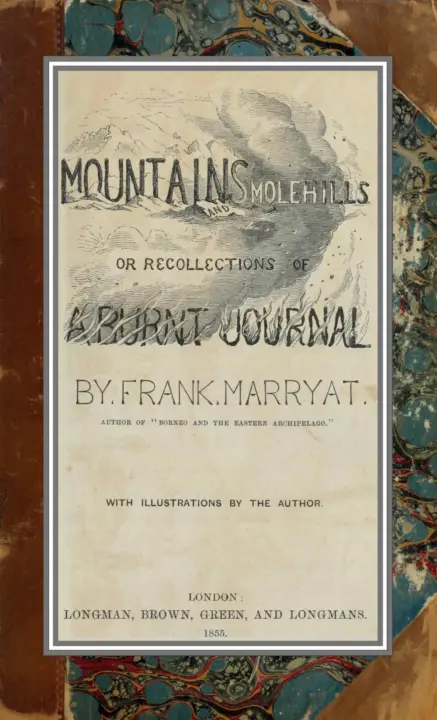
Mountains and molehills; or, Recollections of a burnt journal
Frank Marryat
THE CLASSIC COLLECTION · 1848
"Borneo and the Indian Archipelago" by Frank Marryat is a historical narrative documenting the author's experiences and observations while serving as a midshipman on H. M. S. Samarang during its surveying expedition in the mid-19th century. This work provides an intricate exploration of the cultures, landscapes, and maritime activities encountered across Borneo and the surrounding islands. The opening portion sets the stage for the journey of H. M. S. Samarang, detailing the departure from Portsmouth and the initial stages of the expedition. Marryat introduces his voyage through various locations, including the Canary Islands and Cape of Good Hope, and vividly describes the crew's interactions and encounters along the way. Notably, he emphasizes the importance of accurate representation in drawings, highlighting his own collection of illustrations depicting local costumes and scenery as a vital component of his observations. As the narrative unfolds, it hints at significant encounters with natives, piracy, and the civilizing efforts led by figures such as Mr. Brooke in Sarawak, establishing a rich backdrop for the following chapters.
Introduction adapted from the source catalogue; source summaries may be automatically generated.
Free to read · English · 73,820 words · No account needed
MAKE TIME FOR A GOOD BOOK
On by default. Untick to stop anonymous reading totals. Each page counts after 10 seconds in view. How this works.
Anonymous counting is on unless you have switched it off.
The great error of the last war was, our selection of such an unhealthy and barren island as Hong Kong as our pied-a-terre in China, when we might have had Chusan, or, indeed, any other place which we might have insisted upon. We thought that Chusan was unhealthy because we barracked our soldiers in the swamps, and consequently lost many of the men, when, as it is a most healthy and delightful climate, had the barracks been built on the hills, we probably should not have lost a man. Even now it is not too late. The Chinese dislike our propinquity to their coast at Hong Kong, and the last expedition will have the effect of increasing this dislike. I think, with very little difficulty, the Chinese government would now exchange Chusan for Hong Kong, if it were only to keep such unpleasant barbarians, as the English have proved to be, at a more respectable distance. If we had possession of Chusan, the trade would come to our ports. The Chinese junks would come to us loaded with tea, and take our goods in return. The trade would then be really thrown open, which at present it is not.
Murders and robberies were of daily, or, rather, nightly occurrence at Hong Kong, the offenders being Chinese, who are the most daring robbers perhaps in the world.
I must now detail the events of a cruise of the Samarang during the time that I was in the Iris, and I avail myself of the private journal of one of my friends.
May 9th, sailed from Hong Kong to Batan, to complete the survey of the Bashee group. On the 20th we left Batan to run to Ibyat, about twenty miles from the former island, and although a high table land, it is low when compared with Batan. I never saw an island less inviting in appearance than Ibyat. We landed at the foot of a precipice, nearly perpendicular, and ascended to the summit by means of rough ladders, placed upright against large masses of rock; on either side of which were gaping chasms, the very sight of which were sufficient to unnerve us. This plan was not only the best for landing on this strange island, but, as the natives informed us, was almost the only one where a landing could be effected without great danger. It was near sunset when we landed; the boats returned to the ship, leaving us to partake of the hospitality of the padres from Batan, who had taken a passage in the ship, as they had some spiritual business to transact on this island. About 8 P. M., we arrived at the village of San Raphael, where we slept in a house set apart for the use of the padres. This village is situated in the centre of the island, built in a valley and on eminences which surround it. The most commanding position is occupied by the church and mission house, both of which are much larger, although built of the same materials, and on the same plan, as the houses of the natives. There was but one room in the mission house, which was scantily furnished with some heavy wooden chairs, and some cane settees for bed places; however, thanks to the kindness of the padres, we contrived to make ourselves very comfortable. There are four villages in the island, San Raphael, Santa Maria, Santa Lucia, and Santa Rosa; each consisting of about forty houses, containing about 300 people; so that the population may be taken, at a rough guess, at about 1200. The natives profess the Roman Catholic religion, and appear to be very sincere in their devotion. Divine service is performed morning and evening, at which time the boys and girls of the village walk to the church in two lines, chanting a hymn to the Virgin Mary. Each line is headed by the youngest of either sex, bearing a cross. The boys wore nothing but the middle cloth, and the girls were almost as scantily clothed; the only garment being a skirt or petticoat, not larger than a moderate sized pocket-handkerchief. During two days our friends, the padres, were fully occupied with the important ceremonies of marriage and baptism. Many of the parties joined in matrimony were mere children. They all had, on this important occasion, some addition to their general costume. The bridegroom, for instance, wore a shirt; some of them had actually a pair of trousers. The bride had an additional and large petticoat, and an embroidered handkerchief. They were not at all bashful--there was no blushing--no tears, and, on the contrary, marriage appeared to be considered as an excellent joke, and the laughing and flirtation were carried on to the church door. The padres appeared to be almost worshipped by the poor natives, who, on their arrival and departure, respectfully saluted their hands. But their great affection was shown in a more satisfactory and substantial manner, by the continual supply of goats, pigs, fowls, vegetables, and fruit, which were liberally supplied during our stay. I forgot to say that the marriage certificates were of a very primitive kind; they consisted of a laurel leaf, in which were rudely inscribed the names of the bride and bridegroom. At length, having finished our survey, we bid farewell to our hospitable entertainers, and on the 27th made sail for St. Domingo.
Your reading position is saved on this browser. Take it to another device with a library code. Reading pages adapt to text, rather than matching a printed edition.
BEHIND THE BOOK
This eBook is for the use of anyone anywhere in the United States and most other parts of the world at no cost and with almost no restrictions whatsoever. You may copy it, give it away or re-use it under the terms of the Project Gutenberg License included with this eBook or online at www.gutenberg.org. If you are not located in the United States, you will have to check the laws of the country where you are located before using this eBook. Read the source licence.
The original source file, including credits and licence, is retained by this library. Request an original-format copy at no charge. Please include the book title and Project Gutenberg identifier #26844.
KEEP YOUR CURIOSITY GOING
Wilfrid Scawen Blunt
Wilfrid Scawen Blunt

E. W. (Edgar Watson) Howe
Cécile Tormay

Moritz Busch
John L. Ransom