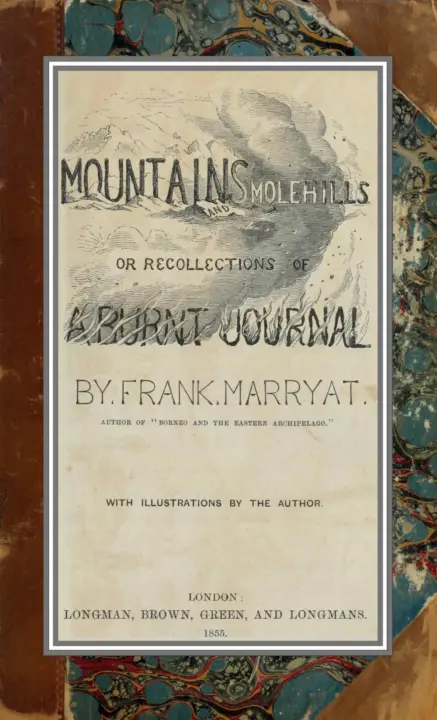
Mountains and molehills; or, Recollections of a burnt journal
Frank Marryat
THE CLASSIC COLLECTION · 1848
"Borneo and the Indian Archipelago" by Frank Marryat is a historical narrative documenting the author's experiences and observations while serving as a midshipman on H. M. S. Samarang during its surveying expedition in the mid-19th century. This work provides an intricate exploration of the cultures, landscapes, and maritime activities encountered across Borneo and the surrounding islands. The opening portion sets the stage for the journey of H. M. S. Samarang, detailing the departure from Portsmouth and the initial stages of the expedition. Marryat introduces his voyage through various locations, including the Canary Islands and Cape of Good Hope, and vividly describes the crew's interactions and encounters along the way. Notably, he emphasizes the importance of accurate representation in drawings, highlighting his own collection of illustrations depicting local costumes and scenery as a vital component of his observations. As the narrative unfolds, it hints at significant encounters with natives, piracy, and the civilizing efforts led by figures such as Mr. Brooke in Sarawak, establishing a rich backdrop for the following chapters.
Introduction adapted from the source catalogue; source summaries may be automatically generated.
Free to read · English · 73,820 words · No account needed
MAKE TIME FOR A GOOD BOOK
On by default. Untick to stop anonymous reading totals. Each page counts after 10 seconds in view. How this works.
Anonymous counting is on unless you have switched it off.
After a hurried breakfast we set off for the foot of the mountain, our party amounting to about eighty people. The guides led the way, followed by the Europeans; and the Dyaks, with the luggage, brought up the rear. In this order we commenced the ascent. Each person was provided with a bamboo, which was found indispensable; and thus, like a party of pilgrims, we proceeded on our way; and before we had gone very far, we discovered that we were subjected to severe penance. The mountain was nearly perpendicular. In some places we had to ascend by a single piece of wood, with rough notches for the feet, resting against a rock twenty or thirty feet above our heads; and on either side was a precipice, so that a false step must have been certain death. In other places a single piece of bamboo was thrown over a frightful chasm, by way of bridge. This, with a slight bamboo rail for the hand, was all that we had to trust to. The careful manner in which we passed these dangers was a source of great laughter and amusement to the Dyaks who followed us. Accustomed from infancy to tread these dangerous paths, although heavily laden, they scorned to support themselves. Some of our party were nearly exhausted, and a long way in the rear before we came to the village. We had to wait for their coming up, and threw ourselves under the shade of some huge trees, that we might contemplate the bird's-eye view beneath. It was a sight which must be seen to be appreciated. Almost as far as the eye could reach was one immense wooded plain, bounded by lofty mountains in the far distance, whose tops pierced the clouds. The rivers appeared like silver threads, running through the jungles; now breaking off, and then regained. At our feet lay the village we had started from, the houses of which appeared like mere points. Shakspeare Cliff was as nothing to it, and his beautiful lines would have fallen very short of the mark; and while we gazed, suddenly a cloud below us would pass between us and the view, and all would be hidden from the sight. Thus we were far above the clouds, and then the clouds would break, and open, and pass and repass over each other, until, like the dissolving views, all was clear again, although the landscape was not changed. It was towards noon before we saw the first mountain village, which we did not immediately enter, as we waited the arrival of the laggards: we stopped, therefore, at a spring of cold water, and enjoyed a refreshing wash. Here we fell in with some pretty Dyak girls, very scantily clothed, who were throwing water at each other in sport. We soon came in for a plentiful share, which we returned with interest; and in this amusing combat we passed half an hour, until all had joined the party. We then entered the village, which was situated in a grove of trees. The houses were built upon posts, as those down by the river side. They were immensely large, with a bamboo platform running the whole length of the building, and divided into many compartments, in each of which a Dyak family resides. We were escorted, through a crowd of wondering Dyaks, to a house in the centre of the village, which was very different in construction from the others. It was perfectly round, and well ventilated by numerous port-holes in the roof, which was pointed. We ascended to the room above by means of a rough ladder, and when we entered we were rather taken aback at finding that we were in the Head House, as it is termed, and that the beams were lined with human heads, all hanging by a small line passed through the top of the skull. They were painted in the most fantastic and hideous manner; pieces of wood, painted to imitate the eyes, were inserted into the sockets, and added not a little to their ghastly grinning appearance. The strangest part of the story, and which added very much to the effect of the scene, was, that these skulls were perpetually moving to and fro, and knocking against, each other. This, I presume, was occasioned by the different currents of air blowing in at the port-holes cut in the roof; but what with their continual motion, their nodding their chins when they hit each other, and their grinning teeth, they really appeared to be endowed with new life, and were a very merry set of fellows. However, whatever might be the first impression occasioned by this very unusual sight, it very soon wore off, and we amused ourselves with those motions which were "not life," as Byron says; and, in the course of the day, succeeded in making a very excellent dinner in company with these gentlemen, although we were none of us sufficiently Don Giovannis to invite our friends above to supper. We visited three villages on the Sarambo mountain. Each of these villages was governed by a chief of its own, but they were subordinate to the great chief, residing in the first village.
Your reading position is saved on this browser. Take it to another device with a library code. Reading pages adapt to text, rather than matching a printed edition.
BEHIND THE BOOK
This eBook is for the use of anyone anywhere in the United States and most other parts of the world at no cost and with almost no restrictions whatsoever. You may copy it, give it away or re-use it under the terms of the Project Gutenberg License included with this eBook or online at www.gutenberg.org. If you are not located in the United States, you will have to check the laws of the country where you are located before using this eBook. Read the source licence.
The original source file, including credits and licence, is retained by this library. Request an original-format copy at no charge. Please include the book title and Project Gutenberg identifier #26844.
KEEP YOUR CURIOSITY GOING
Wilfrid Scawen Blunt
Wilfrid Scawen Blunt

E. W. (Edgar Watson) Howe
Cécile Tormay

Moritz Busch
John L. Ransom