THE CLASSIC COLLECTION✦Tenting on the Plains; or, General Custer in Kansas and TexasCLASSIC FREE BOOKS
Tenting on the Plains; or, General Custer in Kansas and Texas
Elizabeth Bacon Custer
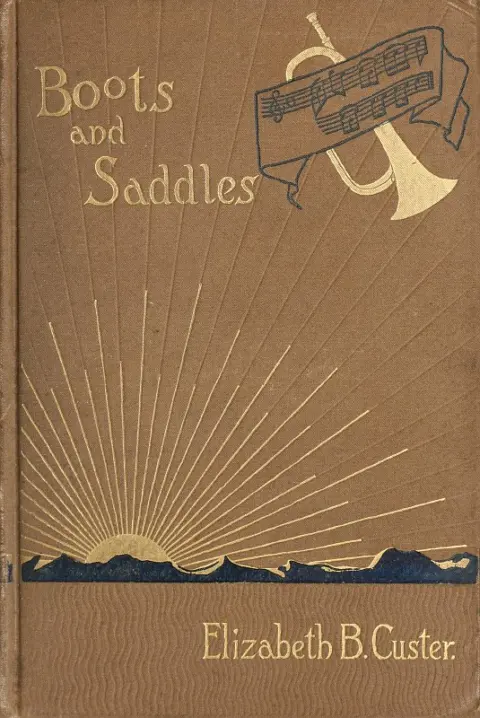
THE CLASSIC COLLECTION · 1885
"Boots and Saddles; Or Life in Dakota with General Custer" by Elizabeth B. Custer is a historical account written in the late 19th century. The book provides an intimate glimpse into the everyday life of an army family stationed in the Dakota territories during a tumultuous period in American history. It primarily revolves around the experiences of Elizabeth Custer as she navigates the challenges and adventures of military life while accompanying her husband, General George Custer, on various campaigns. At the start of the narrative, the author recalls her early encounters with General Custer and their subsequent marriage, interspersed with their military life and relocations across different states. The opening chapters detail their transition to Dakota, highlighting the stark contrasts between the comforts of civilization and the rugged, isolating conditions of military outposts. Through vivid descriptions, Elizabeth conveys her mixed emotions—ranging from excitement to anxiety—regarding their new station and the harsh realities of frontier life, including a particularly treacherous blizzard that tests their resilience and character amidst a community of soldiers and Indigenous tribes. The storytelling is warm and personal, giving readers a sense of the historical context and the emotional landscape of life on the American frontier.
Introduction adapted from the source catalogue; source summaries may be automatically generated.
Free to read · English · 90,258 words · No account needed
MAKE TIME FOR A GOOD BOOK
On by default. Untick to stop anonymous reading totals. Each page counts after 10 seconds in view. How this works.
Anonymous counting is on unless you have switched it off.
We have been sleeping since (and it is now 4 P.M.) under the large trees standing on the river bank. I have just received one letter from you, and I think it is the first instalment only, for I hear there are seven sacks of mail on board the boat. I am sorry I am compelled to write under such hurried circumstances. I am lying on the ground, using my horse-blanket for a desk.
Official Report of the Engagements with Indians on the 4th and 11th
ultimo.
Copy.
Head-quarters Battalion 7th Cavalry, Pompey’s Pillar, Yellowstone River, Montana, Aug. 15, 1873.
Acting Assistant Adjutant-general Yellowstone Expedition:
SIR,--Acting under the instructions of the Brevet-major-general commanding, I proceeded at five o’clock, on the morning of the 4th instant, with one squadron of my command, numbering about ninety men, to explore a route over which the main column could move. Having reached a point on the Yellowstone River, near the mouth of Tongue River, and several miles in advance, and while waiting the arrival of the forces of the expedition, six mounted Sioux dashed boldly into the skirt of timber within which my command had halted and unsaddled, and attempted to stampede our horses. Fortunately our vedettes discovered the approach of the Indians in time to give the alarm. A few well-directed shots soon drove the Indians to a safe distance, where they kept up a series of yells, occasionally firing a few shots. As soon as the squadron could mount, I directed Captain Moylan to move out in pursuit, at the same time I moved with the troops in advance, commanded by First Lieutenant T. W. Custer. Following the Indians at a brisk gait, my suspicions became excited by the confident bearing exhibited by the six Sioux in our front, whose course seemed to lead us near a heavy growth of timber which stood along the river bank above us. When almost within rifle range of this timber, I directed the squadron to halt, while I with two orderlies, all being well mounted, continued after the Sioux in order to develop their intentions. Proceeding a few hundred yards in advance of the squadron, and keeping a watchful eye on the timber to my left, I halted. The six Indians in my front also halted, as if to tempt farther pursuit. Finding all efforts in this direction unavailing, their plans and intentions were quickly made evident, as no sooner was it seen that we intended to advance no farther, than with their characteristic howls and yells over three hundred well-mounted warriors dashed in perfect line from the edge of the timber, and charged down upon Captain Moylan’s squadron, at the same time endeavoring to intercept the small party with me. As soon as the speed of the thorough-bred on which I was mounted brought me within hailing distance of Lieutenant Custer’s troop, I directed that officer to quickly throw forward a dismounted line of troopers, and endeavor to empty a few Indian saddles. The order was obeyed with the greatest alacrity, and as the Sioux came dashing forward, expecting to ride down the squadron, a line of dismounted cavalrymen rose from the grass and delivered almost in the faces of the warriors a volley of carbine bullets which broke and scattered their ranks in all directions, and sent more than one Sioux reeling from his saddle. This check gave us time to make our dispositions to resist the succeeding attacks, which we knew our enemies would soon make upon us. The great superiority of our enemies in numbers, the long distance separating us from the main command, and the belief, afterwards verified, that the woods above us still concealed a portion of the savage forces, induced me to confine my movements, at first, strictly to the defensive. The entire squadron (except the horse-holders) was dismounted and ordered to fight on foot. The Indians outnumbering us almost five to one were enabled to envelop us completely between their lines, formed in a semicircle, and the river which flowed at our backs. The little belt of timber in which we had been first attacked formed a very good cover for our led-horses, while the crest of a second table-land, conveniently located from the timber, gave us an excellent line of defence. The length of our line and the numbers of the enemy prevented us from having any force in reserve; every available officer and man was on the skirmish-line, which was in reality our line of battle, even the number of men holding horses had to be reduced, so that each horse-holder held eight horses. Until the Indians were made to taste quite freely of our lead they displayed unusual boldness, frequently charging up to our line and firing with great deliberation and accuracy. Captain Moylan exercised command along the entire line; Lieutenant Custer commanded the centre; my adjutant, Lieutenant James Calhoun, commanded the right; and Lieutenant Charles A. Varnum, the left. The first Indian killed was shot from his pony by “Bloody Knife,” the Crow who acted as my guide and scout. Soon after Private Charles P. Miller, of “A” troop 7th Cavalry, succeeded in sending a carbine bullet directly through the body of a chief who had been conspicuous throughout the engagement. At the same time it was known that our firing had disabled many of their ponies, while owing to our sheltered position the only damage thus far inflicted upon us was one man and two horses wounded, one of the latter shot in three places.
Your reading position is saved on this browser. Take it to another device with a library code. Reading pages adapt to text, rather than matching a printed edition.
BEHIND THE BOOK
This eBook is for the use of anyone anywhere in the United States and most other parts of the world at no cost and with almost no restrictions whatsoever. You may copy it, give it away or re-use it under the terms of the Project Gutenberg License included with this eBook or online at www.gutenberg.org. If you are not located in the United States, you will have to check the laws of the country where you are located before using this eBook. Read the source licence.
The original source file, including credits and licence, is retained by this library. Request an original-format copy at no charge. Please include the book title and Project Gutenberg identifier #48972.
KEEP YOUR CURIOSITY GOING
Cécile Tormay

Moritz Busch
John L. Ransom
Frances Wright
Cécile Tormay

Mabel Potter Daggett