
The Writing of News A Handbook with Chapters on Newspaper Correspondence and Copy Reading
Charles G. (Charles Griffith) Ross
THE CLASSIC COLLECTION · 1904
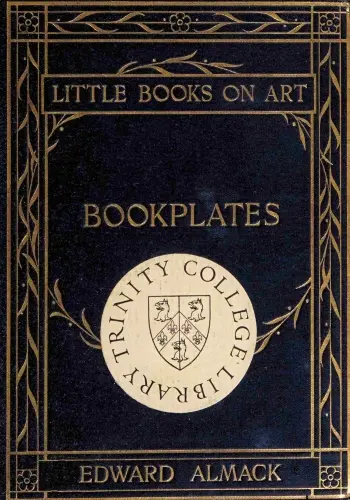
"Bookplates" by Edward Almack is a specialized art book written in the early 20th century. This work delves into the history, styles, and artistry of bookplates—decorative labels indicating ownership of a book—tracing their evolution from early armorial designs to modern interpretations. The book is enriched with illustrations showcasing various bookplate designs, catering to collectors, historians, and those interested in the intersection of visual arts and literature. The opening of "Bookplates" introduces the significance of these artistic labels, asserting that they serve to enhance the books they are affixed to. Almack discusses the different terminologies used across cultures, such as the German "bibliothekzeichen" and the Latin "ex libris," while providing insights into engraving techniques and styles that characterize bookplate art throughout history. The author emphasizes the cultural and personal narratives intertwined with these items, setting the stage for an exploration of notable artists and significant examples in subsequent chapters. This rich introduction establishes a foundation for understanding how bookplates reflect the tastes and identities of their owners across time.
Introduction adapted from the source catalogue; source summaries may be automatically generated.
Free to read · English · 34,031 words · No account needed
MAKE TIME FOR A GOOD BOOK
On by default. Untick to stop anonymous reading totals. Each page counts after 10 seconds in view. How this works.
Anonymous counting is on unless you have switched it off.
Another plate is armorial. Burke gives the arms as or, three crescents, within the horns of each an estoile gules. Crest a crescent and estoile, as in the arms, between two eagles’ wings or. Motto: “Sidus ad sit amicum.”
William Bateman, of Middleton-by-Youlgrave, married Mary, daughter of James Crompton of Brightmet, Lancashire. He died on 28th August, 1861, at Lomberdale House, near Bakewell. William Bateman’s father and grandfather had both done much towards founding the family library and museum.
A fine plate here illustrated is that of the Duke of Beaufort, from a fine copy of the first edition of Eikon Basilike.
Mr. H. B. Wheatley, of Pepys fame, has kindly written me the following notes regarding Conduitt bookplate:--
John Conduitt was born in the year of the Revolution, and was at Westminster School in 1701, and at Trinity College, Cambridge, in
1705. He was M.P. for Whitchurch 1715-34, after which he was elected for Southampton. He was Master of the Mint 1727-37. He succeeded Sir Isaac Newton, but previously to the death of Newton he relieved him of his most onerous duties for some years. He married Mrs. Catherine Barton, Newton’s niece, on 20th August, 1717.
“His only daughter married Viscount Lymington, son of the first Earl of Portsmouth, which accounts for the fact that Newton’s MSS., etc., are in the possession of the Portsmouth family; also the magnificent portrait of Newton by Kneller.
“Conduitt wrote, in 1730, Observations on the Present State of our Gold and Silver Coins, which came into the possession of Dean Swift, and after remaining many years in MS. was published in 1774. Jevons praised the work very highly.
“Conduitt was buried in Westminster Abbey, close by Newton’s grave.
“There is a scandal connected with Mrs. Catherine Barton which biographers of Newton have generally agreed to ignore. She is known to have kept house for Charles Montague, Earl of Halifax (who died in May, 1715), and is generally spoken of as his mistress by the gossips of the day. Augustus de Morgan wrote a book on the subject, which was published after his death, and entitled, Newton, his Friend, and his Niece. 1885. In this De Morgan argued for the opinion which he had formed that Lord Halifax (who died May, 1715) married Mrs. Barton privately about April, 1706. He made out a fair case, but he could obtain no actual evidence, and when Mrs. Barton married Conduitt she was described as a spinster.”
Of his own bookplate, here reproduced, Mr. Henry B. Wheatley, F.S.A.,
kindly writes to me:--
Your reading position is saved on this browser. Take it to another device with a library code. Reading pages adapt to text, rather than matching a printed edition.
BEHIND THE BOOK
This eBook is for the use of anyone anywhere in the United States and most other parts of the world at no cost and with almost no restrictions whatsoever. You may copy it, give it away or re-use it under the terms of the Project Gutenberg License included with this eBook or online at www.gutenberg.org. If you are not located in the United States, you will have to check the laws of the country where you are located before using this eBook. Read the source licence.
The original source file, including credits and licence, is retained by this library. Request an original-format copy at no charge. Please include the book title and Project Gutenberg identifier #60858.
KEEP YOUR CURIOSITY GOING
Charles G. (Charles Griffith) Ross
Hannah Webster Foster

Emily Lawless
Edwin Hamlin Carr

Charles De Lano Hine
Andrew Ure