THE CLASSIC COLLECTION✦A dead man’s diaryCLASSIC FREE BOOKS
A dead man’s diary
Coulson Kernahan
THE CLASSIC COLLECTION · 1871
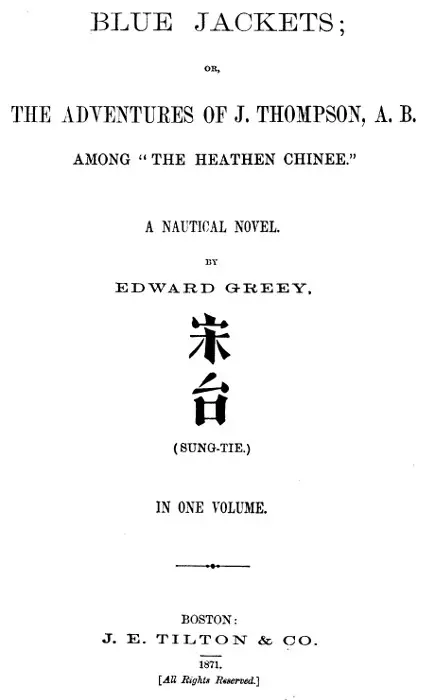
"Blue Jackets; or, The Adventures of J. Thompson, A.B., Among 'the Heathen Chinee'" by Edward Greey is a nautical novel written in the late 19th century. The book primarily follows the misadventures of J. Thompson, an able seaman, as he navigates the challenges of life in the British Navy, dealing with oppressive officers and his longing for his wife amidst the backdrop of naval duties and the foreign environment of China. The narrative sheds light on the harsh realities of naval life and the sociopolitical implications of such experiences during the time. At the start of the story, we are introduced to Tom Clare, a devoted sailor trying to escape the oppressive conditions imposed by his superiors at Woolwich Dockyard. Determined to see his wife, Clare ultimately deserts his post but faces immediate consequences upon his capture. The opening chapters set the tone for the adventure's comedic and tragic elements as Clare navigates the shame and humiliation of his punishment and clings to hope for a better future with his wife. The book builds upon themes of love, resilience, and injustice as it portrays the conflicts between sailors and their commanding officers, revealing both the personal and professional struggles faced in naval service during a tumultuous period.
Introduction adapted from the source catalogue; source summaries may be automatically generated.
Free to read · English · 140,053 words · No account needed
MAKE TIME FOR A GOOD BOOK
On by default. Untick to stop anonymous reading totals. Each page counts after 10 seconds in view. How this works.
Anonymous counting is on unless you have switched it off.
"You had to find fault with him soon after he was drafted to the ship? State to the court what then occurred."
"I was obliged to stop his leave for insolence, the very day he joined the Stinger; and though I spoke kindly to him, he continued this line of conduct, barely doing the work he was appointed to, and that in a sullen, disrespectful manner."
"He deserted from the Stinger, did he not?"
"He did."
"Knowing his character, you were obliged to send a strong force to bring him on board, were you not?"
"Yes. I sent an armed party of marines, as I was aware that, being a desperate man, he would offer resistance."
"Where was he found secreted by the non-commissioned officer?"
Here the president assumed a grave air and informed Puffeigh that he could not put the last question, as Lieutenant Crushe could not testify to hearsay. The examination then proceeded.
"You had other reasons for sending an armed party to secure the
prisoner? Please state them."
"Yes. I was aware that he consorted with people of the worst character."
"Some of them had visited him on board the Stinger, I believe. State if
that be so."
"Yes, a young woman, whose conduct while on board led me to suppose that she had come for no good. She came down with some of the worst characters in Woolwich. He was afterwards arrested in her company."
When Crushe stated that the man was arrested in the company of bad people, Clare bit his lips, and tried to address the court, when he was informed that "he would have an opportunity of asking questions at a later period, but at present he must remain silent."
Upon receiving this rebuke his face flushed with shame, seeing which, the members of the court, who took it for a sign of passion and rebellion, looked at each other, as much as to say, "See what a ruffian the prisoner is."
The corporal was the next witness. With a military salute that concise individual stated his name and rank, and was thus examined by Puffeigh.
"You received orders to arrest the prisoner, and take a strongly-armed
party with you?"
"I did" (with a salute).
"State to the court what occurred on that occasion."
(Saluting) "Well, sir, you see, being a corporal of the Rile Marine division at Woolwich, I knowed that where the prisoner wor a hiding wor a werry bad place, so I went prepared."
"The prisoner showed a determined resistance, I understand? In fact
nearly killed you."
(Saluting) "That he did, sir, and the other willings with him."
"There were women in the house?"
Your reading position is saved on this browser. Take it to another device with a library code. Reading pages adapt to text, rather than matching a printed edition.
BEHIND THE BOOK
This eBook is for the use of anyone anywhere in the United States and most other parts of the world at no cost and with almost no restrictions whatsoever. You may copy it, give it away or re-use it under the terms of the Project Gutenberg License included with this eBook or online at www.gutenberg.org. If you are not located in the United States, you will have to check the laws of the country where you are located before using this eBook. Read the source licence.
The original source file, including credits and licence, is retained by this library. Request an original-format copy at no charge. Please include the book title and Project Gutenberg identifier #58270.
KEEP YOUR CURIOSITY GOING
Coulson Kernahan

Maurice Baring
Frances Wright
Cécile Tormay

Frederic Jesup Stimson

W. H. P. (William Henry Pope) Jarvis