THE CLASSIC COLLECTION✦A dead man’s diaryCLASSIC FREE BOOKS
A dead man’s diary
Coulson Kernahan
THE CLASSIC COLLECTION · 1871
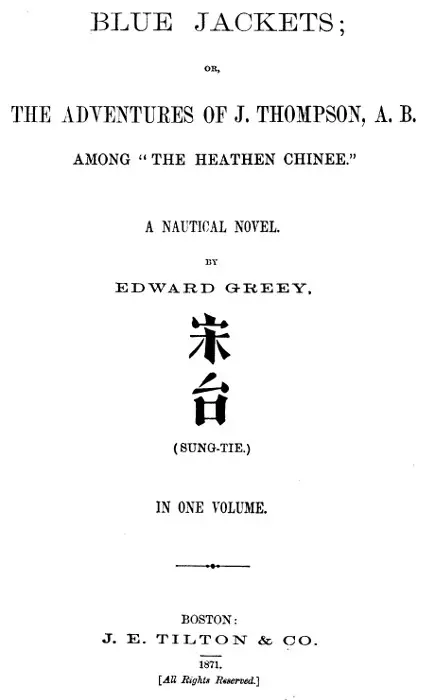
"Blue Jackets; or, The Adventures of J. Thompson, A.B., Among 'the Heathen Chinee'" by Edward Greey is a nautical novel written in the late 19th century. The book primarily follows the misadventures of J. Thompson, an able seaman, as he navigates the challenges of life in the British Navy, dealing with oppressive officers and his longing for his wife amidst the backdrop of naval duties and the foreign environment of China. The narrative sheds light on the harsh realities of naval life and the sociopolitical implications of such experiences during the time. At the start of the story, we are introduced to Tom Clare, a devoted sailor trying to escape the oppressive conditions imposed by his superiors at Woolwich Dockyard. Determined to see his wife, Clare ultimately deserts his post but faces immediate consequences upon his capture. The opening chapters set the tone for the adventure's comedic and tragic elements as Clare navigates the shame and humiliation of his punishment and clings to hope for a better future with his wife. The book builds upon themes of love, resilience, and injustice as it portrays the conflicts between sailors and their commanding officers, revealing both the personal and professional struggles faced in naval service during a tumultuous period.
Introduction adapted from the source catalogue; source summaries may be automatically generated.
Free to read · English · 140,053 words · No account needed
MAKE TIME FOR A GOOD BOOK
On by default. Untick to stop anonymous reading totals. Each page counts after 10 seconds in view. How this works.
Anonymous counting is on unless you have switched it off.
A number of the women of the village had established a market in the centre of the enclosure, and were driving quite a trade in fried eggs, sweet potatoes and little pork pies, while here and there were men carrying huge buckets containing boiled rice, which they sold to the sailors for anything they could get, taking money or goods according to circumstances. Thompson was in attendance upon the officers; and having found a jar of water, which he tested by forcing one of the bearers to swallow a quart, he proceeded to serve the brandy pawnee.
"That's a luxury," observed Crushe. "Thompson, you are one of the few men of the fleet who is not a fool; upon my word, you're not."
"Nobody but you ever thought I were, sir," retorted the coxswain, and with this observation Jerry retired behind the idol, and took a quiet drink.
At this moment a gong was heard, and in marched the "elders," heading a procession of food-bearers. Having deposited their burdens, the coolies withdrew, upon which the "elders" spread the feast out upon the floor of the temple, and invited the officers to partake of the repast.
Puffeigh felt very bewildered at this unlooked-for hospitality, but the fact was, upon their entering the place, Hoo-kee had struck a bargain with the "elders," that, upon consideration of his being paid fifty dollars and free chow-chow for the officers, he would prevent the Fanquis from sacking and destroying their village. Hence all this civility; the "elders" being delighted to find their visitors did not wish to cook and eat any of their infants, that being, according to their traditions, the usual food of the "red-haired, foreign, out-side barbarians."
Puffeigh looked at the food, and then asked Hoo-kee if it were all
right?
"Belle good peece chow-chow, nomba one, fust chop," replied the pilot, who seized a bowl of rice, and a pair of chop-sticks, and proceeded to illustrate the truth of his assertion.
Thompson hovered round the officers, and gave his opinion of the dishes, recommending some, and warning them against others, as his fancy suggested.
"That looks terribly like a boiled dog," he remarked to Crushe, who was turning over a stewed fowl. "It's either that or a cat; don't you eat none of that ere, sir."
The lieutenant left that dish; and seizing another near it, boldly commenced to eat, shutting his eyes to any peculiarity of aspect or taste which he met with during his meal. Puffeigh enjoyed his greatly, but was very much disconcerted by Jerry's remark as he cleared away the last bowl.
"Did you like the last raghot, sir?"
"Well, it wasn't bad; but why do you ask?"
Your reading position is saved on this browser. Take it to another device with a library code. Reading pages adapt to text, rather than matching a printed edition.
BEHIND THE BOOK
This eBook is for the use of anyone anywhere in the United States and most other parts of the world at no cost and with almost no restrictions whatsoever. You may copy it, give it away or re-use it under the terms of the Project Gutenberg License included with this eBook or online at www.gutenberg.org. If you are not located in the United States, you will have to check the laws of the country where you are located before using this eBook. Read the source licence.
The original source file, including credits and licence, is retained by this library. Request an original-format copy at no charge. Please include the book title and Project Gutenberg identifier #58270.
KEEP YOUR CURIOSITY GOING
Coulson Kernahan

Maurice Baring
Frances Wright
Cécile Tormay

Frederic Jesup Stimson

W. H. P. (William Henry Pope) Jarvis